
Salvadoran migrant Kilmar Abrego detained again by ICE
The lawyers of the detainee — who became a symbol of Trump’s deportation policy after being mistakenly deported to his country last March — fear he could be sent to Uganda or Costa Rica
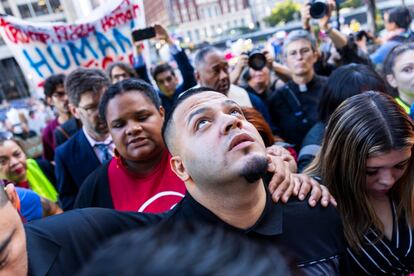

Kilmar Abrego García, the Salvadoran immigrant whose mistaken deportation from the United States to his country of origin made him a symbol of Donald Trump’s hardline deportation policy, was detained again this Monday by Immigration and Customs Enforcement (ICE) when he appeared for an immigration court hearing in Baltimore, Maryland, regarding his case.
His lawyer, Simon Sandoval-Moshenberg, reported that Abrego, 30, could be expelled again — this time to Costa Rica or Uganda.
Abrego had filed a request that he not be sent to any country before a full trial in which he can defend himself, and also before determining whether the host nation is willing to accept him.
Abrego had a court order that prohibited him from being deportated to El Salvador, where he could face reprisals, but where the U.S. government nonetheless expelled him last March. The immigrant was part of a group of about 300 people, mostly Venezuelans, accused of belonging to the Tren de Aragua and other violent gangs. They were expelled under the Alien Enemies Act, a law dating back to the 18th century designed for wartime use. In many of the 300 cases, the deportations were carried out without evidence, or with scant justification.
A Justice Department attorney later admitted that an error had been made in Abrego’s deportation order, and a judge instructed the government to bring him back to the United States.
The Trump administration took months to comply with that judicial decision, arguing that it could not demand the Salvadoran government return one of its citizens and insisting that Abrego was a dangerous criminal: the Justice Department first accused him of belonging to a criminal gang, then of being an abuser, and finally of transporting undocumented immigrants within the United States.
Since Abrego’s return in June — after nearly three months in CECOT, the notorious Salvadoran prison for gang members — the immigrant had been held in a Tennessee prison on a human smuggling charge, which he denies. Abrego was released on Friday, in compliance with a court order. Now, ICE has detained him again after he appeared for his appointment.
His lawyer said that his client has been threatened with deportation to Uganda — a country that has agreed to accept irregular migrants from third countries expelled by the United States — if he does not plead guilty to the human smuggling charge. If he pleads guilty, he would be deported to Costa Rica, which has agreed to receive him as a refugee.
“They’re holding Costa Rica as a carrot, and using Uganda as a stick,” Sandoval-Moshenberg said at a press conference outside the ICE facility where his client is being held. “They’re weaponizing the immigration system in a way that’s completely unconstitutional.”
According to the lawyer, Kilmar Abrego is willing to accept deportation to Costa Rica, where he would have refugee status and would not face the risk of being sent to El Salvador. But he does not want to be forced into pleading guilty.
Sign up for our weekly newsletter to get more English-language news coverage from EL PAÍS USA Edition









































