
A very conservative Supreme Court holds the key to Trump’s agenda
The US president has triggered an avalanche of court rulings against his attempts to expand his own power
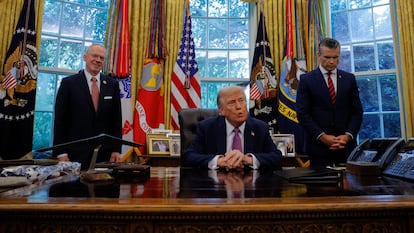

A federal appeals court ruling on Friday overturning the cancellation of protected status for millions of Venezuelans capped 10 days of legal setbacks for the Donald Trump administration and its accumulation of power in the United States. Court after court has blocked key measures of his agenda, from global tariffs to immigration policy, including the freeze on funds for Harvard University. Given the administration’s appeals, either already filed or promised, the conservative Supreme Court will hold the key to whether the Republican president’s agenda is legally valid and Trump can continue accumulating power. Its decisions will have consequences for decades to come.
Over the past week, the president has suffered setback after setback in the court system. And the judges have not spared critical comments in their decisions. Invoking the 18th-century Alien Enemies Act, designed for wartime, to summarily deport illegal immigrants is “illegal.” Withholding $2.2 billion (almost €1.9 billion) in federal funds from Harvard University as a means of pressuring the nation’s oldest educational institution to comply with government demands on faculty hirings and student admissions was motivated by the president’s “power and political views.” Trump’s June order to deploy the National Guard to Los Angeles to counter protests against immigration raids was unlawful and seemed aimed at “creating a national police force with the President as its chief.”
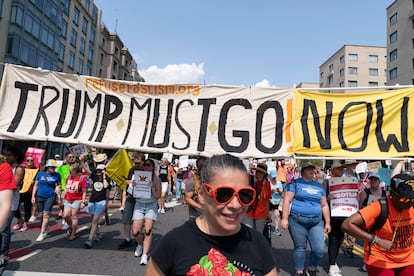
By the time this latest decision was delivered, Trump had already sent troops to DC under the pretext of eliminating crime. And he is threatening to imminently deploy those troops to other Democratic-run cities. The president has specifically cited Baltimore, Chicago, and, most recently, New Orleans.
This past Friday, a federal judge in California concluded that Homeland Security Secretary Kristy Noem assumed powers she didn’t have when she rescinded the Temporary Protected Status (TPS) granted by former Democratic president Joe Biden to hundreds of thousands of Haitians and Venezuelans. “The Secretary’s action in revoking TPS was not only unprecedented in the manner and speed in which it was taken but also violates the law,” wrote San Francisco Judge Edward Chen.
Tariffs, the biggest blow
The string of judicial setbacks had begun a week earlier with perhaps the most serious blow to Trump’s plans: a federal appeals court, by a majority of seven to four, declared unlawful most of the tariffs he has imposed on the rest of the world since his return to the White House in January.
“If allowed to stand, this Decision would literally destroy the United States of America,” claimed Trump after the ruling. His administration is counting on the revenue from these import duties to cover its tax cuts and reduce the ballooning national debt, already exceeding $37 trillion, more than 120% of GDP. In its ruling, the appeals court allowed the tariffs to remain in place until October 14 to give the administration time to react.
The government has already rushed to file, in almost record time, an appeal to the Supreme Court, as Trump had announced he would do. It is asking for an urgent ruling, using rhetoric very typical of the Republican: “If these Tariffs ever went away, it would be a total disaster for the Country.” The tariffs, the state lawyers maintain, promote peace and economic prosperity and their mission is to pull the U.S. back from “the brink of a major economic and national security catastrophe.”
Immigration, education and security
Another avalanche of appeals could arrive in the coming days against rulings regarding deportation policy, funding for Harvard, or the use of the National Guard.
There are other cases yet to be resolved by the courts that are central to the president’s power grab: from the attempt to fire Federal Reserve Governor Lisa Cook, a decision that could affect the central bank’s future as an independent entity, to the use of an obscure mechanism to freeze funds earmarked for foreign aid totaling $4.5 billion that had already been approved by Congress.
The courts are the only institution that has so far stood up to the U.S. president: Congress, under Republican control in both chambers, has avoided upsetting a leader who is extremely popular with his base voters and who threatens to deprive Republican makers who contradict him of their seats.
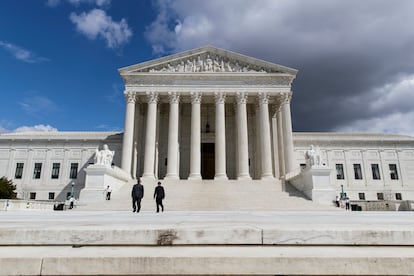
Trump has been defiant in the face of the courts’ attempts to block him. His argument is that the judges who have ruled against him are radical left-wing activists. This includes the so-called Fifth Circuit, whose judges are responsible for the ruling against the use of the Alien Enemies Act and which is considered the most conservative of all the federal high courts. The president thus entrusts the future of his agenda to the Supreme Court.
Six out of nine
Until now, the highest court in the land has tended to side with the president, even at the cost of a certain legal contortionism in some cases. The Supreme Court, which will return from its long summer recess on the first Monday in October, has a large conservative majority: six of the nine justices. Three of them were appointed by Trump himself.
The court has already ruled in favor of Trump in key cases, on several occasions through emergency orders, typically unsigned and with very concise arguments. Even before Trump’s return to the White House, they determined that as president, he enjoys immunity for acts he takes in the exercise of his power. They have also agreed, among other things, that the president has the power to remove officials from independent federal agencies, with the possible exception of the Federal Reserve.
In international economic policy, judges have also tended to side with the administration, recognizing that this is an area where their experience and knowledge are more limited.
“after quietly granting Trump his way on so many matters, often without signing their names to orders, the justices will have no choice but to decide in the light of day: Stand up for the Constitution or lie down for Trump,” observes Michael Waldman, president of the Brennan Center for Justice, in an analysis published this week.
At stake are the limits of presidential power, which Trump is seeking to expand in every possible direction. At the expense, among others, of a Congress that, dominated by Republicans in both chambers, seems content to cede its powers to the White House resident. And, with them, the future of the American system itself, based on the separation and balance of the three branches: executive, legislative, and judicial.
“The stakes go to the heart of American law. Can a president unilaterally set tariff rates, a power no chief executive has ever claimed before? Can a president unilaterally detain and deport migrants simply by asserting, without evidence, that they are gang members invading the United States on behalf of a foreign government?” Brennan continued.
The president’s strategy is to continue issuing executive orders first and then see how far he is allowed to go. And then to challenge in court all the measures taken against him. He figures that even if he doesn’t win every case, the judges will side with him in some. And that will expand his power.
The Supreme Court has already drastically curtailed the ability of lower courts to issue orders temporarily blocking government measures they find dubious nationwide while the merits of the cases are resolved in court.
“The courts aren’t going to strike down all that they’re doing, and, at the end of the day, they’ll end up accomplishing more by flooding the zone” with executive orders, a lawyer who is close to the presidential office told NBC in May.
Trump’s entourage rejects this claim: “The Supreme Court consistently bolstered the Trump administration’s agenda [...] And the victories will continue,” a White House spokeswoman said in a statement.
The battles will begin in a month, with the return of the Supreme Court justices. The world is watching them. At stake, among other things, is global trade. The judges’ decisions in these cases will either trigger or limit the president’s attempts to establish a new model for the U.S. economy and the world as a whole, and will have consequences far beyond this term, argues Josh Lipsky of the Atlantic Council think tank.
Sign up for our weekly newsletter to get more English-language news coverage from EL PAÍS USA Edition









































