
Chapter 8: Rewriting the past to conquer the future
Donald Trump has set out to end the alleged campaigns that, according to him, attempted to tarnish the nation’s greatness by questioning its history

As a worker at the Ministry of Truth, Winston Smith’s main function was to rewrite history to fit the interests of the Party and Big Brother. When his country went to war with Eurasia, he was obliged to change any references to that nation as an ally and portray it as the enemy. When the tables turned and the adversary became Eastasia, he had to do the same in reverse. George Orwell’s 1984 presents this story as a critical allegory of governments that seek to bend facts to their convenience. Smith’s goal was to rewrite the past in order to control the present and conquer the future.
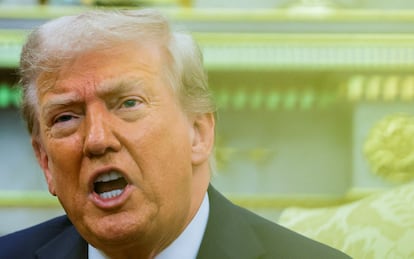
This also seems to be Donald Trump’s objective in the United States. Since assuming the presidency for a second time, he has launched a cultural offensive that historian Paul Josephson provocatively compares to some of the practices employed by Joseph Stalin in the Soviet Union.
For Trump, one of his country’s greatest problems is that it has strayed from its glorious past due to the progressive leaders who preceded him. Therefore, he has set out to end the supposed dishonorable campaigns that, in his view, sought to tarnish the nation’s greatness by questioning its history.
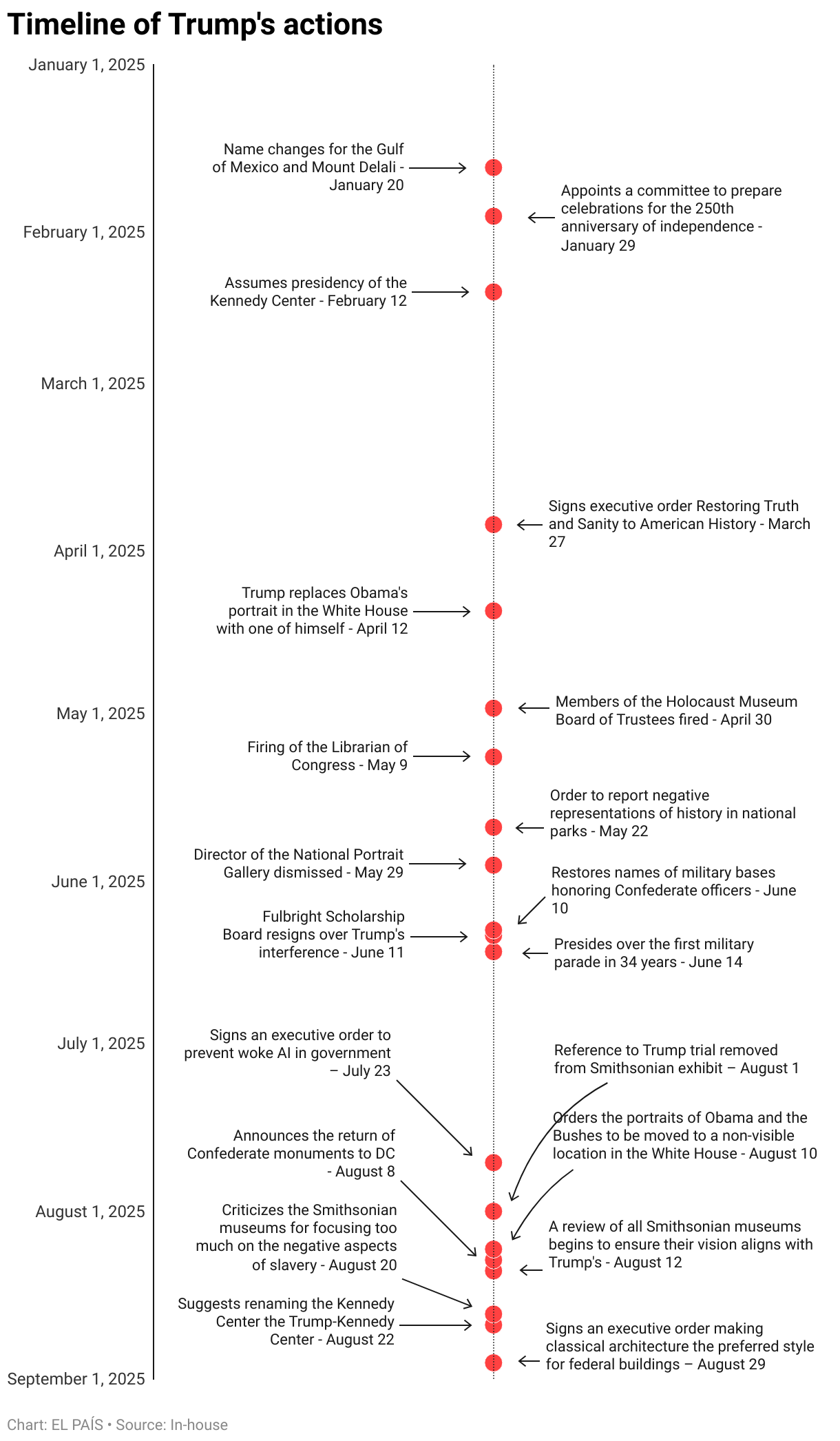
So far in the first year of his second mandate, he has dismissed several directors of cultural institutions, positioned himself as responsible for the Kennedy Center, and ordered a broad review of the Smithsonian museums — the country’s most important — to ensure that the historical narratives they present align with his vision.
Next year, the United States will celebrate 250 years of independence, and by then, Trump wants everything firmly in place. Very firmly. The message is clear: for years the nation’s glorious past was betrayed, and now we are reclaiming it as we enter a new “golden age.”
The president and his supporters thus position themselves as the only legitimate heirs of the Founding Fathers and all the figures who made the United States an economic and military power — whether or not that is true. “Lincoln was a leftist, hugely admired by Marx, yet today’s MAGA people call him conservative,” Curtis Yarvin, the neo-reactionary thinker at the center of the Trump universe and a close ally of Vice President JD Vance, told EL PAÍS.
In 1984, Winston Smith rebels against Big Brother’s dictatorship but ultimately fails. The Party manages to break him, and he ends up submissive to its narrative. Will Trump achieve the same feat in the United States? Below, we review some of the communication tactics used by the MAGA movement to revise history and claim ownership of it.
Restoration by decree
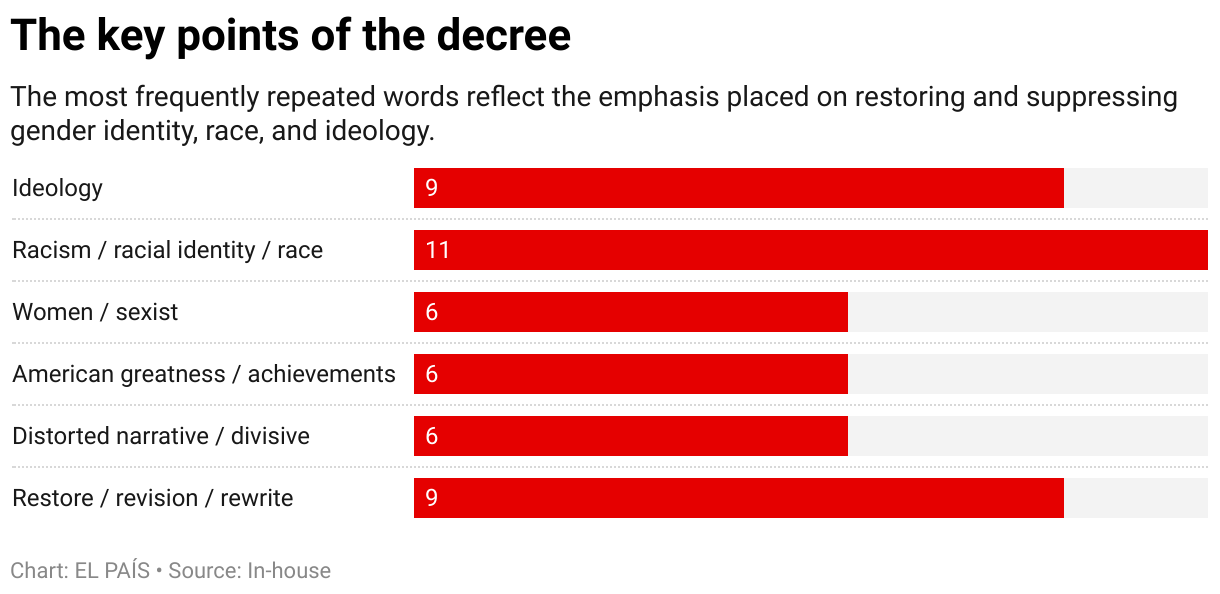
On March 27, Trump signed an executive order titled “Restoring Truth and Sanity to American History.” The document suggests that over the past decade, attempts have been made to distort the nation’s past through a negative lens, placing excessive emphasis on issues of race, gender, and ideology. For this reason, any exhibition that “degrades American values” is prohibited. The stated goal of this order is “saving” the Smithsonian museums and restoring the past.
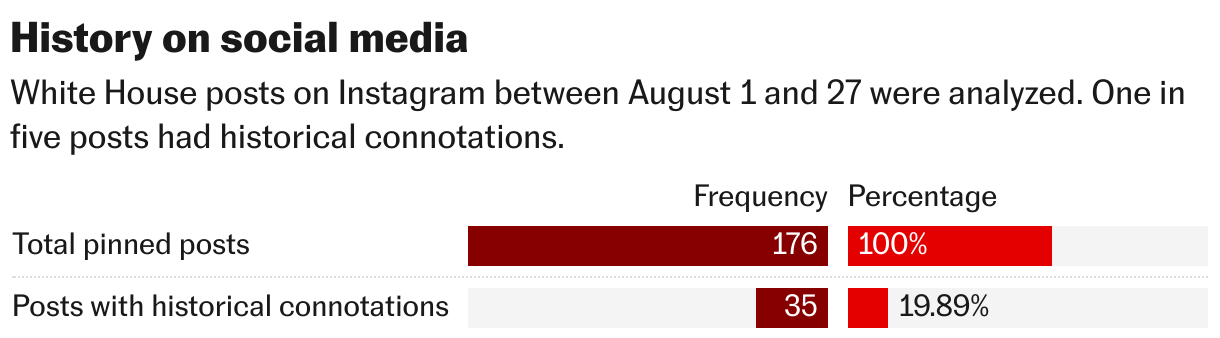
Messages about history on social media
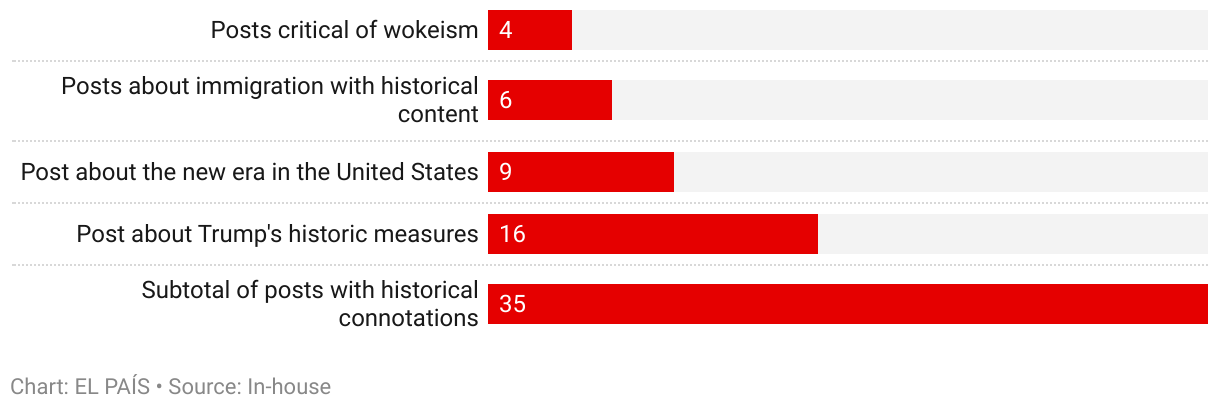
Posts referencing history are common on the White House’s social media channels. They tend to emphasize four main ideas:
1. Woke culture poses a threat to the country and diminishes its greatness, and therefore must be eliminated.
2. Illegal immigration is the antithesis of U.S. history.
3. With Trump, a new era has begun, and the country is great again.
4. Many of the president’s actions are historically significant.
Cultural and historical offensive
On his inauguration day, Trump surprised many by announcing that he would rename the Gulf of Mexico and Mount Delali, which would revert to being called Mount McKinley in honor of the 25th president, William McKinley — one of the figures the Trump movement has sought to celebrate. Since then, he has launched a series of measures of varying scope and significance aimed at influencing the culture and history of the United States.
Reviving the Founding Fathers
The Trump administration has opened a special exhibition at the White House dedicated to the signers of the Declaration of Independence. It includes QR codes that link to AI-generated videos in which each signer explains their story. Since access to the presidential residence is limited, an online guide has been distributed so the exhibition can be recreated in other locations. According to historians who have analyzed the videos, they are biased and present a version of history that leans toward propaganda and whitewashing.
The power of memes
The White House’s most commonly used method to associate immigrants with the historical enemies of the United States is through memes referencing old military recruitment imagery. At the turn of the 20th century, Uncle Sam was used to encourage enlistment for World War I and World War II. Today, the image has been revived to promote volunteer enrollment in the Immigration and Customs Enforcement (ICE) agency. Traditional posters have been replaced by online infographics and memes.
Values or ancestry?
The MAGA movement places particular emphasis on immigration and the threat it poses to the nation’s identity. One of its internal currents, led by JD Vance, goes further by suggesting that proven U.S. lineage should be a fundamental requirement for citizenship. This represents a stark break from the historical notion of the United States as a nation of immigrants, built on the values of freedom, opportunity, and democracy. In various speeches, the vice president has even hinted at the need to extend this idea beyond the U.S., citing the supposed risks faced by Western society.
An asylum seeker, often a young man in his mid-20s, already known to police, rams a car into a crowd and shatters a community. How many times must we suffer these appalling setbacks before we change course and take our shared civilization in a new direction?Vice President JD Vance at the 2025 Munich Security Conference
American citizenship must mean belonging to a nation that guards the sovereignty of its people, especially from a modern world that’s hellbent on dissolving borders and differences in national character.Vice President JD Vance receiving the Claremont Institute's Statesmanship Award.
To find out more
Books:
- George Orwell: 1984
- Margaret MacMillan: Usos y abusos de la historia
- Michel-Rolph Trouillot: Silenciando el pasado: El poder y la producción de la Historia
Articles:
- Paul Josephson: Las guerras culturales de Donald J. Trump: ¿un giro estalinista de la Casa Blanca?
- Xavier Peytibi: William McKinley, el ídolo de Trump
- Tal Axelrod: Inside MAGA’s fight for “Western civilization”
- Daniel Dale: Analysis: Donald Trump’s long history of fake history
- David Remnick: At the Smithsonian, Donald Trump takes aim at history
- Kimberlé Crenshaw and Jason Stanley: Why Trump’s ‘anti-woke’ attack on the Smithsonian matters
- Robert Tait: Historians alarmed as Trump seeks to rewrite US story for 250th anniversary
Videos and podcasts:
- Ezra Klein: The Man Driving the Nationalist Revival on the Right
- Casa Blanca: True meaning of declaration of independence
- MSNBC: ‘He’s trying to rewrite history’: Trump claims Smithsonian focuses too much on ‘how bad slavery was’
- Global News: How the Trump government’s changes gloss over US National Parks history
- Amanda Lewellyn: How Trump is rewriting American history
Documents:
- JD Vance’s speech at the 2025 security conference
- JD Vance’s speech upon receiving the Claremont Institute’s Statesmanship Award
- Executive order “Restoring Truth and Sanity to American History”
Sign up for our weekly newsletter to get more English-language news coverage from EL PAÍS USA Edition









































