
Gregory Bovino, the face of the most violent tactics in Trump’s crusade against immigration
The Border Patrol commander, who has been relieved of his duties in Minneapolis, enjoys the ‘tough guy’ image that won him the president’s favor
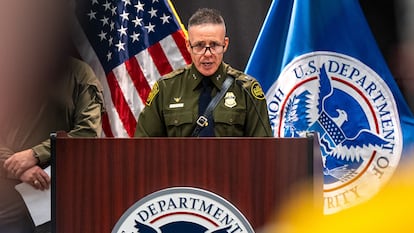
Dozens of agents, their faces covered even beneath gas masks, bulletproof vests, and riot gear, lined up in front of the Minneapolis federal building where the Trump administration has maintained the central base of its intense immigration operation in the city for weeks. Across the freezing street, a group of protesters hurled insults at them. From among the officers emerged Gregory Bovino. He wore a long, double-breasted, military-green coat and a matching scarf to protect himself from the sub-zero temperatures. Yellow patches on each shoulder identified him as a U.S. Border Patrol agent. He scanned the crowd from side to side, whispered a few words, and disappeared again among the agents. Seconds later, they charged the protesters with tear gas and pepper spray.
It was nothing new in the operations that Bovino, 55, has led against immigration in recent months in several U.S. cities, operations that have earned him criticism, lawsuits, and the approval of President Donald Trump — at least until he was relieved of his duties in Minneapolis on Monday and replaced with the White House’s border czar, Tom Homan. Bovino’s rise to the position of “commander at large” of the Border Patrol, as designated by Secretary of Homeland Security Kristi Noem, coincided with Trump’s dissatisfaction with the pace of migrant deportations, insufficient to achieve his goal of carrying out the “largest deportation in history.” The Republican criticized Immigration and Customs Enforcement (ICE) for not making more arrests and, to remedy this, last June he turned to Bovino, a proponent of more aggressive tactics, who has been present at the main flash points in the country.
Minneapolis was Bovino’s latest stop, but his face first became known to the public in June of last year when Trump put him in charge of the anti-immigration campaign in Los Angeles, which resulted in thousands of arrests. Chicago, Charlotte (North Carolina), and New Orleans followed.
During the operation in California, agents smashed car windows, broke down doors of residences, and patrolled MacArthur Park on horseback, spreading fear among the population. The speed and forcefulness of the operation were unprecedented. Bovino’s professional rise illustrated the radical shift that immigration policy has undergone during Trump’s second term.
In September, the Republican put him in charge of Operation Midway Blitz in Chicago, where his controversial methods in detaining migrants met with strong public opposition. Bovino ordered his agents to charge violently against protesters, and he himself was filmed using tear gas. A federal judge in Chicago, who had prohibited such methods, determined that Bovino lied under oath during depositions related to his operations and required him to provide daily reports on the actions of his agents, although an appeals court overturned that ruling.
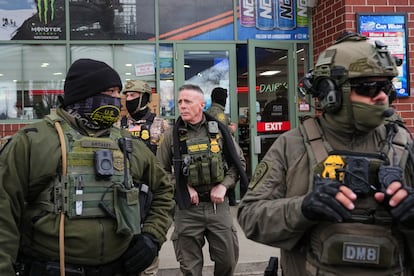
Under Bovino’s command, agents routinely deployed pepper spray and tear gas, and even used a helicopter to raid a house in an operation more reminiscent of a Hollywood film. Bovino, in fact, likes to present himself as a tough guy in an action movie. Clad in his tactical gear, he enjoys appearing in videos and photos wielding high-caliber weapons. His profile picture on the social network X shows him wearing a bulletproof vest and carrying an M4 assault rifle with a telescopic sight, and he posts videos of his agents’ operations set to action-movie music, often using slow motion.
His foray into propaganda began in his previous role as chief of the Border Patrol in the El Centro sector of southeastern California. In September 2020, shortly after taking command, his social media team posted a fictional video depicting a supposed migrant entering the United States and murdering the first person he encountered. The video had to be taken down due to the controversy it generated.
Meteoric rise
Bovino grew up in the Blue Ridge Mountains of North Carolina, part of the Appalachian mountain range. He studied natural resources and public administration and joined the Border Patrol in 1996. In 2004, he was appointed deputy chief of the Special Operations Division at the Washington headquarters of Customs and Border Protection (CBP), the agency that oversees the Border Patrol. In 2018, he was assigned as patrol chief for the New Orleans sector.
From his post in El Centro, California, Bovino was highly critical of the influx of migrants during the presidency of Democrat Joe Biden. He testified before Congress twice, and on one occasion, he was urged to retire. However, Bovino became a hero of the Trumpian MAGA movement. Republican administration officials describe him as “a tough guy,” a badass.
Just a month before Trump’s return to the White House, Bovino did his best to curry favor with the new president. Two weeks before the inauguration, he sent dozens of agents to Kern County in California’s Central Valley to conduct arrests at gas stations and along the highway, terrorizing the migrant community in the agricultural heartland of the nation’s most populous state.
Bovino then announced that the operation was intended to arrest criminals, but only one of the 78 detainees had a criminal record. The American Civil Liberties Union (ACLU) filed a lawsuit on behalf of the United Farm Workers union and five Kern County residents, accusing the agency of racial discrimination and of coercing at least 40 detained migrants into “accepting voluntary deportation.”
The use of racial profiling in arrests — prioritizing people with darker skin tones or who don’t speak English well — is a pattern that has drawn criticism in Los Angeles, Chicago, and Minneapolis. Bovino has denied the allegations and this week declared in Minnesota that the operations “are lawful, they are targeted, and they are focused on individuals who pose a serious threat.” “They are not random and they are not political,” he asserted.
Border Patrol operations are focused, professional and always effective as we've seen in Bakersfield, Los Angeles, Chicago, Charlotte, New Orleans, and now Minneapolis. More to come - stay frosty PAs!!! 🇺🇸 🇺🇲 #USBP https://t.co/CYKIEQ00i5
— Commander Op At Large CA Gregory K. Bovino (@CMDROpAtLargeCA) January 21, 2026
His penchant for violence has earned him enemies, and the government has been working hard to defend him, despite his removal from the fray in Minneapolis. Last Thursday, Juan Espinoza Martinez, 37, went on trial in Chicago for allegedly offering a $10,000 reward for Bovino’s life, according to the prosecution. Defense attorneys said the defendant, a carpenter with about $20 in his bank account, sent messages amounting to “neighborhood gossip” to his brother and a friend, who turned out to be a government informant. After less than four hours of deliberation, the jury found him not guilty.
Sign up for our weekly newsletter to get more English-language news coverage from EL PAÍS USA Edition









































