
The father’s plea that ICE ignored: ‘I have a daughter with Down syndrome and autism and a wife with cancer, please don’t deport me’
Walter Marcelino Chau, who was sent back to Peru, awaits the possibility of returning to the US to be with his wife and daughter, who have no one to help them

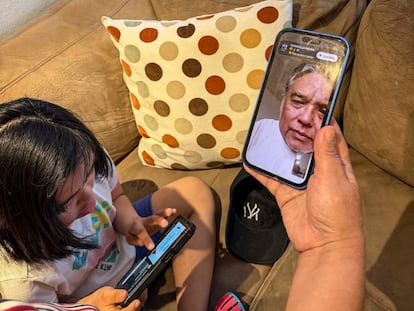
The phone rings. It’s Dad, who has shrunk to the size of the cell phone screen, far away in a place called Lima, Peru. “Ashley, my baby!” he calls to his daughter, his voice drifting into the Miami Gardens apartment where they lived together for years. The girl is engrossed in the music playing on her tablet, ignoring him. “Ashley, my sweet little girl!” he calls again, but she acts as if she can’t hear him, hitting herself. “Don’t hurt yourself like that!” he pleads, seemingly having lost all authority and become a stranger to his daughter. The mother bursts into tears. The father does, too. They imagine that Ashley, so used to Walter Marcelino Chau taking her to school or cuddling her before bed, no longer recognizes him. If they show her a video of Walter showering her with affection, Ashley turns her face away. If he calls her to see how she is this morning, she turns her back on him. “We don’t know how she’s processing her thoughts now,” the father says. In reality, no one has yet come to terms with the fact that he was deported by the U.S. government despite pleading with the authorities.
María Choque, Ashley’s 56-year-old mother, was 39 when she was told not only that she was pregnant, but that the baby would be born with Down syndrome. Doctors recommended she terminate the pregnancy. María resisted. “If God blessed me with a child, at my age, I was going to go ahead with it,” she says. But the doctors insisted she have an abortion, until Walter confronted them. “I told one doctor: Look, this is none of your business; it’s not you who is going to take care of her, even if she were born with five arms and eight heads, that’s not your problem, she’s my daughter.”
Ashley was born in 2008 with Down syndrome and autism. “I’ve dedicated 17 years to her,” says her mother. The girl doesn’t speak and also suffers from seizures, which have worsened since her father was taken away. It’s Maria who picks her up if she falls, takes her to the bathroom, dresses her, and accompanies her on the school bus to a special education school—tasks she used to share with Walter. Once, a long time ago, Maria went into her room and saw Ashley clinging tightly to her father on the bed. “I said, ‘Lord, if you ever have to take me, take me first, but keep them together.’”
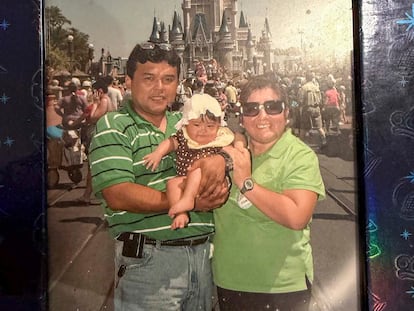
But it was the husband who was taken away by immigration authorities, leaving a bottomless void in the house. When Walter, 60, arrived home after his shift driving for Uber or Lyft on Miami’s main avenues, Ashley would rush to greet him. It was all kisses and hugs, they say. The girl can’t put into words the fact that her father wasn’t there, but María has found her sitting at the foot of the stairs, her gaze lost in thought, as if she were waiting eternally for someone. “She looks at me as if to say, ‘When is my daddy coming home?’” Sometimes María comforts her: “You know what?” she says. “Daddy’s coming back sometime soon.” And she just stares at me.
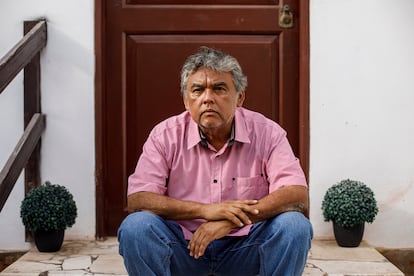
Every day, at five in the morning, Walter religiously calls his wife and asks how she slept and how their daughter slept. At times, Walter breaks down and confesses to Maria that it’s all too much for him: “I miss the life I had there.” Twenty-five years in Miami, more than enough time to become a stranger in his own country. And Peru received him like one. “Lima has grown so much commercially; before, there weren’t so many businesses, so many people. The routes have changed, the streets have been widened. To this day, I haven’t gotten used to it; I don’t recognize it. Except for a few friends, very few people remember me.”
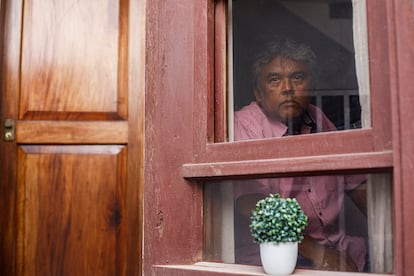
Sometimes he looks out the window of the family home he returned to and goes over his fears one by one: the expenses for Maria and Ashley, who now depend on government assistance; the monthly rent payment; how much their mother has to work cleaning houses; the care of the little girl; and the cancer. Maria was diagnosed with stage four metastatic cancer in her femur, after ICE detained him in a detention center.
“Maria is the person I’ve lived with for 30 years. The three of us had each other. It’s like my arms have been cut off,” says Walter, almost apologizing for bursting into tears. “I try to feel okay, but I can’t. I know what my wife and I are going through. It’s awful. It’s like having your hands tied and only your neck left to watch.”
“I love you all, take care”
On December 30, 2025, while Walter spent his days detained at the Alligator Alcatraz detention center, Maria entered the operating room at Jackson Memorial Hospital in Miami. Three years earlier, she had undergone a mastectomy due to breast cancer, which had now reappeared in her right femur. Maria kept it a secret, saying she didn’t want to worry Walter, who was already stressed by the confinement and the psoriasis that was breaking out on his body.
Although the doctor recommended she stay in the hospital for two days after the surgery, the mother refused. Suffering from fever and chills, she returned home, with no one to spend the night with Ashley. Her husband only learned of her illness after he had already been deported, almost a month later. “Why didn’t you tell me anything?” he demanded. “Because we didn’t want to worry you. Because we were hoping you’d come back.”
Walter had always come back. Maria, a devout believer in God, had dreamed during those days that she was strolling through the Bayside Mall and that ICE (Immigration and Customs Enforcement) agents were walking past her without noticing. The interpretation for her was clear: God had made them invisible to the immigration agents. But the morning of November 17, 2025, was the last she spent with her husband. “We had breakfast, and he told me he’d be back for lunch. But he never came back.”
Walter appeared that day, as he did every year, before immigration authorities at the Miramar offices. They had arrived in the United States from Lima on tourist visas: he in 2000, she a year later. They had settled in Miami and hoped for a new life: she cleaning houses, he working for a fish company. In 2007, while checking the trunk of his car outside his workplace, ICE officers pointed a gun at his back. They were looking for someone else, not him, but the authorities arrested several of the undocumented workers in the area.
Walter was detained for 15 days until the company paid $15,000 for his release on bail. “They loved him, they really liked him,” says Maria. In 2011, after Ashley was born, her father received a deportation order after losing his political asylum case. From then on, he went to Miramar to report to the authorities every year. On one occasion, he explained to the officials that he was the father of a child with a disability and asked them to please consider not deporting him. The officials granted him a supervised release order. “They did everything to help me,” says Walter.
Year after year, he showed authorities documents proving he was the guardian of a girl with Down syndrome. “They always reviewed the case and let me go because I was dedicated to my daughter,” he says. Until now. The rules during the last year and a half, under the Trump Administration, have been merciless. The order was to capture as many migrants as possible, so much so that in fiscal year 2025, the total number of deportations from the country was 442,637, according to official government figures.
This time, an officer at Miramar told him he couldn’t leave. “Ma’am, please, I’ve been coming here for years without any problems. You can check my records, my tax payments. I have a daughter with a disability; she can’t speak, she has Down syndrome, and my wife is in remission from breast cancer. Please don’t deport me,” he said. The officer asked, “Is your daughter an American citizen?” The father replied that she was. “And that was the last time I spoke to an immigration officer until they put me on a plane three months later.”
U.S. authorities have labeled every migrant they can capture as a criminal, without pausing to evaluate individual cases. Attorney Liudmila Marcelo, who works in South Florida, explained to EL PAÍS that people with deportation orders under ICE supervision who also have immediate family members who are citizens or residents with serious health problems can appeal using Form 246, called “Application for Stay of Deportation or Removal” or “Stop of Deportation.” “This form must be accompanied by evidence such as medical records, a statement from the family member who is a citizen or resident explaining in detail how the absence of this person would affect them if the deportation order is carried out, proof of tax payments, letters of recommendation, police records, and a valid passport, among other things.”
The lawyer explains that, in previous years, ICE granted these stays of deportation “for a period of one year, after which the person had to file another request and thus remained under their supervision, with their work permit, and supporting their family.” However, in recent months the situation has been different. “ICE is denying these requests more frequently, or simply not responding. If the person is detained, it is much less likely that they will respond before deportation, even though legally they should do so before carrying out the deportation.”
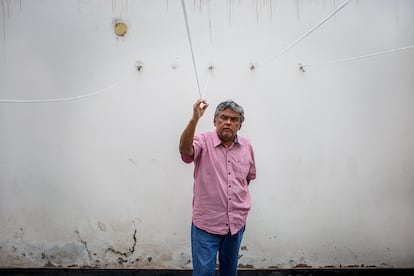
Walter, with a pending court case, didn’t even have time to appear before a judge. On January 28, 2026, he was put on a plane in Texas and landed a few hours later in Guayaquil, Ecuador. There were about 50 Peruvian citizens who, after a two-hour layover, arrived in handcuffs at a military airport in Lima. Their country had no objection to receiving them. According to figures from the National Institute of Statistics and Informatics (INEI), 1,060,000 Peruvian citizens reside in the United States, of whom about 300,000 are undocumented. Although there are no figures on how many Peruvian migrants the Trump administration deported in the last fiscal year, Peruvian authorities report that some 12,000 undocumented immigrants have returned to the country since 2022.
In Maria’s ears, Walter’s words on the day they arrested him still echo. “They took me prisoner,” she heard her husband say in a quick call. “I love you, take care.” He said nothing more.
“I didn’t commit any crime”
The cell phone rings at the Miami Gardens house, and this time it’s not Walter, but the doctor, who has warned Maria that she must go to the hospital urgently because of elevated liver enzymes. She may have an inflamed or damaged liver. Maria tells him she’s sorry, but she can’t just leave like this and leave the girl without anyone to take care of her.
María and Walter are among those who believe that people are frightened by the misfortunes of others. Their few acquaintances have distanced themselves. “They think you’re going to call them to ask for money,” says María. A cousin disappeared the day they asked her to grant power of attorney to transfer custody of Ashley, in case something happened to her mother. “We understand that it’s difficult to assume custody of a human being with a disability. But that’s the human condition. When they don’t need you, or you’re no longer useful, they turn their backs on you,” says Walter.
It was a friend of many years who offered to take responsibility for sending the girl to Peru in her mother’s absence. Walter wanted to be prepared: “If María were detained or something happened, my daughter would be practically at the mercy of the state, in an orphanage. That’s our fear. I don’t want my daughter to go to any detention center.”
The other possibility, a permanent return of the entire family to Peru, is not an option they are considering. Walter himself hasn’t been able to find work since he came to live with his ailing mother in the Chorrillos district. “I’m 60 years old and I’ve arrived in a place where no one knows me, where it’s difficult for even a young man to find work, so imagine what it’s like for someone like me.” He also says there’s no life for a child with a disability in his country, nor the kind of support they receive in the United States.
Against all logic, faith continues to sustain the family. “I trust that something will happen, because this little girl needs her father,” says Maria. He still can’t find an explanation for why he was separated from his family like this. “I didn’t commit any crime. All I did in 25 years in that country was support my family,” says Walter. Maria still has the last pair of pajamas her husband wore, the ones he took off the morning he was taken into ICE custody. “I haven’t washed them. I still have them. I want to see my husband in Miami wearing those pajamas.” Maria believes he will return; they have shared a lifetime together. She believes it can’t be any other way.
Sign up for our weekly newsletter to get more English-language news coverage from EL PAÍS USA Edition









































