
Iranian regime seeks to buy time by opening up to negotiations with Washington
Donald Trump’s offer of dialogue could deepen the struggle between pragmatists and ultraconservatives in a political system already weakened by protests
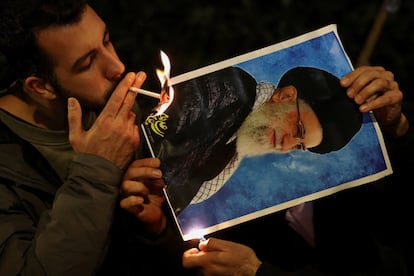

On July 20, 1988, Ayatollah Ruhollah Khomeini, then Supreme Leader and founder of the Islamic Republic of Iran, appeared on national radio to announce the end of the war with Iraq. He did so by comparing the decision to “drinking from a poisoned chalice.” Khomeini knew that, after eight years of war and more than 200,000 soldiers killed, the survival of his regime depended on draining that cup to the dregs. That phrase, deeply ingrained in the collective memory of Iranians, could well be applied to the Islamic Republic now, as former head of the Iran branch of Israeli defense intelligence Danny Citrinowicz pointed out on Monday on X. A regime facing demonstrations that it claimed to have “under control” on Monday — through repression — and facing the threat of a new attack from the United States, must either undertake a “change in policy” — the “poisoned chalice 2.0,” as the analyst calls it — or face its demise, if not as a result of these protests, then in others to come, as predicted by Citrinowicz and other experts.
One of those changes could concern the Iranian nuclear program, which the West fears is aimed at acquiring atomic weapons, something Tehran denies. On Monday, during a meeting with diplomats, Iranian Foreign Minister Abbas Araghchi declared that his country is open to negotiations with the United States, as reported by the Qatari channel Al Jazeera. A day earlier, Donald Trump, aboard Air Force One, had stated that he had received an offer from Iranian authorities to “negotiate” about the program. The U.S. president did not rule out “very strong” military or other options against Tehran, he said, even if this potential dialogue materializes.
The statements from both men corroborated what was already suspected after Oman’s Foreign Minister Sayyid Badr Albusaidi, a leading regional negotiator, traveled to Tehran on Saturday, as anti-regime protests intensified. In the Iranian capital, he met with the top officials of the regime’s more moderate faction, which is more open to compromises with the West: President Masoud Pezeshkian, Foreign Minister Araghchi, and the secretary of the Supreme National Security Council, Ali Larijani.
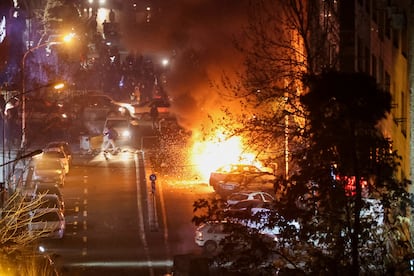
Oman hosted the nuclear negotiations between Washington and Tehran in June — Araghchi led his country’s delegation — during which Iran drew a red line: its refusal to completely abandon its uranium enrichment program, as demanded by the U.S., which the current Supreme Leader Ali Khamenei has repeatedly defended as a sovereign right. This refusal was the pretext used by Israel, its regional nemesis, to launch a wave of military attacks on the eve of the sixth round of negotiations against Iranian nuclear facilities and military and civilian targets, in which Washington also participated.
An Iranian source, quoted by the well-informed regional news portal Amwaj, alluded to how Oman’s foreign minister had conveyed a U.S. ultimatum to his counterparts. The following day, Trump revealed the alleged offer from Tehran, which suggests that the latest wave of anti-regime protests may have led Iran to reconsider its refusal to return to the negotiating table.
The Iranian regime “is trying to survive. If Trump offers them that possibility [through negotiations], they will probably accept it,” notes Luciano Zaccara, senior fellow at the New Ground Research think tank, from Qatar. That doesn’t mean that, as in June, an unpredictable Trump won’t “bomb Iran again in the middle of negotiations.”
Citrinowicz believes that Washington “will try to exploit Iran’s strategic weakness” to secure a deal that satisfies its interests. The Asian nation, for its part, subjected to severe sanctions — which is crippling its population — due to its nuclear program and lacking the capacity to mitigate the economic crisis that initially sparked the protests, may be trying to buy time and delay or limit the scope of a potential U.S. attack.
This would be designed not only to appease Trump, but also a weary population, with the highly hypothetical possibility of sanctions relief that a new nuclear agreement would entail. However, given the recurring protests in the country, it seems unlikely that this distant prospect will be enough to quell the outrage of many Iranians, especially since the NGO Iran Human Rights raised the death toll from the repression to 648 on Monday, including nine children.
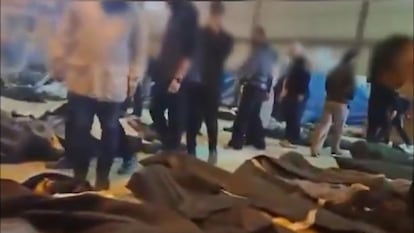
Whether or not that dialogue takes place, the situation in Iran will likely “increase political polarization” within a power structure where “a reformist government” [that of President Pezeshkian] coexists with ultraconservative forces, Raffaele Mauriello, Iranologist and professor at Tehran’s Allameh Tabataba’i University, told this newspaper from Italy.
In September, while Pezeshkian was engaged in intense activity at the United Nations General Assembly to try to prevent the reinstatement of Security Council sanctions over the Iranian nuclear program, Supreme Leader Khamenei defined the possibility of a return to dialogue with Washington as an “irreparable” mistake.
The situation has changed since December 28, when the protests erupted — initially economic, but later taking on a political dimension — and which, to the regime’s dismay, were initially led by cell phone vendors in Tehran’s Grand Bazaar, a sector hit hard by the 40% devaluation of the rial. The bazaar vendors have traditionally been loyal to the Islamic Republic and played a leading role in the revolution that overthrew the Shah.
An analysis published last Friday in The Economist also highlighted how Khamenei’s “stature as a leader” had already diminished since the June attacks, a fact that, coupled with the demonstrations, could lead him to concede and drink the poisoned chalice of negotiations with the United States, offered by moderates as a way to save the Islamic Republic. Without a successor — at least as far as anyone knows — and in the twilight of his life at 86, Khamenei has “dwindling” options for imposing his policies on those around him, the analysis asserted, although he still retains the final say on the nuclear issue.
Zaccara’s sources in Iran indicate that, in any case, a faction within the regime believes that “the only option for survival is to rearm, not to negotiate.” This has been, and may still be, the position of the Supreme Leader’s inner circle.
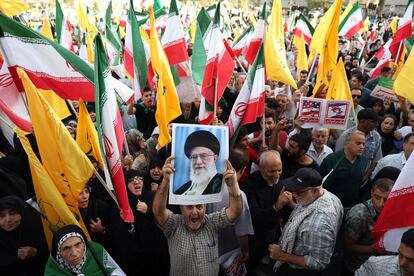
Both the Supreme Leader and the Islamic Republic still have leverage that Washington is likely considering. The first is the support of its military and security forces. Another is that Khamenei is the religious leader of the Shia Muslims, not only in Iran, but also those scattered among minorities in neighboring countries or, in the case of volatile Iraq, even those who constitute a majority. A military regime change could lead to chaos, inflame the region, and encourage separatist tendencies — something Washington’s Arab allies, especially Saudi Arabia, where the Trump family has significant economic interests, also want to avoid.
The Islamic regime also enjoys a base of popular support, Professor Mauriello points out, whether due to ideology or the need for survival. Some eight million Iranians depend on the public sector in one way or another. In the last presidential elections, 13 million out of a total of 61 million voters cast their ballots for Saeed Jalili, the ultraconservative who embodied the essence of the Islamic Republic.
Sign up for our weekly newsletter to get more English-language news coverage from EL PAÍS USA Edition









































