
Mojtaba Khamenei’s whereabouts remain unknown, but regime shows no signs of a power vacuum
The new supreme leader’s public absence since the war began is fueling speculation, although Tehran maintains that he is in ‘perfect health’ and ‘in charge’
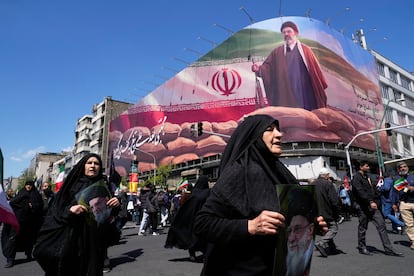

The current Iranian political system has spent 47 years under the shadow of the charismatic figure who shaped its course: Ayatollah Ruhollah Khomeini, its founder and first Supreme Leader (1979-1989). Often defined as the “regime of the ayatollahs” — Khomeini enshrined clerical authority over state decisions — the Islamic Republic is an autocracy that has continued to function throughout the 40-day war, even after Israel and the United States killed Supreme Leader Ali Khamenei. And it continues to do so while his successor, Mojtaba Khamenei, remains at large. According to speculation, Khamenei may be wounded or even incapacitated.
Tehran categorically denies this. On Thursday, Iranian Deputy Foreign Minister Saeed Khatibzadeh assured the semi-official ISNA news agency that the supreme leader is in “perfect health” and has “everything under control.” He also stated that Khamenei was “in his office,” now that Israeli and American airstrikes have temporarily ceased under the fragile ceasefire agreement announced on Wednesday.
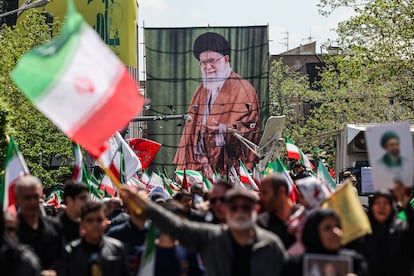
These statements, made on the same day that a large demonstration in Tehran commemorated the end of the 40-day mourning period for the death of Ali Khamenei —who has still not been buried — do not resolve the mystery surrounding the whereabouts and well-being of the new supreme leader, 56. In the preceding days, unverified reports circulated and contradicted one another, with only one certainty: there has been no public trace of him since February 28, when his father died in one of the first airstrikes against Iran. Nor has there been any since his appointment on March 8 as the third Supreme Leader of the Islamic Republic.
Last Tuesday, the British newspaper The Times, citing an alleged U.S. and Israeli intelligence memo, reported that the Iranian leader was “unconscious” and “gravely ill,” and therefore unable to participate in government or war decisions. Surprisingly (given that the United States and, above all, Israel have repeatedly stated their intention to kill him), the memo revealed where these intelligence services placed the Iranian supreme leader: in Qom, about 85 miles south of Tehran. There, the article stated, Khamenei was being treated for his injuries.
The Times, always referring to the cited source, stated that the Iranian leader is so close to death that he could even be buried in a mausoleum that is being planned in the holy Shia city to house the body of his father.
Two days after what appears to be a leak to the British newspaper, this Thursday — shortly before the Iranian deputy foreign minister’s statements — another outlet, this time the U.S. website Axios, published an article attributing the decision to reach a ceasefire with the United States to the intervention and instructions of Mojtaba Khamenei. Axios cites three sources; one of them, an “Israeli official.”
Since his appointment as successor, the new supreme leader has not appeared in public. Speeches attributed to him by Iranian authorities have been disseminated, read by state television announcers or shared on social media, such as the one released this Thursday in which Khamenei supposedly asserted that his country does not seek war. However, neither his voice — not even a recording — nor his actual image has been heard or seen. Last Monday, Tehran released an AI-generated video in which a digital image of Khamenei’s son enters a control room displaying a map of Israel’s Dimona nuclear facility.
Iranian state television, linked to the regime, read a new statement on Thursday attributed to Khamenei in which he asserted that Tehran “will take the management of the strategic Strait of Hormuz to a new phase.” The statement added: “Iran does not seek war, but it will not relinquish its rights and considers all resistance fronts as a unified entity.”
Iran had claimed, shortly after his appointment in March, that the new leader was wounded, though not seriously, in the same airstrike that killed his father, mother, and other relatives. Paradoxically, in Western eyes, this announcement was intended to enhance the symbolic value that the status of “living martyr” holds for Shias; that is, someone who is physically or emotionally wounded, or loses family members, in war, thus demonstrating their willingness to endure martyrdom.
Iranian authorities had already indicated before Thursday that their new leader “is in charge.” Last week, Iranian Foreign Ministry spokesman Esmaeil Baqaei stated that he is “perfectly healthy” and attempted to dispel the rumors, maintaining that his public absence “is not unusual” in times of war.
“It is very possible that Mojtaba Khamenei is incapacitated, as there are no signs of life from him,” says Ali Alfoneh, an Iranian political scientist and senior fellow at the Arab Gulf States Institute (AGSI), in an email from Washington. He points to a fact that supports this: “Other Iranian leaders have issued video messages from safe locations.”
His possible incapacity, Alfoneh points out, has not, however, caused a power vacuum in the regime, which “already had a de facto collective leadership, even during the last year of Ayatollah Ali Khamenei’s life.”
“This leadership is composed of the president [Masoud Pezeshkian]; the speaker of parliament [Mohammad Baqer Ghalibaf, who will head the Iranian negotiating delegation in Islamabad starting this Friday]; the head of the judiciary [Gholam Hossein Mohseni Eje’i]; a representative of the Islamic Revolutionary Guard Corps (either Major General Mohsen Rezaei or Brigadier General Ahmad Vahidi); and a representative of the regular army,” the expert explains. This collective leadership, he insists, “remains under the command of Mojtaba Khamenei.”
Message to the public
When Mojtaba Khamenei was appointed the new supreme leader, it was interpreted as a challenge to Donald Trump, who had opposed his nomination. The U.S. president was then subjected to widespread ridicule on social media, with many pointing out that one of the “achievements” of the war was replacing an elderly Khamenei with a younger, more radical one. Meanwhile, the Islamic Republic was trying to demonstrate two things, according to various experts at the time: first, the continuity and stability of the system; and second, that there had never been a power vacuum, not even momentarily, in Iran.
And that was precisely one of the objectives of Israel and the United States: to create an institutional vacuum in the Islamic Republic by killing its leader, hoping that, by eliminating the ace of the equation and bombing the country, the regime would collapse like a house of cards.
Forty days after the death of Ali Khamenei, the Iranian regime appears neither to be faltering nor is there any sign of a power vacuum, despite the conspicuous absence of the supreme leader and the assassinations of numerous regime officials. However, Washington has fueled rumors concerning Mojtaba Khamenei, allowing it to project a victory narrative by describing Iran as a leaderless country, with no one at the helm. Or perhaps it is in the hands of a leader who is wounded, unconscious, or even dead.
On March 14, U.S. Secretary of Defense Pete Hegseth asserted that Mojtaba Khamenei had been “wounded and likely disfigured” in the bombing that killed his father. In that statement, Hegseth described the leader as a cornered animal and the Islamic Republic as a rudderless ship: “He’s scared, he’s injured, he’s on the run and he lacks legitimacy. Who’s in charge? Iran may not even know” he said.
Two days later, U.S. tabloid The New York Post published a report portraying Khamenei as a leader whose legitimacy had been undermined in the eyes of the Islamic Republic itself due to his alleged homosexuality. The article cited two “intelligence officials” and another “close to the White House” as its sources.
Another rumor, reported in mid-March by the Kuwaiti newspaper Al-Jarida, placed the Iranian supreme leader in Moscow, where the publication claimed he had been flown on a Russian military plane to receive treatment for his injuries at the offer of President Vladimir Putin himself. When journalists asked Dmitry Peskov about this, the Kremlin spokesman did not respond.
Even before his appointment, Mojtaba Khamenei was a shadowy figure, whose voice was virtually unknown to most Iranians. Yet, he undoubtedly wielded power. He had served as deputy for political and security affairs in his father’s office, and his ties to the Revolutionary Guard and its intelligence apparatus were close — connections that analysts agree were instrumental in his rise to power.
However, Iran has never been a one-man regime. The absence, at least publicly, of Khamenei without resulting in a power vacuum has, in fact, “a solid historical precedent,” Ali Alfoneh points out.
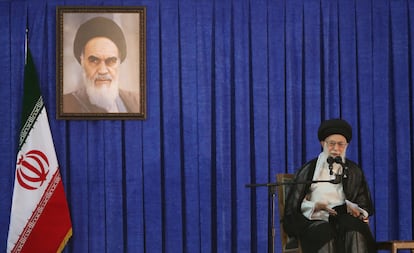
“In 1980, Grand Ayatollah Ruhollah Khomeini, founder of the Islamic Republic, suffered an acute myocardial infarction and, until his death in 1989, Iran was governed by a collective leadership composed of President Ali Khamenei, Speaker of Parliament Akbar Hashemi Rafsanjani, Chief Justice Mousavi Ardabili, and the leader’s son, Ahmad Khomeini, who used his father’s seal ring to promulgate decrees that legitimized the triumvirate’s decisions,” he explains.
The “only difference” that the AGSI researcher sees with the current situation is that now “the Revolutionary Guard and, on paper, the regular army also participate in strategic decision-making,” as a sign of the “greater influence” they have acquired since 1989.
Sign up for our weekly newsletter to get more English-language news coverage from EL PAÍS USA Edition









































