Vali Nasr, former Iran adviser to the Obama administration: ‘Tehran has more leverage now than before the war’
The Johns Hopkins University professor believes the conflict has revealed the limits of Trump’s assumption that everything can be achieved by force
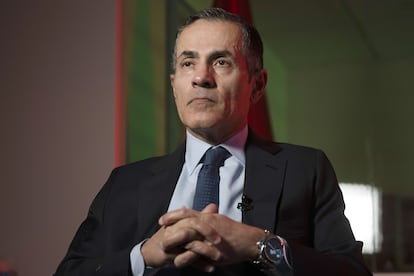

Political scientist Vali Nasr, 65, is widely regarded as one of the leading global experts on Iran, Shiism, the Islamic Republic, and U.S. policy in the Middle East. Nasr is a professor at Johns Hopkins University and the author of seminal works on his native country. But his work extends beyond academia: between 2009 and 2011, he served as senior adviser to Richard Holbrooke, Washington’s special representative for Afghanistan and Pakistan. During that period, he also advised the State Department and president Barack Obama on Iran.
Speaking via video call on Tuesday from the U.S., the expert expressed cautious optimism about the negotiations that began Saturday in Pakistan between Tehran and Washington. He also described how this war has revealed the limits of U.S. President Donald Trump’s belief that everything can be achieved through military force. After 40 days of strikes, Trump’s willingness to negotiate with his enemy suggests, in Nasr’s view, an admission of failure.
Question. What is the current status of the peace negotiations that began in Pakistan?
Answer. I think they made significant progress at the Islamabad meeting. They would not have been talking for 21 hours until 3:00 a.m. if they had made no progress. The most important issue is that after 40 days of fighting, both sides don’t want to return to war, even though their positions are still far apart.
Q. What are the main obstacles?
A. The lack of trust is crucial. You are not negotiating with just the country; you’re also negotiating with the leader. If that leader is narcissistic, wants total victory, wants the other side to cave in, and has shown himself to be untrustworthy by leaving the 2015 nuclear agreement, the consequence is the belief that this leader could break a new agreement. Furthermore, the United States bombed Iran in the midst of negotiations [in June 2025 and February]. It’s not just a question of whether Iran can trust the United States, but whether it can trust this president. Trump’s calculations in this war proved to be wrong: that it would be quick, that Iran would surrender, and that there would be a massive rebellion. He also failed to foresee that Iran would be capable of escalating the war to threaten the global economy. The Iranians didn’t go to Islamabad just to sign on a dotted line and surrender.
Q. What is the objective of the U.S. blockade of the Strait of Hormuz?
A. It’s a way of increasing pressure on Iran, but it’s also increasing pressure on the international community. China, Saudi Arabia, and other countries are balking at the way Trump is approaching the blockade, which is based on the assumption that Iran will quickly collapse — a calculation that may also be wrong. What if the Iranians are willing to survive by eating grass? What if oil gets to $200 a barrel? What if the Iranians also close the Red Sea [with attacks by their ally, the Houthi militia]?
Q. What do you think of Spain’s stance on this conflict?
A. The way Spain has handled not just the Iran war, but also the Gaza war, has raised its global standing, while the United States and the rest of Western Europe are on the losing side.
Q. Is the war destroying U.S. hegemony?
A. I wouldn’t say it has destroyed it, but it has strategically downsized it. Trump’s assumption that the United States can have its way through war, intimidation, and tariffs has reached its limit in Iran. It has been fighting for 40 days, and it’s not getting its way. The only thing it can do is try to escalate into something much bigger, like erasing Iran’s civilization or launching a massive air campaign, or it can opt for the only alternative: a deal. An agreement does not mean dictating; it means that the United States asked to negotiate, which suggests that, after 40 days of war, it has lost. Israel, too, is reaching the limits of what its military can do. It came out of the Gaza war on the assumption that its military could settle every single issue to Israel’s advantage. Now those two countries combined have not been able to win this war the way they wanted: Iran has survived.
Q. Has Iran more leverage than before the war?
A. Yes. It has gained leverage by frustrating U.S. and Israeli plans and proving itself not to be an easy bite to digest. It has also capitalized on having taken Israel and the U.S. in particular by surprise by waging war on Arab countries, U.S. bases, energy infrastructure, and closing the Strait of Hormuz, which has become a new front against which the U.S. cannot defend. They can sink Iran’s Navy, but that doesn’t mean anything. Iran can maintain the blockade from the air with drones, mines, and cheap weaponry. What’s bizarre is that Washington’s only response to Iran’s closure of the Strait of Hormuz is to close it even further.
Q. Why does Trump continue to define the issue of the Iranian nuclear program as “the only one that matters”?
A. Because it’s an issue that he can get a win out of. It’s also the issue Iran is most likely to negotiate. There won’t be any wins on Iranian missiles or the Strait of Hormuz blockade, so that issue remains the easiest way to strike a deal where [Trump] can claim victory and the Iranians can get sanctions relief.
Q. What is the internal situation like in Iran?
A. A number of assumptions have proven false. One is that people rebel and betray their country in the middle of a war. Second, the Iranian population is very angry and did rise in rebellion in January, but it is not organized. There is no political party or structured opposition, and a sudden outburst of anger is very different from an organization capable of sustaining a political campaign. Third, the more the war went on, the more it became very obvious that the war is against the country, not against its leadership. When Israel bombs universities, hospitals, and neighborhoods; when it destroys infrastructure, it makes that clear.
Q. Is there a resurgence of nationalism?
A. More and more nationalism has kicked in, but nationalism does not mean support for the regime. It does mean that there isn’t going to be a political uprising right now, because many people in Iran understand that, whether you’re in the Revolutionary Guard or the Basij [militia] or against the regime, right now you’re defending your country. That doesn’t mean that when the war ends, politics won’t return. The Islamic Republic is not all of a sudden popular.
Q. Will Iranians demonstrate again?
A. Obviously, unless things change drastically. This war is transforming things so much that it’s not helpful to look at the past as a model for the future, because it will change Iran and its government profoundly, and not necessarily for the better. If there is a deal and serious sanctions relief, the outlook will be very different. What happened in January is still there: thousands upon thousands of people killed after millions rose up. The problems that led Iranians to rebel in January are still there: poverty, isolation, inflation, and shortages, now compounded by the enormous damage caused by this war.
Q. One prediction is that Iran will be a Revolutionary Guard dictatorship with a religious facade.
A. That’s simplistic. The IRGC [Islamic Revolutionary Guard Corps] was already in control, and undoubtedly that dominance has become more prominent during the war, but it’s not the whole system. Iran has a multi-nodal system, and it’s not just about the clerics and the IRGC; there are also oligarchs and a political class with different factions.
Q. Will a strong man emerge from this war?
A. Iran has a leader. He’s called Mojtaba Khamenei. Whether he will survive the war, whether he is capable of governing, is a different matter, but, as we speak, he is the main leader of Iran, by virtue of the Constitution and the power he wields. Everyone else holds their positions because he appointed them; from the commander of the IRGC to the national security adviser. Even the role played by [Mohammed Bagher] Qalibaf [the speaker of the Iranian Parliament, who is leading his country’s delegation in Islamabad] is because of Mojtaba Khamenei.
Q. He is often described as a puppet of the Revolutionary Guard.
A. He is the Revolutionary Guard. The Revolutionary Guard that is now in control was his making for over 30 years. All the commanders he has appointed are the people closest to him. The real question is: how does he intend to rule Iran? We are seeing his fingerprints in how Iran is conducting the war and the negotiations, but we have not seen how he intends to govern the country in a peacetime situation.
Q. What is the best-case scenario for Iran? And the worst?
A. In the worst-case scenario, Iran will become a more isolated, impoverished, and dictatorial regime — far worse than it is now, both economically and politically — and a menace to the region, with the risk of acquiring nuclear weapons. In the best-case scenario, if this war is resolved through an agreement, Iran would have a vested interest in the stability and security of the region. In that scenario, even if it controls the Strait of Hormuz, it would have a financial incentive to cooperate with the Arab states. Maybe lifting the sanctions would open its economy and give it an incentive to behave itself. Iran is not going to become something completely different overnight; for it to follow the path of China after Mao or Vietnam after the war with the United States, as opposed to the path of North Korea, it has to have incentives.
Q. Do you rule out a change of regime?
A. There is nothing right now that tells me that the Islamic Republic is about to collapse or that the population is ready to overthrow it. Most likely, with its current leadership, it will remain in power in Iran for a period of time after the war. What I do see as possible is that, in the future, the Islamic Republic will become more like Saudi Arabia and the United Arab Emirates, with more cultural freedoms but not political ones, especially since the group that has seized power is pushing a very hard line in that regard.
Sign up for our weekly newsletter to get more English-language news coverage from EL PAÍS USA Edition