
Donald Trump’s double blockade of Hormuz: A high-stakes gamble with many limitations
The United States is tightening the negotiating rope, weakening Iran’s position and increasing Chinese pressure on the regime. But putting this into practice will not be easy
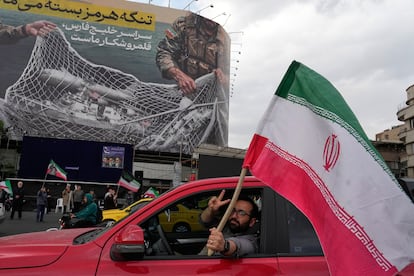
Does it make sense to block a strait that has already been blocked for six weeks? That seemingly contradictory question takes on a very different hue in the ever-complicated mind of U.S. President Donald Trump, who on Monday carried out the threat he had voiced just hours earlier. A new gambit that has baffled analysts and investors. The Strait of Hormuz would have — indeed, according to the Pentagon, already has — a double lock: that of Tehran, aware that it is its greatest defence against U.S. and Israeli aggression; and that of Washington, for now a strategy as vague as it is potentially destabilising. A bold move that is difficult to put into practice.
Trump’s ultimate intentions are almost always a mystery. This obscurity is greatly exacerbated by the lack of clear explanations regarding the ultimate goal of this second Hormuz blockade. There are, however, some clues about his intentions: he wants to further weaken the Iranian economy and make things difficult for China, forcing Tehran to negotiate. But it won’t be easy, and it will certainly be costly: if the blockade proves effective — which is by no means certain, given that three oil tankers passed through on Tuesday — the Strait of Hormuz will be brought to a dangerous standstill.
A blockade that is anything but easy. The offensive against Iran is proving to be a harsh dose of reality for the White House. Despite the assassination of Supreme Leader Ali Khamenei, the regime continues to operate largely unchanged. The calls from the U.S. and Israel for an uprising by the Iranian population have, for now, fallen on deaf ears: if they have achieved anything, it has been precisely the opposite: uniting Iranian society against a common enemy.
Trump has threatened to bomb all Iranian ships and boats that try to cross the strategic waterway. But Iran is not Venezuela, where the U.S. Navy imposed a total blockade last December on ships trying to leave the country with oil for export. “It’s still fresh in our minds, but this has nothing to do with that,” explains Gonzalo Escribano of the Elcano Royal Institute in Spain. “There are two major constraints: I very much doubt they would want to bomb an oil tanker or a methane tanker bound for China or India, to give just two examples, because that would lead to a much greater escalation of the conflict. And secondly: if they intercept one of these vessels on the high seas, which port are they going to take it to? Yemen? Pakistan? It’s a long way from the U.S., and most of its allies in the region are in the Persian Gulf, not outside it,” he points out.
“The big question remains to what extent the U.S. will strictly enforce the blockade,” write Henning Gloystein and Gregory Brew, specialists at the Eurasia consultancy, in a client analysis. “Full enforcement could involve the seizure of Chinese-owned vessels, as well as ships belonging to allied countries in Asia and Europe.”
Suffocating Iran. Even before the war the Iranian economy was in a highly precarious situation, with runaway inflation, street protests, and a clear decline in economic activity. Now, things are getting even more complicated: its energy exports, which had continued to flow steadily in recent weeks, will dwindle. Some $235 million less will be coming in each day — a significant loss for a battered economy in dire need of foreign currency.
Kharg Island, through which 90% of Iran’s oil exports leave, would be completely isolated if the U.S. Navy manages to block the Strait of Hormuz. Two of the country’s six largest ports (Imam Khamenei and Bandar Abbas) would also be rendered inaccessible, cutting off major import and export routes for supplies to Chabahar in the Gulf of Oman and to the Caspian Sea.
Pressure on Xi Jinping. The move comes just as Tehran and Beijing, along with half a dozen other friendly countries, were beginning to gradually restore energy transit. Although China has been preparing for a crisis of this magnitude for months, or perhaps years, with large-scale stockpiling of oil and gas, Iran’s removal from its supply equation forces it to seek new suppliers at a time of global power struggles for energy shipments.
Trump is thus trying to force Xi Jinping to increase pressure on Tehran. If anyone can convince Iran of the need for a peace agreement, the U.S. president must be thinking, it’s his Chinese counterpart. What Washington may not be taking into account is the extremely high penetration rates of renewable energy in China, its enormous capacity to replace gas with coal for electricity generation, and the fact that the extremely high penetration rates of electric cars are reducing — and at an ever-increasing rate — its demand for hydrocarbons.
Even less supply on the market. Crude oil and gas prices reacted sharply on Monday to the confirmation of the blockade, erasing much of the relief that had greeted the ceasefire. And with good reason: one of the few clear things in the short term is that, if the blockade is successful, the availability of energy commodities from the Gulf will be even lower, which is saying something. The few oil tankers and LNG carriers that — as a result of the agreements between Iran and a handful of countries that had tried to secure a minimum supply — were trickling out toward the Indian Ocean would stop doing so in the coming hours or days.
The fact that the U.S., thanks to the fracking revolution, now enjoys a level of fuel self-sufficiency unthinkable not so long ago doesn’t mean it isn’t vulnerable to price fluctuations. Drivers are paying significantly more to fill up their vehicles today than they did at the end of March, when Trump embarked on an adventure with a highly uncertain outcome. And with the midterm elections just around the corner, this is highly volatile for a clearly struggling Republican party. Trump returned to the White House promising to lower the cost of living and, 15 months later, his record is meager.
Trump’s contradictions. The U.S. president is a walking contradiction. Almost at the same time as announcing the oil blockade in the Persian Gulf, he wrote on his social media platform, Truth: “34 Ships went through the Strait of Hormuz yesterday, which is by far the highest number since this foolish closure began.”
No sooner does he accuse Iran of violating international law by blocking the Strait of Hormuz than he orders the U.S. Navy to halt traffic through the waterway. While encouraging former partners to buy U.S. oil as an alternative to Iranian crude, which is priced high due to the crisis, he sends a message to the UK and Norway urging them to abandon renewable energy and drill new oil wells. “Europe is desperate for Energy, and yet the United Kingdom refuses to open North Sea Oil, one of the greatest fields in the World. Tragic!!! Aberdeen should be booming. Norway sells its North Sea Oil to the U.K. at double the price. They are making a fortune. U.K., which is better situated on the North Sea for purposes of energy than Norway, should, DRILL, BABY, DRILL!!! It is absolutely crazy that they don’t… AND, NO MORE WINDMILLS!” Pure Trump.
Sign up for our weekly newsletter to get more English-language news coverage from EL PAÍS USA Edition









































