
Contradictions and threats: Donald Trump’s mixed messages on Iran
The president has suspended his threat to destroy the country, as he did with his previous ultimatums. It’s yet another example of his shifting storyline on the conflict
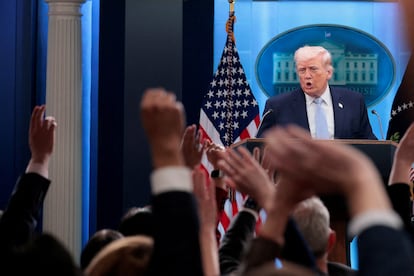

Donald Trump’s war against Iran has been marked by a relentless series of contradictions. The U.S. president has repeatedly walked back his own announcements and promises — sometimes within days, and at times within mere hours — both regarding his real objective in the war (regime change, or preventing Iran from acquiring nuclear weapons?) and the duration of the offensive (initially four or five weeks, then three, later two, and now indefinitely). The campaign, launched at Israel’s urging, has also featured operations that, far from being coordinated, have at times unfolded haphazardly, without the other military partner even being informed.
The only certainty is that, after a month of war, those objectives have expanded — and have often contradicted one another. A week ago, Trump claimed the conflict had nothing to do with oil; immediately afterward, he posted that the United States should “take the oil and make a fortune,” citing Venezuela as an example. He also said the war was practically over, yet at the same time — in a national address on April 1 — he threatened weeks of intensified attacks on Iranian infrastructure.
That speech perfectly encapsulated what looks like a form of political hesitation — the suspicion, if not the realization, that this war is not going to be won — in the face of Iran’s resistance. The address was a string of familiar talking points, devoid of new information, only slightly more orderly, almost scripted, gathering together all his previous proclamations, usually posted on his Truth Social network. What’s more, within 48 hours, he went from telling other nations that they themselves could reopen the Strait of Hormuz once the United States withdrew, to insisting that Washington could do it “easily.” He has since gone back to saying that the countries that use the strait should handle it themselves.
This is nothing new: throughout these six weeks, the same lack of coherence has repeated itself — whether by chance or by incompetence — just as it did in the first 48 hours of the war, when Trump suggested in rapid succession, with no logical sequence between the statements, that his goal was regime change, only to assert shortly afterward that his aim was to prevent Tehran from acquiring nuclear weapons.
The same can be said of the war’s supposed duration: on the second day, he spoke of four or five weeks; 24 hours later, he warned that the timeline could be extended because the United States had “the capability and willingness to go far longer.” Today, Washington’s acceptance of the two‑week ceasefire mediated by Pakistan seems to indicate that the timetable is malleable and, in Trump’s hands, especially relative.
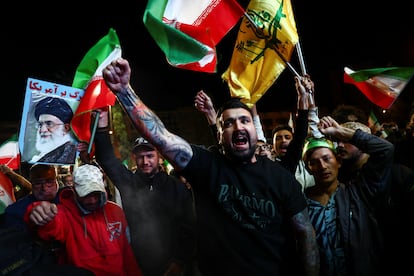
The fact that the president openly contradicts himself — he has put at least three ultimatums on hold since late March, suggesting they were bluster rather than categorical warnings — is hardly extraordinary. “I can change my mind in seconds,” Trump responded when the inconsistencies in his supposed discourse were pointed out to him. These U-turns, the shifting timelines and mixed messages may be due in part to the fact that he is the one delivering his version of the offensive in the Middle East every day, in numerous appearances, interviews, and posts on his network.
That constant informational and online overexposure may have contributed to the sheer volume of inconsistencies. On March 29, for example, he began the day claiming that the diplomatic outlook was excellent because, he said, Iran had agreed to most of the 15 points on the U.S. list of demands conveyed through Pakistan. He also claimed that Iran had sent oil to the United States as a gesture of good faith, “to show you the fact that we’re real and solid.” But hours later, in an interview with the British newspaper Financial Times, he said he wanted to “take the oil” in Iran and was considering taking control of Kharg Island, from which 90% of Tehran’s oil exports are managed. “Maybe we take Kharg Island, maybe we don’t. We have a lot of options,” he said.
Worse still was the impression left by his April 1 address — announced with the solemnity of a nationwide broadcast and supposedly meant to project clarity, strength, and resolve — that no one in the United States was actually at the controls of this war. In practice, it revealed a disconnect — or two incompatible realities — from what is actually happening: in one sentence, the United States had achieved its “core strategic objectives,” Iran had been “eviscerated,” and was “no longer a threat.” In the next, Washington was still striking targets in multiple countries, the Strait of Hormuz was effectively closed, and the president was warning that the war would continue for “two or three more weeks” with heavy bombardments.
In the same address, Trump spoke of “victories [for the United States] like few people have ever seen” before adding the U.S. was only “on track” to complete its objectives. On the one hand, Trump said the U.S. had scored “swift, decisive, overwhelming victories,” but on the other, the conflict was described as a generational struggle requiring patience and resolve.
By the sixth week of the war, Trump had become entangled in his own rhetoric, and his messages were increasingly confusing — if not embarrassing. First he said that Iran “have no navy,” only to declare shortly afterward: “Most of Iran’s naval power has been sunk.” Both claims cannot be true at the same time; one excludes the other. But the Trump appears indifferent to the basic principles of logic.
The culmination of this jumble of assertions and self‑contradictions was the latest threat against Iran, which on Tuesday was suspended in the middle of the countdown to Armageddon. A card player would call such an ultimatum an all‑or‑nothing gamble, but in Trump’s case, it has almost become a nervous tic — one that can only escalate if the “victory” he so often proclaims — that is, the war itself — becomes entrenched.
Sign up for our weekly newsletter to get more English-language news coverage from EL PAÍS USA Edition









































