
Shia militias fighting in Iraq lash out at the US: “Iran didn’t start the war”
Fighters from pro-Iranian factions, state-linked militias, and regular army forces are intertwined in a complex web that exacerbates tensions between Baghdad and Washington
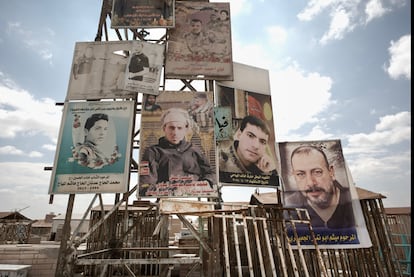

There are city names like Fallujah and Mosul that evoke war and destruction, even though few can locate them on a map of Iraq. The former became associated with the fierce resistance against the U.S. Marines during the 2003 invasion, which toppled Saddam Hussein and ushered in a new political system dominated by Shia parties, which hold a majority in the country. The latter became a symbol of the rise of jihadism when, in June 2014, Abu Bakr al-Baghdadi proclaimed the so-called caliphate of the Islamic State (ISIS) from the pulpit of the Great Mosque of al-Nuri.
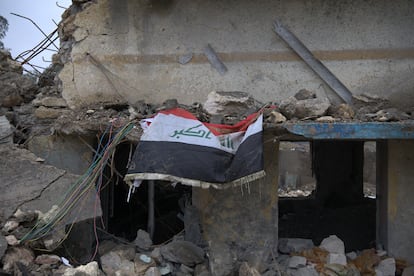
Both episodes profoundly marked Iraq, leaving a political, social, and religious imprint that has constrained successive governments in Baghdad. More than two decades after the invasion, in these cities and on the highways leading to them, concrete is beginning to take hold, and the air is thick with the scent of fresh paint from ongoing reconstruction. But since the joint U.S.-Israeli offensive against Iran on February 28, these cities have once again become targets of drones and missiles in a country that, despite its resistance, has already been drawn into a new conflict.
“Who started the war? Iran or America [as the U.S. is referred to in the Arab world]?” asks Mohamad Adnan, a man in his thirties and liaison between the Popular Mobilization Forces (PMF) and the Iraqi army. “It was America,” he continues, “that, in its democratic culture, assassinated the Ayatollah [Ali Khamenei] because an individual in Washington decided to replace Iran’s leader with another, as they did in Venezuela, without consulting the Iranian people or holding elections.” Adnan, like most members of the Hashd al-Shaabi, as the PMF is known in Iraq, exudes indignation: “What would happen if they did that to the King of Spain?” Despite the risk he runs as a declared target of U.S. missiles and the movement’s usual reluctance to receive the foreign press, he agrees to speak with EL PAÍS. He does so in the relative safety afforded by a modern shopping mall filled with affluent civilians in the center of Baghdad.
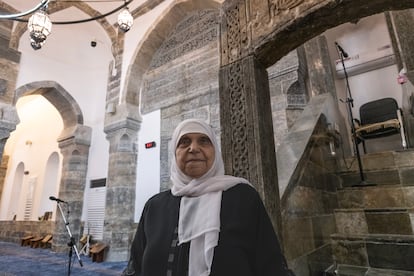
He claims to have lost more than 52 men in U.S. attacks on bases used by the PMF, which Washington has labeled as pro-Iranian forces. “We are an organization that reports to the prime minister’s office and we follow his orders,” he argues. “Western countries, especially NATO, should be grateful,” he says, referring to the estimated 5,000 “martyrs” they lost in the fight against ISIS (2014-2017). Faced with the increased crossfire, NATO announced on March 20 the evacuation of its military personnel from Iraq, who had been training Iraqi security forces and the PMF since 2016.
The truth is that, in Iraq, the PMF are considered heroes who saved the country from the caliphate when its own army collapsed, leaving the way clear for jihadist forces that, in a matter of days, seized control of parts of the territory, committing massacres, looting museums, and appropriating the central bank’s gold reserves. Today, the PMF numbers around 170,000 men and operates in parallel, but in coordination, with the approximately 400,000 uniformed members of the regular army. Distinguishing between the personnel of both forces is complex, as many Iraqi families have one son in the PMF and another in the Armed Forces. Furthermore, both groups share tasks and military bases, such as Habbaniyah in the western region of Amber, where last week a U.S. fighter jet killed seven soldiers and wounded 23 others, straining relations with Baghdad.
Officially, no one can explain what justifies maintaining two parallel armies instead of merging them when the ISIS threat is now minimal. Adnan alludes to security, reconstruction, or anti-drug operations in a country that has gone from being a transit point to a consumer of opium and methamphetamines.
The fighter jumps up when questioned about the link to Iran and the reason Washington gives for pressuring the Iraqi government to disband the PMF. “Don’t say we’re agents of Iran. We fight for our country. Not in Syria, not in Turkey, and we haven’t attacked any other country.” This liaison officer recounts that he left his job in 2014 to take up arms and fight ISIS. They haven’t forgotten that the first to come to their aid was Iran “with weapons, advisors, and training.” The U.S. and NATO arrived later, he adds.
Avoiding civil war
However, unofficially and in hushed tones, the existence of the PMF is explained by the Shia religious factor that unites its members in a parallel military that has seized political power by force, “compensating this community after decades of oppression” under Saddam Hussein’s regime. They consider themselves the guardians of this new order — which they believe is more representative of the Shia majority — and a check on the ambitions of any foreign power, autocrat, or transnational movement tempted to interfere again in a country that holds the world’s fifth-largest oil reserves. “The government is trying to disarm the militias, but doing so now, with the Iran War, could lead to another civil war,” explains an Iraqi official who requests anonymity. Confronting their ally Iran also means aligning themselves with their enemy, Israel.
It was precisely the dean and highest religious authority of the Najaf school, Grand Ayatollah Ali al-Sistani, who, three days after ISIS seized Mosul in 2014, issued his historic defensive fatwa calling on all able-bodied Iraqis to rise up and defend the country and the holy cities of Najaf and Karbala, beacons of Shiism. This religious order mobilized tens of thousands of volunteers and gave rise to the Popular Mobilization Forces PMF. This umbrella organization encompasses some 80 militias that are now entrenched in the government, with their leaders holding seats in parliament. The opposition accuses them of monopolizing the economic sector and contributing to the corruption of a state whose coffers depend on hydrocarbon exports by 90%.
Parallel armies
With a rising death toll of police officers and uniformed personnel, Baghdad has recalled the U.S. chargé d’affaires for consultations. In an interview with EL PAÍS, Prime Minister Mohammed Shia’ al-Sudani reaffirmed the PMF’s status as part of the state apparatus, distinguishing it from the “factions” with which his government is negotiating disarmament. An ally of Washington, the prime minister leads the only Middle Eastern state that denounces an “aggression against a sovereign country,” Iran, with which it shares a 1,400-kilometer (870-mile) border. He adds that the pro-Iranian Iraqi factions are conditioning their disarmament on the withdrawal of U.S. troops.
“Our primary objective is the end of the U.S. occupation and sovereignty so that Iraqis can govern themselves,” replies a sheikh and one of the leaders of the Al-Nujaba faction (the Honorable Ones, in Arabic), one of the three main armed groups — along with Kataib Hezbollah and Kataib al-Shuhadah — responsible for drone and missile attacks on U.S. bases and interests in Iraq. He asks that his name not be used, and the call is made through the cell phone of a trusted intermediary. Unlike the PMF, Al-Nujaba does attack outside of Iraq, launching drones or missiles against U.S. bases or those of its allies, Syria and Kuwait. In the absence of official figures, the number of its fighters is estimated at several thousand.
He maintains that his faction cannot remain neutral in the conflict and must take “a united stance against U.S. and Zionist influence, Islamophobia, and occupation in this war.” He defends the shared Islamic identity with Iran, demands sovereignty for his people and the peoples of the Middle East, and denounces the U.S. plundering of the region’s resources and wealth. This leader asserts that there is no difference between what “the sheikhs [of his faction] want and the universal right to self-determination of peoples enshrined in the UN.”
The sheikh is clearer in differentiating the role of the PMF from that of the “Islamic resistance” factions: “We are independent in leadership, management, and funding.” They answer to clerics, not politicians. But the truth is that nothing is so clear in Iraq, where the three resistance factions that have entered the war maintain some brigades within the PMF, such as the 12th Brigade of Al-Nujaba, and others outside of it. For this reason, the U.S. accuses them of using the PMF’s military bases to launch attacks against its interests. Thus, regular soldiers, militants from the Islamic factions, and PMF personnel end up at the same military base.
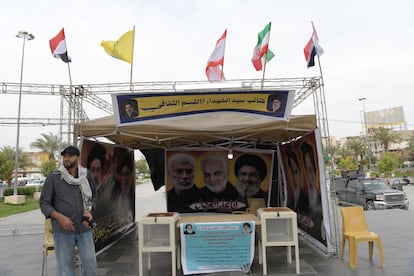
In Tahrir Square (Liberation Square, in Arabic), a group of young PMF members are organizing a fundraising event for their Lebanese and Iranian brothers and sisters displaced by the war. “We are forbidden from fighting outside of Iraq, so we collect money for them,” explains Haj Ashraf, one of the members. Behind him looms a huge poster with the smiling faces of the slain leaders of the Iraqi (Abu Mahdi al-Muhandis), Lebanese (Hassan Nasrallah), and Iranian (Qassem Soleimani) militias, while above his head flies a flag made from a fusion of the Hezbollah, Iraqi, Iranian, and Palestinian flags. He says his movement is not opposed to Jews, but to those who “kill women and children by the tens of thousands,” something he argues they do not do in Israel.
Not far from there, in Baghdad’s Old City, stands Firdos Square, famous for a photograph taken when a statue of Saddam Hussein was toppled after U.S. Marines entered the city. Nearby, American journalist Shelly Kittleson was kidnapped on Tuesday by the Kataib Hezbollah militia, according to a U.S. State Department representative. This incident has further strained relations with Baghdad and highlighted the Iraqi army’s difficulty in controlling rogue factions. “The Iraqi government has not prevented terrorist attacks in or from Iraqi territory. Iran-aligned terrorist militia groups may claim to be associated with the Iraqi government,” the U.S. Embassy stated in a post on its official account on Thursday, after urging its citizens to leave the country immediately.
Sign up for our weekly newsletter to get more English-language news coverage from EL PAÍS USA Edition









































