
Trump asks weary public for patience over a war that will end ‘shortly’
The Strait of Hormuz, blockaded by Iran, will open ‘naturally’ when the conflict ends ‘in two or three weeks,’ predicts the US president, who threatens to ‘strike hard’ at Tehran within that timeframe
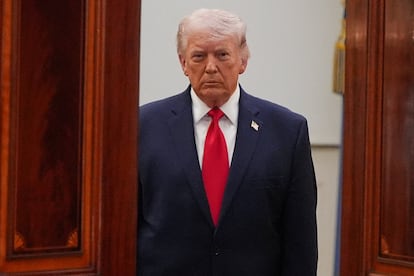

There were no surprises in Donald Trump’s highly anticipated speech about the war against Iran. Nor were there any new attacks on his NATO allies, whom he had lashed out against hours earlier. The “important update” was just that, an update to ask for patience; a slightly more orderly repetition than usual of his statements from recent days: that the conflict is only two or three weeks away from ending, that the military objectives have been achieved, and that the Strait of Hormuz will “naturally” open once hostilities have ceased. Other countries will have to be responsible for guaranteeing transit.
“Thanks to the progress we’ve made I can say tonight that we are on track to complete all of America’s military objectives shortly, very shortly,” the president promised in his address. “We’ve done all of it; their navy is gone. Their air force is gone. Their missiles are just about used up or beaten. Taken together, these actions will cripple Iran’s military, crush their ability to support terrorist proxies and deny them the ability to build a nuclear bomb” he added, vowing to strike “extremely hard” in the next two or three weeks. “We’re going to bring them back to the stone ages, where they belong.”
Trump’s speech was his first formal address to the nation of his second term. Broadcast during prime time and on a highly solemn stage — before the East Room in the White House lobby — he sought to reassure markets reeling from the closure of the strategic Strait of Hormuz and the resulting energy price hikes, and voters fearful of a new “eternal war” in the Middle East and its impact on household finances.
In a brief 20-minute address, the president, who delivered his speech standing up and sounded tired, insisted that the conflict is already won. He claimed that the rise in crude oil prices is only short-term and entirely Iran’s fault for launching “deranged terror attacks on commercial oil tankers from neighboring countries that have nothing to do with the conflict.” He asserted that prices will plummet as soon as the conflict ends and that, in any case, the United States doesn’t need oil from the Persian Gulf because it is the world’s largest producer. “Buy from us,” he urged the countries affected by the strangulation of the strait. He also asked for patience, noting that other military conflicts in which the U.S. was involved — the World Wars, the Korean War, and the Vietnam War — lasted for years, while this one has only been active for 32 days.
He offered no new details about what circumstances would need to be met for him to declare victory and withdraw U.S. forces, or how he planned to get to that point in those two or three weeks. There were no allusions to operations on the ground, nor to specific negotiations with Iran. Nor, despite his own earlier announcement, was there any attack on NATO partners.
The speech came at a time when the war against Iran — which Trump believed he could resolve quickly, with minimal cost and maximum benefit, turning the Islamic Republic into a Venezuelan-style protectorate — has become far more complicated for the president than he anticipated, despite his triumphalist pronouncements. In addition to the loss of 13 U.S. military personnel — and more than 300 wounded — there have been losses of expensive equipment, a dramatic increase in gasoline prices, and a plummeting drop in his approval ratings.
It is no coincidence that the president made a specific mention of Venezuela and what he considers the great military and geopolitical achievement of his term so far. “Now we’re working along with Venezuela — [we] are, in a true sense, joint-venture partners,” he claimed. “We’re getting along incredibly well in the production and sale of massive amounts of oil and gas. The second-largest reserves on Earth after the United States of America.”
Military reinforcements
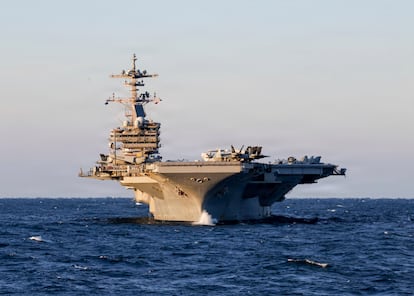
The speech also came as 3,500 troops — 2,500 Marines and 1,000 sailors — and a group of amphibious assault ships arrived in the Middle East last weekend. A similar number are en route, and orders have been given to mobilize some 2,000 paratroopers from the 82nd Airborne Division. All of them will join the approximately 50,000 U.S. troops already in the region, prompting speculation about a possible incursion into Iranian territory: on Kharg Island, where the bulk of its oil industry is concentrated; in the Strait of Hormuz, to force its opening; or the more dramatic, but far riskier, operation: into mainland Iran to seize enriched uranium.
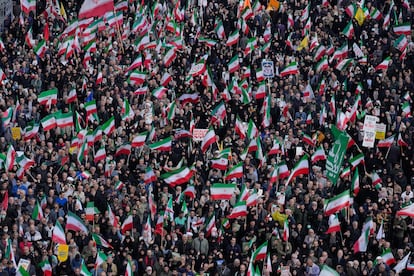
A president who likes to see quick results — whether sustainable or not — finds the situation, five weeks after ordering the attack, very different from what he imagined: the regime remains intact, with no apparent internal cracks or defections despite the deaths of many of its key figures, including Supreme Leader Ali Khamenei. Tehran appears strong. It has secured control of the Strait of Hormuz and has no intention of relinquishing it; certainly not unless the United States agrees to provide clear and tangible security guarantees. The forces of the Islamic Republic continue to fire on adversary targets, and the nuclear threat has not dissipated: Iranian enriched uranium remains somewhere underground in the country.
Since Monday, Trump had been hinting, in increasingly clear messages, at what he would say in his speech. He declared the war won and all military objectives achieved: more than 13,000 targets had been bombed and more than 150 Iranian Navy ships destroyed; missile arsenals and the capacity to rebuild them had been annihilated; and Iran’s ability to attack U.S. allies had been decimated.
The president also considers regime change a success, despite the fact that theocratic structures remain in place and, under the control of the Revolutionary Guard, have become more radical. The U.S. president maintains that the new leadership is much more reasonable than the previous one and is engaged in talks with Washington that are progressing well, while Tehran denies that negotiations are taking place. It only acknowledges mere exchanges of messages.
A message against NATO
The Republican also planned to lash out at NATO and its member countries, as he had told Reuters. Someone must have talked him out of it: none of the furious attacks and threats of retaliation he had been making in recent days materialized. One reason was these nations’ refusal to participate in an operation to forcibly open the Strait of Hormuz. Another was the refusal of countries like Spain and Italy to cede the use of their bases or airspace for the war.
On Tuesday, the U.S. president warned in a social media post of his willingness to withdraw his massive military deployment from the Persian Gulf without having secured the opening of the Strait of Hormuz. He called on countries that consume fuel passing through that corridor to “go get your own oil.” He also indicated a timeframe of “two or three weeks” for this withdrawal.
On Wednesday, he asserted that Iranian authorities had requested a ceasefire. However, he maintained that he would only accept it in exchange for free maritime traffic through the Strait of Hormuz.
He also threatened NATO countries with the United States’ withdrawal from the North Atlantic Treaty Organization or, at the very least, a drastic reduction in its role as leader of the alliance that has served as the backbone of transatlantic defense for the past eight decades. In an interview with conservative British newspaper The Daily Telegraph, he even went so far as to call the organization a “paper tiger.” The warning, although he avoided mentioning it in his speech, has already had an initial effect: next week, NATO Secretary General Mark Rutte will travel to Washington to meet with him.
Sign up for our weekly newsletter to get more English-language news coverage from EL PAÍS USA Edition









































