
Machu Picchu’s credibility crisis: A problem for Peru’s next president
The organization New7Wonders has issued a fresh warning: the Inca citadel is at risk of losing its designation as one of the Wonders of the World due to severe management failures
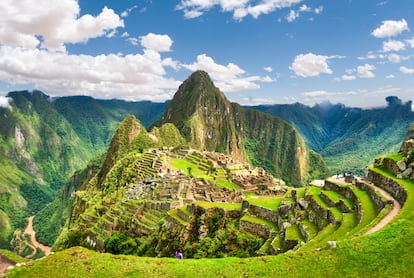

An open letter from Zurich, addressed to Keiko Fujimori and Roberto Sánchez — the two presidential contenders — has shaken up the runoff election in Peru. New7Wonders, the Switzerland‑based organization that in 2007 created the contest to determine the New Seven Wonders of the World, has reminded Peru that Machu Picchu faces a concrete threat: losing the international recognition that turned the Inca citadel into a magnet for millions of travelers and one of those places one must see at least once in their lives.
Recently, Machu Picchu has stopped making headlines solely for its ancestral allure and has instead been overtaken by the chaos and tensions surrounding it: corruption allegations in ticket sales, rising prices for tourism services, indefinite strikes, clashes between unions and security forces, endless lines, blockades, and accidents. In December, a train collision on the route to the llaqta (citadel) left one person dead and more than a hundred injured. And caught in the middle were thousands of stranded, bewildered, and frightened tourists.
“People travel to Machu Picchu thinking that they will visit a marvel of the world,” Jean Paul de la Fuente, director of New7Wonders, told AP. “But for many that dream is turning into a nightmare.”
In September 2025, the organization issued a lengthy statement warning for the first time that Machu Picchu was at risk of losing its official status as one of the modern Wonders of the World. It urged authorities to “urgently redouble the efforts needed to guarantee the protection and proper comprehensive management” of the site.
Peru has seen three presidents since then: Dina Boluarte, José Jerí, and José María Balcázar, who on Friday marked his first hundred days in office. All signs suggest that none has taken up the issue with the necessary commitment. Early last week, New7Wonders issued a second warning, stating that “there has been no progress or change in any of the problems that are undermining Machu Picchu’s credibility” and that it is still at risk of losing its status.
The statement argues that this inaction is mainly due to the “quasi political-administrative paralysis facing Peru,” where no leader has completed their full term since 2016. It stresses that, with elections approaching, the organization wants to ensure Machu Picchu is a priority on the next government’s agenda. “We hope and trust that whoever is elected will commit fully, with our advice and resolve, to revitalize Machu Picchu so it can once again be a truly credible Wonder,” the letter concludes, addressing Fujimori and Sánchez, who will compete for the presidency on June 7.
So far, neither presidential candidate has said a word on the matter. The silence is particularly striking in the case of Sánchez, who served as minister of Foreign Trade and Tourism between 2021 and 2022, when Machu Picchu was still trying to recover from the blow of the COVID-19 pandemic. During those years, the historic sanctuary received fewer than half a million visitors — barely a third of pre‑COVID levels. Although numbers have improved, it has still not fully bounced back. Between January and November 2025, Machu Picchu received 1.4 million visitors, 3% fewer than in the same period in 2019, when it reached 1.5 million, according to the Peruvian Institute of Economics (IPE).
“It is estimated that, over the last five years, Machu Picchu has lost more than 5.3 million visits compared with its pre-pandemic trend,” the institute notes.
Machu Picchu is an undeniable economic engine for the country. It accounts for 35% of the international tourist flow that normally visits Peru. Yet local authorities argue that this has not translated into greater benefits for the region and its communities. Cusco’s regional governor, Werner Salcedo, says that the regional Culture Directorate collects roughly 250 million soles ($73.5 million) annually from ticket sales to the citadel, of which only seven million soles ($2 million) are invested in its preservation.
Journalist Roberto Ochoa, director of Andares magazine, explains that one reason behind the unplanned tourism boom dates back to the early 2000s, when Aguas Calientes — the town closest to Machu Picchu — was renamed “Machu Picchu Pueblo” in an attempt to “trick everyone into believing it was home to the descendants of the people who built the llaqta.” Hotels, restaurants, and housing were built without any roadmap. The area became run down. “When they realized there was an oversupply, pressure began to increase tourist flow […] The problem of Machu Picchu stems from the existence of Aguas Calientes as a free‑for‑all zone where mafias do as they please. And it began during Pedro Castillo’s misrule,” Ochoa says.
As if the debate needed more tension, the Ministry of Culture and the Cusco Chamber of Tourism have tried to downplay New7Wonders’ warning, arguing it has merely “commercial aims.” Both insist that the only institution with authority to evaluate Machu Picchu’s condition is UNESCO, which in 1983 inscribed the Inca citadel on the World Heritage List as “a masterpiece of art, urbanism, architecture, and engineering.” The argument seeks to soften the alarm, though it does not necessarily dispel concerns about the deteriorating tourist experience surrounding one of the planet’s greatest archaeological treasures.
“Of course the list has commercial aims and that benefits Cusco. Machu Picchu’s inclusion on the New7Wonders list triggered the current boom of Peruvian and foreign tourists. Downplaying this warning is pure cynicism, especially considering that UNESCO has also sounded the alarm about the dangers facing not only the llaqta but the entire Historic Sanctuary of Machu Picchu,” Ochoa adds.
Machu Picchu is becoming one of those uncomfortable problems the next president will no longer be able to kick down the road. Whoever takes office on July 28 — Fujimori or Sánchez — will inherit not only an archaeological jewel under pressure, but also a questioned tourism model, entrenched local conflicts, and an international warning that threatens to erode Peru’s most iconic showcase to the world.
Sign up for our weekly newsletter to get more English-language news coverage from EL PAÍS USA Edition









































