
Abstention and blank votes, the undisputed winners of Peru’s elections
More than six million Peruvians stayed home in a vote marked by fragmentation and distrust, and over three million ballots were cast null
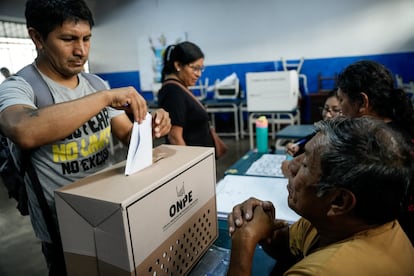

Of the 27.3 million Peruvians called to the polls on April 12 for the first round of the general elections, more than six million chose not to vote. It wasn’t just apathy. According to estimates from the Institute of Peruvian Studies (IEP), 26% of those who stayed home did so because they preferred to work and simply pay the fine. Another 5% remained at home for a harder‑to‑reverse reason: they do not trust elections and have no interest in them.
Since the mid-20th century, Peruvian politics has been a story of disillusionment, marked by illusory prosperity and reforms that never come to fruition. It has alternated between authoritarian regimes that foster nationalism and promise a firm hand in vulnerable times, and democracies that inspire more hope in their returns than in their performance.
For the second consecutive election, no candidate reached 20% of the valid votes in the first round. As more than one analyst has said, it was a “fight of the dwarfs.” Keiko Fujimori (People’s Force, FP) the daughter of the former autocrat who is vying for the presidency in the fourth time, came in first with just 17%. Roberto Sánchez (Together for Peru, JP) and Rafael López Aliaga (Popular Renewal, RP) will each make it to the runoff with just 12%. Twenty‑eight candidates finished below 4%, and 23 failed to reach even a single‑digit share of the vote.
Peru’s 2026 elections were unlike any before: 36 presidential candidates —Napoleón Becerra died weeks before the vote, yet nearly eleven thousand people still cast ballots for him — crowded a ballot paper larger than a family‑size pizza box. Beyond the outbursts of sore losers who revived the specter of fraud, the contest will be remembered for something else: had blank and null votes formed a political bloc, they would have led the race with more than three million supporters.
Political parties — most of them rented out for election season and lacking any real ideological compass — are finding it increasingly difficult to inspire trust or satisfaction among voters. Julio F. Carrión, Patricia Zárate, and Jorge Aragón, political scientists and researchers at the IEP, set out to explain this multi‑layered phenomenon in Desencanto (Disenchantment), a book published just weeks before the vote.
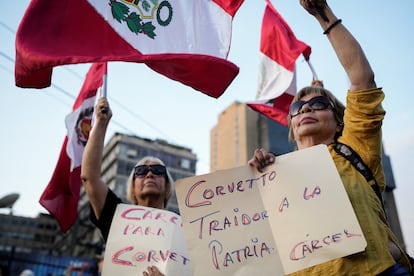
“What we found, in general, is a distrustful country that barely trusts its family, shows little interest in politics, has seen its partisan sympathies collapse, offers weak support for democracy, is very dissatisfied with the performance of the system and feels no pride or respect for it, nor does it believe that it defends people’s fundamental rights, and feels very disconnected from its representatives,” reads one of the conclusions of the publication.
Based on surveys and measurements, the book lays bare the extent of Peruvians’ dissatisfaction with how democracy works in their country. In 2023, Peru registered the second‑lowest level of satisfaction in South America and the Caribbean (19.2%), ahead only of Haiti, according to the AmericasBarometer. By 2025, the figure had fallen to 12% — a fertile ground for anti‑democratic alternatives.
Only 20.3% of Peruvians believe their basic rights are protected, 11 points below the regional average. Another indicator is access to justice: just 18.6% of citizens think the courts guarantee a fair trial, according to 2023 surveys. Again, these are the lowest figures in the region.
Peru is about to have its ninth president in a decade, a period of deep instability that has triggered repeated waves of protest. According to the study, Peruvians are among the most likely in Latin America to take to the streets (between 10% and 14%), yet they rarely join civil‑society organizations and even less often become members of political parties. They struggle to channel their discontent.
“It’s an indicator that this is the only path they see as having political influence due to the disintegration of political parties. The tragedy of Peru is that participation in protests doesn’t translate into institutional consequences,” says Julio F. Carrión, a professor at the University of Delaware in the United States.
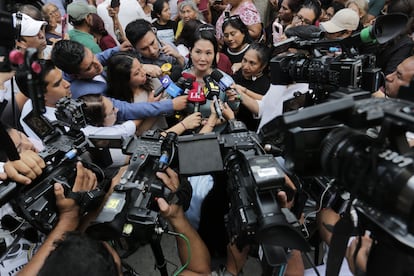
Public opinion and political culture specialist Patricia Zárate points out that the mobilizations in Peru have an anti-political character. “There’s a misunderstanding. Because if you want to generate change, your protest has to be political, but the reaction is usually against it. It’s a contradiction in itself. Added to this is a very moralistic cultural elite and young people who, due to their lack of political education, are scandalized that members of Congress negotiate among themselves, when that’s what politics is: negotiation.”
Whenever elections reach their most decisive stages, anti‑Fujimorism resurfaces. This is a political movement aimed at preventing Fujimorism — named after former dictator Alberto Fujimori — from returning to power, at least formally. Given its influence in Congress and other state institutions, many argue it already governs from the shadows.
“I don’t see how you can build anything political that way,” says Zárate. “It’s not just that you’re confronting the leaders of Fujimorism, but you also despise the people who vote for them. There’s a spirit of revenge, and that’s part of the problem. Because Fujimorismo disgusts them, they make no effort to understand it.”
For his part, Jorge Aragón points out that, in reality, it’s a duality: anti-Fujimorism and anti-leftism. “They share the same logic. It’s understandable in a country where rejection is stronger than proposals.”
Amid the uncertainty surrounding the elections, all three analysts agree that one key to overcoming this disenchantment is strengthening the state, gradually building solid institutions, and encouraging ideological positions that — despite their differences — remain committed to democratic practices.
“Unfortunately, the vote has been so divided that we will once again end up with two candidates for whom the vast majority of Peruvians would not vote,” concludes Julio F. Carrión. Another election defined more by what voters want to avoid than by what they hope to build.
Sign up for our weekly newsletter to get more English-language news coverage from EL PAÍS USA Edition









































