
Ships defy the blockades in Hormuz with false identities, disabled transponders and spoofing
The use of irregular navigation tactics is surging, while the United States says its maritime cordon has forced 14 vessels to turn back
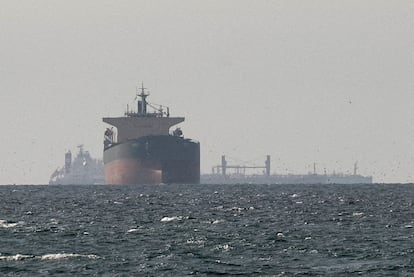

The dual blockade imposed by Iran and the United States on the Strait of Hormuz — one of the world’s main routes for oil and gas shipments — has turned maritime transit into a cat‑and‑mouse game. Ships are attempting to slip through by using irregular routes and evasive maneuvers to exploit exceptions, while others have been forced to halt their voyages or turn back to avoid confrontations that could jeopardize fragile negotiations and the tenuous ceasefire in place.
While the Iranian blockade of the Strait of Hormuz focuses on the narrowest part of this waterway — about 20 miles wide — the U.S. blockade is located further east, at the mouth of the Gulf of Oman, where it meets the Indian Ocean, a stretch of about 180 miles from north to south. A dozen U.S. warships, including the aircraft carrier USS Abraham Lincoln, along with numerous aircraft have been deployed in these waters to enforce the blockade, which went into effect on Monday.
Every afternoon, the U.S. Central Command publishes the results of its mission, emphasizing that no vessel has breached its barrier. “After 72 hours of enforcement, 14 vessels have turned around to comply with the blockade at the direction of American forces,” it posted on social media on Thursday.
Among the vessels that reversed course is the Rich Starry, a Chinese‑owned ship carrying 250,000 barrels of methanol and sanctioned by the United States. It was the first to pass through Hormuz after the U.S. blockade began, but later turned back in the Gulf of Oman and was anchored off Iran’s Qeshm Island on Thursday, according to MarineTraffic data.
“Merchant ships have continued to transit the Strait of Hormuz using routes closer to Iran, suggesting that Iran’s approval mechanism remains in effect. The U.S. naval posture appears to be focused on a distancing blockade, aiming to restrict traffic to and from Iranian ports without completely closing the strait,” Daniel Mueller, senior analyst at the maritime risk management firm Ambrey, told EL PAÍS.
A report by maritime intelligence firm Windward stated that, during the first 48 hours of the naval blockade, 19 ships passed through the Strait of Hormuz, five heading towards the Persian Gulf and 14 towards the Gulf of Oman, including at least two tankers and five cargo ships flying the Iranian flag, although it is unclear whether they have reached Indian Ocean waters.
On Thursday, Bloomberg reported that two more ships sanctioned by the United States and linked to Iran had passed through the Strait of Hormuz. “Ships were observed transiting the strait heading to Iran, with some changing their stated destination to mask that they will be calling in Iranian port,” explained the specialized publication Lloyd’s List.
The rules of the blockade are not entirely clear. In several statements, the United States claimed that “neutral” vessels were allowed to pass, but on Thursday, U.S. forces issued a Navtex — a telegraphic alert to ships and ports in the area — adding that, in addition to Iranian vessels, the U.S. fleet will “board” for search and even seizure any vessel subject to U.S. sanctions or suspected of “smuggling,” including any type of hydrocarbons.
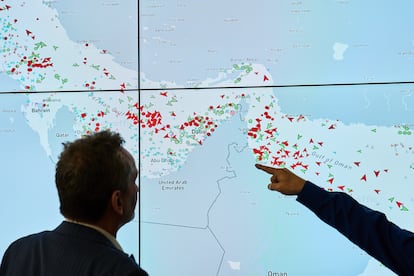
This situation has led to a rise in the use of diversionary maneuvers, according to a report by maritime intelligence firm Windward. International maritime regulations require large and heavyweight ships to keep their transponders switched on at all times. These devices communicate with the Automatic Identification System (AIS) and transmit the vessel’s name, position, route, and other details.
In recent years — especially since Russia’s invasion of Ukraine — maritime operators have increasingly resorted to tactics such as sailing with their AIS transponders switched off, something permitted only in limited risk situations. Ships use this to avoid detection or conceal the ports they call at, leading to the rise of so‑called “ghost fleets” or “dark fleets” that rely on these illicit practices.
Other methods include spoofing, which involves manipulating AIS data such as a vessel’s position, identification number, or navigation history. According to Mueller, this creates “navigational hazards, especially in such congested waterways” and “increases the possibility of collisions.” Furthermore, it increases the risks for the various regulatory layers involved in each maritime shipment (shipowners, vessel owners, freight and vessel insurers, shipping agents, etc.) by “undermining transparency” and “complicating due diligence processes.”
“Zombie ships”
A variant of spoofing is the tactic dubbed the “zombie ship,” in which the identity of another vessel, often decommissioned, is transmitted. This has been detected on several occasions in the Strait of Hormuz. One example is a tanker using the identity Race — a ship dismantled more than a decade ago — which, after slipping through the blockade, is now heading toward India. Its AIS signal claims it loaded cargo in Iraq’s port of Basra, though Lloyd’s List believes the cargo is Iranian, either loaded directly in Iran or via a ship‑to‑ship transfer.
“More sophisticated efforts to hide voyages to Iranian ports have been taking place for years. Shadow fleet tankers often broadcast false AIS positions placing them in non-Iranian ports in the Middle East to hide that they are in fact, loading Iranian cargoes,” the shipping publication states, citing a recent analysis that estimated that “about half” of the declared calls at the Iraqi port of Khor al-Zubair, near the border with Iran, are false and used to mask the cargo of Iranian crude oil or gas.
Mueller argues that these tactics have been observed since the beginning of the conflict, but clarifies that “while they make remote tracking of the ships more difficult,” they “do not prevent their detection by radar or physical interception.” The U.S. deployment includes several reconnaissance aircraft, along with the use of optical radar and devices for intercepting radio signals and even cell phone calls from sailors on board, which can limit the effectiveness of diversionary tactics used by ships attempting to evade the blockade. U.S. Joint Chiefs of Staff Chairman Dan Caine has warned that “ghost ships” and vessels violating international navigation rules in the blockade zone risk being boarded by U.S. forces.
Sign up for our weekly newsletter to get more English-language news coverage from EL PAÍS USA Edition









































