
Iranians fear escalation of the war: ‘Until you see it with your own eyes, you don’t realize how terrifying it is’
Donald Trump’s statements about opening a dialogue provoke diverse reactions among the Iranian population, ranging from fear and hope to uncertainty
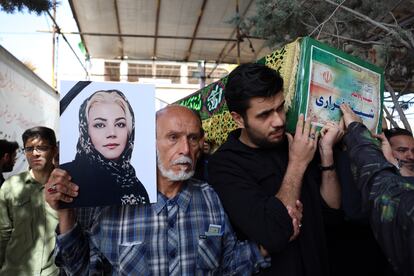

Last Monday, Donald Trump announced negotiations with Iran and, at the same time, suspended the ultimatum with which he had threatened to attack power plants and key infrastructure if the Strait of Hormuz was not reopened. The news generated a mixture of skepticism and caution among analysts and citizens in the Islamic Republic.
Past experiences have led many Iranians to fear an increase in military clashes. Hamid, a nurse and resident of Tehran, commented: “Last time, Trump also said they were negotiating and that the Islamic Republic was seeking an agreement.” He interprets this as meaning that “[the Americans] want to buy time and prepare for more attacks.”
Sasan, an architect and resident of Tehran, questions the conditions set by the United States, such as the dismantling of Iranian nuclear sites and the reopening of the Strait of Hormuz. With irony, he asks, “If they give in, how will they respond to their most radical supporters?” and predicts that “the Islamic regime’s obstinacy in its positions will likely intensify the conflict.”
Seyed Hossein Mousavian, Iran’s former ambassador to Germany and a former nuclear negotiator, shares the public’s pessimism and calls Trump’s statements about possible negotiations “a big deception.” Mousavian also warns of “a massive and decisive operation against Iran in the Persian Gulf region” that, according to the expert, could be carried out “in the coming days.”
Shahin Modarres, an international security analyst based in Rome, said on X that “the United States isn’t risking too much by showing a willingness to engage in a new round of negotiations, whether to stabilize energy markets, create divisions within the Iranian government, or buy time for eventual military action.” Modarres added that, “in Ali Khamenei’s absence, the chances of reaching an agreement have increased,” although he didn’t rule out the remaining obstacles.
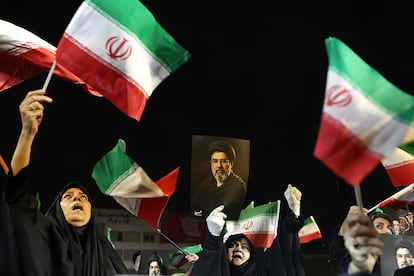
A segment of Iranian society, directly affected by the war, is clamoring above all for an immediate end to the fighting. Nasrin, an architecture student, offers a vivid and moving account of the reality on the ground. Present in Tehran at the start of the attacks, she states: “Until you see it with your own eyes, you don’t realize how terrifying it is.” Although she remains skeptical about negotiations, she emphasizes: “The sooner the war ends, the better.”
The bombing she witnessed was devastating: “My fiancé and I were near Shohada Square, and we almost died. In the blink of an eye, everything collapsed… Ordinary people were thrown into the air, and a car was buried under the rubble,” she recounts. Nasrin, now in Spain after crossing the border from Turkey, says that scene will never be erased from her memory, and she hopes that, “somehow,” the war will end.
Meanwhile, severe information restrictions have added complexity to the situation. Iran’s security and communications apparatus, as in previous episodes, has limited citizens’ free access to news through internet shutdowns and strict control of information flow. Therefore, accounts like Nasrin’s, from March 16, can only now be disseminated, offering just a glimpse of the reality on the ground — a reality that could be revealed more fully once connectivity is completely restored.
Under these conditions, citizens are forced to resort to expensive virtual private networks (VPNs), which in many cases only allow for the sending of text messages, or to clandestine connections to Starlink terminals to communicate with the outside world.
In this climate of uncertainty, Sara, a bank employee in Tehran, refers to Trump’s previous promise that “help is on the way” and observes with disappointment: “Some thought that at least some of these attacks would be aimed at helping the Iranian people, but in the terms of the agreement, there’s nothing about us.” Farid, an accountant in Isfahan, sums up another widespread sentiment: “The ideology of the Islamic regime doesn’t disappear with the signing of any agreement,” he remarks, and emphasizes that “the people must ultimately put an end to the regime.” Sara insists that Trump is making a mistake by projecting a scheme similar to that of Venezuela onto Iran. “Iran is not Venezuela.”
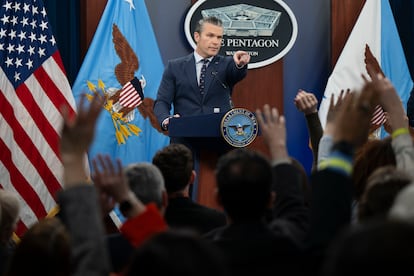
This type of criticism reflects a broader concern: many Iranians, regardless of the veracity of diplomatic exchanges, express deep dissatisfaction with the absence of mechanisms that incorporate popular demands on human rights and the release of political prisoners into any eventual agreement.
On the other hand, activists and citizens like Sheida, a graphic designer living in Andisheh, 20 miles southwest of the capital, fear that a possible agreement would consolidate the status quo. “In recent months, many people [protesters] were killed trying to force regime change,” she recalls, noting that “many are in prison and some even face the death penalty.” “Others have already been executed,” she adds. For Sheida, making a deal with the Islamic regime in the current context would be tantamount to “turning our backs on the people” and would be “unforgivable.” Farid, for his part, fears that any agreement could result in the survival of “a wounded Islamic regime” that “has crossed every red line.”
Sign up for our weekly newsletter to get more English-language news coverage from EL PAÍS USA Edition









































