
US naval blockade strains Iran’s already fragile economy
Iranians are facing a potentially more critical scenario than what was seen under previous cycles of sanctions
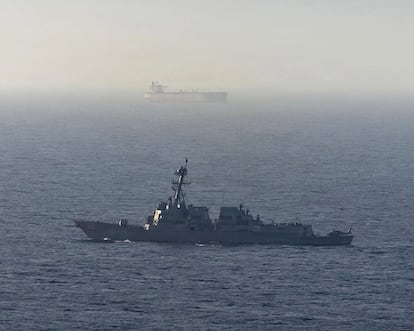

At the outset of the U.S.–Israel war against Iran, Tehran tried to maintain a balance of power through an asymmetric‑warfare strategy. But Iran’s subsequent closure of the Strait of Hormuz fundamentally altered the conflict, pushing it into a new phase. Washington, for its part, cycled through several approaches: unsuccessful attempts to rally international support, failed efforts to reopen the strait by force, fruitless diplomatic talks with Tehran, and even threats to bomb Iran “back to the Stone Age.” Ultimately, the United States shifted to an economic‑pressure strategy, targeting Iran’s maritime trade in an effort to force Tehran to pull back.
More than 10 days into this new phase and the tightening of U.S. economic pressure, Iran’s economy is facing a potentially more severe scenario than in previous rounds of sanctions.
For decades, the impact of U.S. sanctions, compounded by structural corruption and domestic mismanagement, has fallen primarily on ordinary Iranians, especially middle‑ and lower‑income groups whose purchasing power has steadily eroded.
Between 2011 and 2020, Iran’s economy saw an average annual decline of 0.6% in per‑capita GDP — a period the World Bank has described as the country’s “lost decade.” During those years, inflation hovered around 40%, and the rial steadily depreciated, eroding living standards. By 2022, roughly 30% of Iranians were living below the poverty line, according to the Iranian Parliament’s Research Center, while the World Bank estimated that nearly 40% were economically vulnerable.
In recent years, the situation has worsened as the currency has continued to lose value and the country has remained heavily dependent on imports. Last year, the poverty line for a family of four was estimated at around 80 million tomans per month (about $520), while the average salary for a skilled worker was roughly 35 million tomans (about $227). This widening gap has contributed to the steady contraction of Iran’s middle class.
According to Iran’s Statistical Center, “year-on-year food inflation, which was just under 43% a year ago, reached nearly 125% before the blockade.” Sohrab Delanguizan, an economist and university professor, warns that “although the national currency has depreciated, the price increases for imported goods are growing at an even faster rate due to rising logistical costs and risks.”
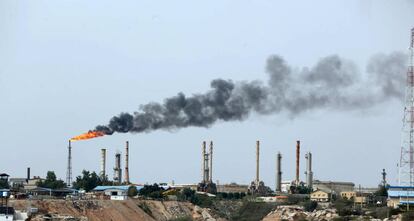
Before these restrictions, Iran exported around 1.6 million barrels of oil per day, more than 90% of it through the Khark Island terminal. A significant portion of these exports reached Asian markets, especially China, via indirect routes, intermediary companies in the United Arab Emirates and Malaysia, and shadow shipping networks, offering discounts and incentives. Ultimately, the foreign currency earned from the sales remained in the hands of fiduciary companies, leading to widespread corruption.
According to data from Iran’s National Petrochemical Company, three major ports, Bandar Abbas (Rajai), Mahshahr (Imam Khomeini) and Asaluyeh, channel about $20 billion annually in exports of gas, petrochemicals and energy derivatives, constituting the core of the country’s non-oil energy foreign trade.
From Dubai, Hamid, a businessman in the petrochemical sector, believes the blockade is having a widespread impact on all sectors of society: “In this economic war, everyone loses, without exception.” He expresses doubts about the effectiveness of strategies to circumvent the blockade: “Changing routes, disabling tracking systems, or limited transit through the Strait of Hormuz.” In his opinion, “many of these practices are more propaganda than operational reality.”
Hamid estimates that before the strait’s closure, “daily exports were around $200 million,” and says that “the supposed revenue from tolls on ships in transit would not exceed, in the best-case scenario, $10 million per day,” given the current limited traffic. What’s more, he explains that “without an agreement, not even a regional one, such a charge would be illegal.”
In contrast, Foad Izadi, an academic at the University of Tehran aligned with the official Iranian position, argued on the platform X: “The Strait of Hormuz is not in ‘international waters’ or on the high seas. The Strait of Hormuz is classified as an ‘international strait’ comprised exclusively of the territorial waters of two countries: Iran and Oman.” He added: “Iran is not a member of the United Nations Convention on the Law of the Sea, just like the United States. According to international law, countries are only bound by treaties they have signed and ratified.”
In response to this new scenario, Iran is reportedly exploring alternative trade routes through Iraq, Turkey, Pakistan, and Turkmenistan. However, experts such as Ata Mohamed Tabriz, a political scientist and international relations analyst in Barcelona, warn that “the viability of these routes will depend both on the cooperation of the countries involved and on the resilience of the Iranian economy in the short term.” According to this expert, “currently, around 90% of the country’s imports depend on southern ports, highlighting a high degree of structural vulnerability in Iranian foreign trade.”
Morteza, an owner of a livestock feed factory in Khuzestan, says: “All our raw materials are imported. Prices have risen sharply in the last year.” Regarding the new situation, he explains: “Since the start of the war, in practice, we have to buy some products like soybeans on the open market, where there is also limited availability and very high prices.” He says that in recent months, “many poultry farmers have been forced to reduce chick incubation and increase slaughter rates.”
U.S. sanctions on Iran are part of Washington’s long‑standing maximum pressure strategy aimed at weakening the country’s power structure. Critics, however, argue that these measures have repeatedly suffered from enforcement gaps that allowed partial evasion.
In this context, a vast informal economy has taken root. Networks close to Iran’s political elite operate through shell companies, regional intermediaries, and a shadow fleet that enables the export of oil and petrochemical products. Analysts say this system has helped create economic oligarchies tied to political power.
Social historian Toraj Atabaki of Leiden University described them in an interview with Deutsche Welle’s Persian service as “ruling families.” “Their power is not as great as that of the Revolutionary Guard, but it is enough to influence key decision-making processes in the country,” he said.
Until the outbreak of the war, these oligarchic networks operated alongside Revolutionary Guard commanders as a parallel power structure. Since the conflict began, senior Guard figures have become more visible at the center of decision‑making, yet this web of wealth and influence remains a key actor operating largely in the shadows. As analyst Mohamed notes, “these oligarchies have become integrated into the state apparatus.”
The new U.S.‑imposed maritime blockade adds a new layer to decades of sanctions: direct pressure on the economic lifeline of these “ruling families,” known in Iranian political debate as “sanctions intermediaries,” due to the disruption of oil and petrochemical flows from Iran’s southern ports.
Sign up for our weekly newsletter to get more English-language news coverage from EL PAÍS USA Edition









































