
From a soldier with insider information to rigged thermometers: The multimillion-dollar scams on Polymarket
The arrest of a US military officer who participated in Maduro’s capture and the investigation in France into the tampering of thermometers at Charles de Gaulle Airport are the latest incidents of misconduct in the prediction market

There are no such things as coincidences. What are the odds that a Polymarket user pockets a hefty profit by betting on the exact moment Nicolás Maduro would cease to be president of Venezuela? And what are the odds that others walk away with more than $35,000 for predicting the temperature in Paris on an ordinary day? These are always‑winning wagers inside the booming prediction market, which is built entirely on binary outcomes — A or B. Fast, easy money.
Last week, the Commodity Futures Trading Commission (CFTC) ordered an arrest connected to the U.S. military operation that captured Venezuelan president Nicolás Maduro. According to a statement released Thursday, soldier Gannon Ken Van Dyke — who took part in the secret mission to detain the Venezuelan leader — earned $400,000 thanks to a bet placed on the Polymarket prediction platform.
The complaint says Van Dyke used sensitive information to buy more than 436,000 “Yes” shares on a market asking whether Maduro would leave power before February 2026. According to the reports published so far, the servicemember made more than $404,000 in profit from those trades.
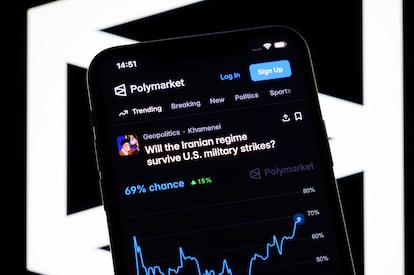
Polymarket has also seen suspicious activity tied to bets on the ouster of Iran’s leader, Ayatollah Ali Khamenei, placed just hours before he was killed in U.S. and Israeli airstrikes. Similar irregular trades appeared in stock‑index futures right before the well‑timed pause in the tariff war launched by U.S. President Donald Trump in 2025.
The CFTC’s authority to pursue insider trading based on government information is relatively new. Normally, that role falls to the Securities and Exchange Commission (SEC). Concerns that futures traders might be profiting from internal government data led lawmakers to include a provision known as the “Eddie Murphy rule” in 2010. The rule outlawed in the commodities market the kind of scheme portrayed in the 1980s film Trading Places, in which the characters played by Murphy and Dan Aykroyd use a leaked government crop report to make millions betting on frozen orange juice futures.
As if the shadow of U.S. government insider information weren’t long enough, Polymarket appears to have become fertile ground for other types of fraud. French authorities are now investigating the manipulation of temperature sensors at Charles de Gaulle Airport. Météo France, the national meteorological agency, filed a complaint after detecting bets on the prediction platform that generated roughly $35,000 in profit. A probe found abnormal temperature spikes at the airport between April 6 and 15 that coincided with wagers placed on Polymarket. It hasn’t been verified, but a video circulating on social media shows a man holding a hair dryer next to one of the sensors.
$4 billion in trades
If coincidences are rare, they are even rarer in politics. The odds that a market operator places a multimillion‑dollar bet just minutes before the president of the United States makes an announcement capable of moving global markets are vanishingly small. And for that to happen two, three, four, even five times in four months… almost impossible. The combined value of those trades: $4.2 billion. Trades that always paid off.
The pattern linking Trump and the prediction markets repeated itself last week. Late Tuesday afternoon, several intermediaries took positions in oil‑price futures, moving $430 million. They stood to gain if crude prices fell. And that is exactly what happened — within 16 minutes. The first batch of contracts was executed at 7:54 p.m. (Spain time), and at 8:10 p.m. Donald Trump posted on his social network, Truth Social, that he had decided to extend the ceasefire with Iran.
Those contracts allowed the prescient traders to lock in sales of oil at nearly $101 a barrel, as the market price dropped to $96.8 after Trump’s message — a 4% return. In a matter of minutes.
Five days earlier, a similar pattern emerged. Twenty minutes before Iran’s foreign minister announced on social media that the Strait of Hormuz would reopen to commercial traffic, traders placed $760 million on a drop in oil prices. Someone in New York seemed to know what Islamabad and Washington had agreed to.
On April 7, even more money moved: $950 million just hours before Trump announced a two‑week ceasefire. And two weeks before that, on March 23, the same pattern repeated. Fifteen minutes before Trump revealed he was postponing planned strikes on Iranian energy infrastructure, anonymous traders wagered $500 million on a fall in oil prices.
At this point, either someone is time‑traveling like Marty McFly with his sports almanac in Back to the Future II, or there are leaks coming out of the White House that are lining a few pockets. Several Democratic members of Congress have called on the government to investigate, and the CFTC has opened a probe into possible insider trading. The agency’s chair says there is zero tolerance for fraud, but so far, the investigation has made little progress.
Stock‑market pattern
The suspicious activity isn’t limited to the oil market. In three of the episodes mentioned, there were also multimillion‑dollar bets that the stock market would rise. In those cases, traders used futures contracts on the S&P 500, the index that tracks the performance of major North American companies. On March 23, excess volume in that market exceeded $1.5 billion. Within hours, Trump’s announcement sent stocks up nearly 4%.
Prominent Democratic lawmakers and other critics argue that this pattern is far too precise to be explained by skill or luck alone.
Last Wednesday, Congressman Ritchie Torres asked the CFTC to expand its investigation to include “suspicious” oil‑futures trades placed before Trump’s announcement extending the ceasefire last week. “This is not an isolated incident,” he wrote. “This pattern of trading activity raises profound concerns.”
So far, no evidence has emerged that White House staff members have profited from insider information. Even so, senior officials recently sent an email to all employees warning them not to use confidential information to trade in the markets.
Sign up for our weekly newsletter to get more English-language news coverage from EL PAÍS USA Edition









































