
Experts call for tighter controls on prediction markets: ‘They pose underappreciated threats to democratic integrity’
A ‘Science’ article warns of the scant regulation governing platforms that allow betting on current events and urges a legal response comparable to the one applied to tobacco companies or social‑media giants
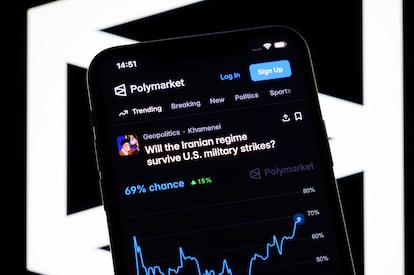

Will there be a peace agreement between Israel and Hezbollah before April 30? Who will win the 2028 U.S. presidential election? Will the price of Bitcoin rise or fall in the next five minutes? These are just some examples of bets available today on Polymarket and Kalshi, two leading prediction sites. In the past, bets have also been placed on the likelihood of a U.S. attack on Iran or whether the fighter pilot shot down in that conflict would be rescued, sparking controversy due to ethical concerns. But there is a deeper concern: some of these markets, and the profits they generate, raise suspicions about the potential for manipulation and the use of classified information.
These platforms, where users can gamble on almost anything, are very popular in the U.S., where they continue to grow. But they shouldn’t be taken lightly, according to an article published on Thursday in the journal Science, which calls for stricter regulation. U.S. federal law prohibits betting on crimes or assassinations — relevant for Kalshi, which is based in the country — but Polymarket operates largely abroad, and anyone can access it through a VPN, which allows users to connect as if they were in another country.
“Prediction markets pose underappreciated threats to democratic integrity, from electoral manipulation to insider trading on classified government action,” the study argues. This is one of the main criticisms made by Nizan Geslevich and Sharon Rabinovitz, legal scholars at the University of Haifa, who authored the study: scientific literature, they argue, has demonstrated that traders’ beliefs determine market probabilities, which in turn determine those beliefs.
On the other hand, “prediction markets create financial incentives to leak or exploit classified information, eroding operational security on which democratic governance depends.” A few days before the U.S. attack on Venezuela, an anonymous user suspiciously placed a bet on Polymarket that the military operation was imminent. They won over $400,000 with the investment made just hours before Trump gave the green light.
How can this market be regulated? In the U.S., former U.S. president Joe Biden attempted to regulate the sector. The Commodity Futures Trading Commission (CFTC) opened an investigation into Polymarket, which resulted in a $1.4 million fine and a ban preventing U.S. citizens from accessing the platform. But once Trump took office, the legal obstacles disappeared. The two major companies in the industry count the president’s son, Donald Trump Jr., as an adviser or strategic consultant.
In the European Union, the Digital Services Act (DSA) applies only to platforms with more than 45 million users — a threshold prediction markets are still far from reaching.
“Policy interventions should address platform design, market transparency, and regulatory architecture,” argue Geslevich and Rabinovitz, who call for the creation of inter-institutional working groups that bring together experts in finance, cybersecurity, and public health to monitor market manipulation and patterns of compulsive use. “Prediction markets stand at a crossroads: Ethically designed, they could enhance decision-making; as currently deployed, they risk behavioral and democratic harms,” they conclude.
Addictive design
But the article also warns of another danger: the public‑health impact of these markets could be severe — potentially even greater than that of conventional betting platforms.
“The lag between tobacco popularization and scientific consensus on its harms enabled millions of preventable deaths. The delay between social media proliferation and recognition of its health consequences may have left generations as unwitting experimental subjects,” the article warns. “We face a similar moment. Many prediction market features are shared with trading, gaming, gambling, social media platforms, and various apps. However, prediction markets sit at a distinctive intersection: They intensify techniques pioneered by those industries, apply them to socially and politically salient content, and wrap them in the epistemic authority of ‘forecasting.’”
According to the experts, betting companies offer a product that, like tobacco, gambling, or social media, can be very harmful to health and society. But they do so with an aura of respectability that can lead potential users to ignore these possible negative consequences.
The authors argue that part of the blame lies with the scientific community itself, where many view this phenomenon as a harmless social experiment. “Scientific silence grants legitimacy to systems exploiting science’s reputation while violating its principles,” the article states.
The growth of these sites has been meteoric. By late 2025, prediction markets were handling around $2 billion in weekly bets. In December alone, Kalshi and Polymarket processed nearly $12 billion worth of contracts, a 400% increase from the previous year, according to the investment bank Piper Sandler. Although these platforms have existed for years, their breakout moment came during the 2024 U.S. presidential election: while polls still showed a tight race between Trump and Harris, prediction markets overwhelmingly priced the Republican candidate as the likely winner. That success put them squarely on the radar.
The growth of these websites has been meteoric. By the end of 2025, prediction markets were handling around $2 billion a week in bets. Kalshi and Polymarket alone, two of the leading operators, saw $12 billion in trading volume in December, a 400% increase over the previous year, according to the investment bank Piper Sandler. Although they have been operating for years, their breakout moment came during the 2024 U.S. presidential election: while polls still showed a tight race between Trump and Kamala Harris, prediction markets overwhelmingly priced the Republican candidate as the likely winner. That success put them on the map.
The Science article identifies three main problems surrounding prediction markets, all of them interconnected: their public‑health impact, their design, which mirrors online gambling platforms, and their potential use as tools for democratic manipulation.
Traditional casinos impose a series of safeguards — age verification, delays in cash withdrawals — to encourage players to remain aware of their behavior. Prediction markets, by contrast, rely on structures such as gamified interfaces, algorithmic targeting, and cryptocurrency integration, which, the authors argue, allow these systems to operate ”as a population-scale harm-delivery mechanism, systematically bypassing safeguards."
The authors also stress that prediction markets disproportionately affect young users and those with limited financial experience, as well as economically marginalized groups “for whom engagement recasts financial stakes as civic engagement or identity expression.” The fact that major outlets such as The Wall Street Journal, CNN, or Reuters incorporate prediction‑market data — and that financial influencers promote it — gives these platforms a social legitimacy that can be appealing and normalizes their use.
Without the stigma associated with being labeled a gambler, it becomes easier to get carried away, even if the consequences are similar. “Participants perceive themselves as analysts or engaged citizens rather than gamblers, a distortion hindering help-seeking even as financial and psychological damage accumulates,” the article explains.
Public health
According to the study, 46.2% of adults and 17.9% of adolescents worldwide have engaged in some form of gambling in the past year. Gambling‑related disorders affect between 2.7% and 15.8% of online gamblers — far higher than rates associated with traditional gambling. Subclinical harms also carry significant economic costs: more than €100 billion ($117 billion) across the European Union, the researchers note. Access to treatment is low (between 4% and 20%), with dropout rates ranging from 39% to 70%.
The World Health Organization classifies gambling disorders as mental‑health conditions and recognizes the specific risks posed by digital platforms. This classification followed decades of research showing that behavioral addictions activate similar neural pathways, produce comparable disruptions, and respond to similar interventions as substance‑use disorders. “Despite similar risk markers, prediction markets remain understudied,” Geslevich and Rabinovitz argue.
“Even if only 2 to 3% of users develop behavioral disorders, widespread dysfunction across millions of occasional users could generate public health costs rivaling gambling’s documented burden,” the article continues. “Prediction markets risk replicating this burden at scale through similar addictive mechanisms while operating outside the regulatory frameworks, public health infrastructure, and social awareness developed over decades for traditional gambling.”
Still, the researchers acknowledge key differences between online casinos and prediction markets: “[The latter] resolve to verifiable real-world events, can reward skill, and often involve episodic use; gambling rates cannot simply be applied.”
Sign up for our weekly newsletter to get more English-language news coverage from EL PAÍS USA Edition









































