
Marvin Dunn, the Miami historian challenging Trump’s presidential library: ‘This is commercial benefit for the family directly’
The author and activist has filed two lawsuits to block the transfer of the land the Republican intends to use for the construction of the 47-story building in south Florida
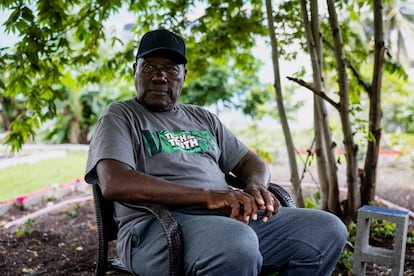

Marvin Dunn moves with surprising agility among the beds of lettuce, cabbage, and potatoes on his community farm in Overtown, a historic Black neighborhood in Miami that was fractured by the construction of the interstate highway in the 1960s. The farm, squeezed between I-95 and the high-rises packed into nearby downtown, is a kind of oasis where the 85-year-old historian — one of the most recognized voices on the history of segregation in Florida — hosts talks, distributes banned books, and is now preparing a new legal battle to stop construction of Donald Trump’s presidential library a little over 1,000 meters away.
“It’s wrong for the president [to do this], any president, not just this one. I’d be just as upset if [former president Barack] Obama did this,” the author, activist and former university professor says in the shade of a tree. “No president should take land that really belongs to the future generations of students in our community. No president should take land from students for personal commercial benefit, and that’s what this is. This is not going to be a library. This is gonna be a commercial benefit, luxury apartments for the benefit of the Trump family directly,” he adds.
Dunn had already tried to stop the project last year, when he sued Miami Dade College (MDC), alleging that the board had transferred the land — owned by the college for years — for the presidential library without sufficient notice or public debate, in violation of Florida’s transparency laws. The MDC board re-held the vote with the required notice and a judge dismissed the lawsuit in December.
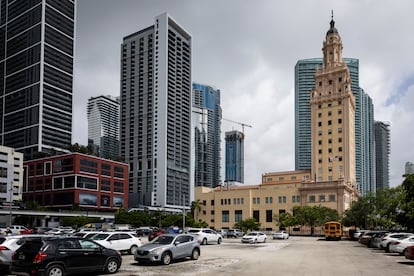
But now Dunn is back with a federal lawsuit filed on behalf of his community organization, Dunn’s Overtown Farm, alongside two downtown residents and a college student. The litigation seeks to block the transfer of the more than 10,000-square-meter parcel next to the iconic Freedom Tower, valued at tens of millions of dollars and transferred by the State of Florida for $10 to Trump’s presidential library.
The plaintiffs argue that the project violates the emoluments clause of the U.S. Constitution, which prohibits a president from receiving financial benefits beyond his official salary.
“Florida’s transfer of valuable land to President Trump flagrantly violates the emoluments clause,” says Gerald Greenberg, the plaintiffs’ attorney. “The president and his family have made clear that, unlike other presidential libraries, they intend to use these lands to make profits.”
Dunn sums it up thus: Governor Ron DeSantis “wants the political credit, and that’s illegal. What’s gonna happen? Texas comes up and says, ‘We’ll give you 10,000 acres of land. What’ll we get?’; another state could say ‘we’ll give you oil rights.’ Where does that all end? It becomes a competition to win the president’s favor based upon what they give the president. The folks who wrote the Constitution anticipated this, to avoid this very problem, and here we are, and this is the first president who’s even tested this [limit].”
For Dunn, the project represents a loss for future generations of Miami students, a city battered by gentrification, a real estate boom, and outmigration. He says he felt “personally hurt” by the project. “I have grandchildren. My grandkids may have wanted to go to Miami Dade College, or may have wanted to be involved in urban agriculture. So my sense was that this is an injury to my own family, the future of my grandkids.”
Project plans released show an ambitious complex with a 47-story tower that would operate as a hotel, luxury condominiums, offices, restaurants, and retail space, as well as areas dedicated to the presidential library. Dunn contends it is a commercial luxury real estate venture disguised as a presidential library, and that the land should serve students and community uses.
“They could build that library at Mar-a-Lago, in West Palm Beach” — where Trump has his residence — “but it wouldn’t produce the millions of dollars it would in downtown Miami,” Dunn says. They could also have considered universities with large available spaces, but in downtown “that’s where the money is,” he adds.
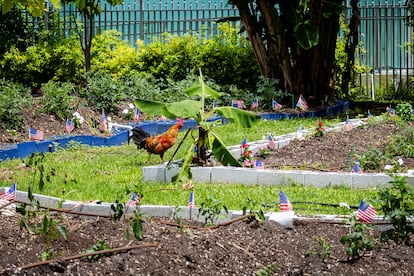
For years, Dunn has worked with students from MDC’s Culinary Institute on urban agriculture programs at the community farm, where they learn to grow food in urban spaces, and he even helped try to develop a community garden on the Wolfson campus — an initiative that ultimately failed for lack of land. The parcel transferred for the presidential library could have been used precisely for similar community projects. “That garden could be on those lands they’re handing over,” he notes.
He also objects to the presidential library foundation “coming back saying, ‘Well, we’ll give Miami Dade College a million dollars, or $3 million.’ Peanuts, chump change for what they’re gonna get out of that building. So at the very least, if they put up luxury apartments on that property, and they have money coming into the Trump Library Foundation for those apartments, Miami Dade College should get some of that money going forward. For as long as they’ve got people paying for those apartments, some of that money should go to Miami Dade College,” he says. But “that means then they got to open up their books, so we get to know who’s investing, who the foreign investors are, where the money’s coming from. I don’t think they’re going to stand for that. I think they’ll move to another site rather than be open to sharing the financial benefits of this venture with Miami Dade College.”
A $10 transaction
MDC had acquired the land in 2004 for more than $24 million, with the goal of expanding its downtown campus. The site currently serves as employee parking. MDC president Madeline Pumariega transferred the deed in January for $10 to a state board overseen by Governor DeSantis, which in turn transferred it the following month for $10 to the Donald J. Trump Presidential Library Foundation.
In a Bendixen & Amandi poll in Miami-Dade, 74% of respondents opposed the transfer of the land.
Dunn also finds it offensive that the project would rise next to the Freedom Tower, a symbol of Cuban exile, in a city now hit by Trump’s anti-immigrant policies. “Isn’t that a paradox? That they would put that thing next to the Freedom Tower?” he asks.
“I think right now the basic view among most white Americans is that this is a white country, and that being a white country is under threat from immigration of these Brown people moving in,” Dunn says. “And the best way to stop it is to limit immigration of people who are Black or Brown. It’s an attempt to keep the United States as a white country, and it’s doomed to fail.”
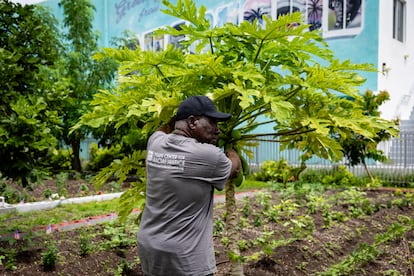
Dunn worked for more than three decades as a psychology professor at Florida International University (FIU), where he chaired the department before retiring in 2006. Born in 1940 in DeLand, central Florida, into a family of farmworkers, Dunn served in the Navy for seven years, is the author of several books on African American history in Florida, and has devoted much of his career to recovering stories of racial violence and segregation that have been left out of official history texts.
His book Black Miami in the Twentieth Century is considered a reference work on the history of Miami’s Black community. In 2020, after George Floyd’s death in Minneapolis, he founded the Miami Center for Racial Justice, an organization focused on preserving historical memory. He has also been one of the most visible figures opposing restrictions on teaching racial history in Florida pushed by Governor DeSantis, which has even led to the banning of certain books.
Dunn distributes those banned books and offers conversations about African American history under a tree on FIU’s southwest Miami campus. In Overtown, he also runs Roots in the City, an urban agriculture project to transform vacant lots into community gardens.
Dunn says that although there is “outrage and many people who believe those lands should never have been given away, there is also a lot of fear.” “There are people who privately tell me they agree with me, but they don’t want to be publicly associated with this lawsuit” for fear of reprisals.
“I have never been more lonely in my life,” he admits. “I have friends in academia that I’ve known for 30 years who will not return a phone call. Not out of any animosity to me. They don’t wanna be associated with anything that brings a shadow to them because of what I’m doing. There are folks who, in my opinion, should be standing up, should be joining this effort publicly, but who say to me privately, ‘We’re with you, but no, I’m not gonna join your lawsuit. Too risky. These folks are thugs, but good luck.’ I’m not trying to sound like a hero or anything, but verbal support only goes so far.”
Sign up for our weekly newsletter to get more English-language news coverage from EL PAÍS USA Edition









































