
US soldier involved in Maduro’s capture charged after winning $400,000 from prediction bets
Military officer Gannon Ken Van Dyke used Polymarket to bet on actions in Venezuela that he helped carry out
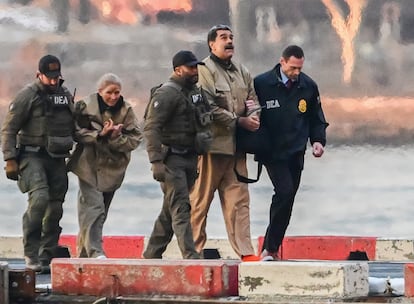

A U.S. soldier was charged on Thursday with using classified information about the capture of Venezuelan president Nicolás Maduro — information he accessed through his official duties — to place bets on prediction markets and earn more than $400,000.
Gannon Ken Van Dyke, 38, was indicted in federal court in Manhattan on charges including wire fraud, commodities fraud, unlawful use of confidential government information, and unlawful monetary transactions, according to the U.S. Department of Justice. If convicted on all counts, he faces a maximum combined sentence of up to 40 years in prison.
According to the indictment, the soldier participated directly in the planning and execution of Operation Absolute Resolve, the military mission that culminated in the arrest of Maduro and his wife, Cilia Flores, in Caracas in the early hours of January 3. Van Dyke had signed confidentiality agreements in which he pledged not to disclose or use in any way classified information related to military operations.
In recent months, Polymarket, a platform for betting on future events, has gained considerable notoriety due to the vast sums of money involved, particularly in predictions about U.S. military actions. The enormous profits made by anonymous users, especially following U.S. military operations in Iran, have raised concerns about insider trading by individuals within the U.S. administration or armed forces.
However, when asked about the Van Dyke case on Thursday, U.S. President Donald Trump — who claimed to know nothing about the controversy — downplayed the trend of betting on prediction markets. “The whole world, unfortunately, has become somewhat of a casino. And you look at what’s going on all over the world, in Europe and every place, they’re doing these betting things,” Trump said from the Oval Office. “I was never much in favor of it. I don’t like it conceptually, but it is what it is.” Two weeks ago, the White House banned its employees from betting on prediction platforms.
But in late December 2025, prediction markets were not yet under scrutiny. That changed when Van Dyke opened a Polymarket account on December 26. Between then and the night of January 26, 2026, he placed 13 bets — all in the same direction: that U.S. forces would be in Venezuela before January 31, that Maduro would be removed or out of power by then, that the United States would invade Venezuela before that date, and that Trump would invoke war powers against the country.
He wagered roughly $33,000 in total. When Trump publicly announced the success of the operation in the early hours of January 3, Polymarket resolved several of those contracts in favor of “yes” bettors, and Van Dyke collected nearly $410,000.
Van Dyke’s actions after the operation appear to be the clearest indication that he knew he had acted illegally. On January 3, he transferred most of his profits to an overseas cryptocurrency wallet and opened a new online brokerage account to move the funds.
A few days later, as reports began circulating about unusual betting patterns in markets tied to Venezuela and Maduro, he tried to erase his digital footprint. On January 6, he asked Polymarket to delete his account, falsely claiming he had lost access to the associated email. That same day, he changed the email linked to his crypto platform account to an address he had created on December 14 under a different name. These steps were not enough, however, and investigators were able to identify him.
“Widespread access to prediction markets is a relatively new phenomenon, but federal laws protecting national security information fully apply,” said Acting Attorney General Todd Blanche when announcing the charges.
Blanche’s statement points to a regulatory gap this case may help define: what happens when classified information is not leaked to a journalist or sold to a foreign power — the scenarios nondisclosure agreements are designed to prevent — but instead used for personal enrichment on a legally operated betting platform.
Polymarket, based in New York and operating primarily with cryptocurrencies, has become one of the world’s most closely watched prediction markets in recent years. During the 2024 U.S. presidential election, it drew global media attention for its relatively accurate forecasts. Its reputation as a neutral barometer of probabilities, however, has been shaken in recent months by opaque bets tied to military operations.
Sign up for our weekly newsletter to get more English-language news coverage from EL PAÍS USA Edition









































