
Why is Trump propping up Milei while neglecting the needs of Americans?
The Republican is dismantling government programs that working families in the United States depend on. Abroad, he is shoring up an administration aligned with his policies
In January, Donald Trump opened his inaugural address by promising to “put America first” daily and usher in a new golden age for American families. Ten months in, Americans are still waiting for the golden age to arrive and reeling from Trump administration policies that have actively made their lives worse.
His administration’s signature legislation delivers the largest Medicaid cuts in U.S. history, threatening to strip coverage from 15 million people while taking food assistance from children, seniors, and people with disabilities. His erratic trade policy has worsened the cost-of-living crisis, amounting to an average $1,300 tax increase per household this year. And as the Republican shutdown drags on, essential services are halted and paychecks paused for hundreds of thousands of federal workers, and the administration plans to cut off food aid funding on November 1.
Now, with government operations paralyzed and Americans’ pocketbooks reeling, the White House has made the extraordinary decision to move forward with a $20 billion bailout for Argentina (plus an additional $20 billion in private loans). Republicans and Democrats alike are asking what, exactly, is “America First” about sending billions of U.S. dollars abroad while Americans are suffering at home. The irony is especially sharp for U.S. farmers, who have been shut out of China’s soybean market because of Trump’s trade war — just as Argentina moves in to fill that gap. While Washington props up Buenos Aires, small-farm bankruptcies here have climbed to a five-year high.
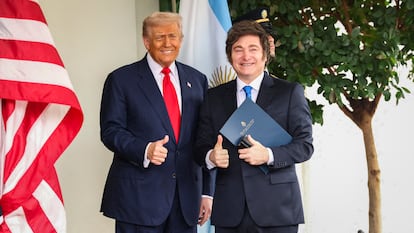
During a White House meeting with Argentine President Javier Milei last week, President Trump provided the answer. Asked how the bailout would help the U.S., he replied, “Just helping a great philosophy take over a great country.” Even Trump knows this deal has nothing to do with helping Americans and everything to do with propping up a political ally.
Treasury Secretary Scott Bessent has called Argentina a “systemically important ally,” but its real importance to this administration is political rather than economic.
President Milei has styled himself as an ideological cousin of Trump and Elon Musk, though his campaign of extreme austerity came first. At the Conservative Political Action Conference (CPAC) in Washington, D.C., this February, Milei presented Musk with a chainsaw to highlight the links between Musk’s Department of Government Efficiency, or DOGE, and Milei’s austerity campaign in Argentina. Like DOGE, Milei’s program was billed as a war on waste, but in practice, it became a showy slashing spree that gutted public services while doing little to fix Argentina’s deeper economic problems.
In the days leading up to Argentina’s midterm elections on Sunday, Trump made it clear that he tied the fate of his own political movement to Milei’s survival in power, even warning that the United States would not “waste our time” with Argentina if the ruling coalition failed. With Milei now strengthened after the vote, the administration appears even more emboldened to deepen its support.
That motivation behind the bailout should alarm every taxpayer. Using U.S. funds to influence a foreign election is a glaring misuse of public money. This is all the more troubling given that the administration has imposed deep cuts to foreign aid programs that sustain life-saving initiatives in struggling countries. Before the cuts led by DOGE, the global budget of USAID — the U.S. government’s international development agency — stood at about $35 billion, slightly more than what is now being allocated to Argentina alone. Those USAID cuts are estimated to have already caused hundreds of thousands of preventable deaths worldwide.
Even the structure of the bailout raises red flags. The Treasury Department is utilizing the Exchange Stabilization Fund, or ESF, to extend a massive line of credit without any conditionality or immediate congressional oversight. Such intervention is almost without precedent. Historically, deployment of the ESF — such as for Mexico in 1995 and Asian economies in 1997 — came with clear repayment terms and transparency requirements to protect American taxpayers. The Trump administration has disclosed no such safeguards here.
This is important, as Argentina’s capacity to repay the loan is highly uncertain. The Milei government has been burning through billions in reserves to prop up an overvalued exchange rate — a strategy that cannot last, no matter how much it borrows from the United States or other institutions. The Treasury Department owes the public an explanation of what safeguards or repayment terms exist to protect U.S. taxpayers from loss.
That’s why, last week, I led 35 of my colleagues in drafting a letter to Secretary Bessent demanding transparency about this deal. We expressed concern over the legality and political motivations behind the bailout and urged the Treasury Department to halt any disbursements until Congress and the public receive real answers. Americans deserve to know why their tax dollars are being used to prop up a foreign government while they struggle at home.
So far, the Treasury Department has provided very little information. In response to a letter from Senator Elizabeth Warren seeking oversight of the bailout, Secretary Bessent failed to offer key details and merely insisted that taxpayers would be protected. It was an evasive and, frankly, insulting reply to legitimate questions about a massive commitment of public funds. After the midterm elections, Trump even suggested sending additional support to Argentina if needed.
At the same time, Trump claimed that the United States had “made a lot of money” as a result of the vote in Argentina — a comment that raises serious questions about who is really benefiting. Reports show that major U.S. investment firms such as Fidelity, Pimco, and Discovery Capital Management could profit directly from the intervention due to their exposure to Argentine bonds. This only heightens concerns that the bailout is serving Wall Street’s interests rather than those of the American public.
Trump’s promise to put America first has become a hollow slogan. At home, he’s dismantling the government programs that working families rely on. Abroad, he’s using taxpayer dollars on a risky bailout of a foreign government that shares his politics. If this is his idea of America first, Americans deserve far better.
Sign up for our weekly newsletter to get more English-language news coverage from EL PAÍS USA Edition









































