
Milei wins Argentina’s midterm elections with more than 40% of the vote
The far right bounced back from its defeat two months ago in Buenos Aires against Peronism and scored solid results in major provinces such as Córdoba, Mendoza, Santa Fe, and Entre Ríos


Javier Milei won Argentina’s legislative elections on Sunday with 40.8% of the votes. It was an unexpectedly large victory, which the far-right leader hailed as historic. Milei had plenty of reasons to celebrate. After four months of turmoil for the Argentine government — with the economy dependent on a financial bailout from U.S. President Donald Trump, high-profile corruption scandals, and even candidates disqualified for links to drug trafficking — it had feared winning closer to 30% than 40% of the vote.
Milei even celebrated a narrow victory in Buenos Aires province, where just two months ago, in the provincial legislative elections, he had lost to Peronism — the dominant political movement in Argentina founded by former president Juan Domingo Perón that blends nationalism, social justice, and strong state involvement in the economy — by more than 14 points. The far-right also won decisively in the capital and in large provinces such as Córdoba, Mendoza, Entre Ríos, and Santa Fe.
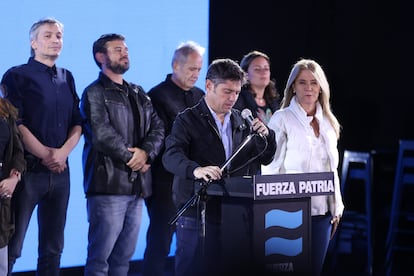
“Today the people decided to leave behind 100 years of decline; today the construction of a great Argentina begins,” Milei said in his first victory speech.
The president thanked his ministers one by one, including those who had already resigned, such as Foreign Minister Gerardo Werthein and Justice Minister Mariano Cuneo Libarona, and then called for unity with the opposition.
“As of December 10, we will have 101 deputies instead of 37,” said Milei. “And in the Senate, we will go from six senators to 20. As of December 10, we will have the most reformist Congress in Argentine history. We are pleased to know that in many provinces, the second-largest force is not Kirchnerism [a left-wing branch of Peronism inspired by former presidents Néstor and Cristina Kirchner that emphasizes social welfare programs and state intervention], but rather the provincial ruling parties, rational forces that know that one plus one equals two. That is why we invited the governors to discuss these agreements.”
Milei took the stage wearing a suit and tie, not his usual black leather jacket — “dressed like a president,” as he often says — and his tone was calm.
The Buenos Aires result explains much of the far-right’s triumph. It is the largest district in the country, with nearly 40% of the national electorate, and overturning the previous defeat to Peronism had not been within even the government’s most optimistic forecasts. La Libertad Avanza (Freedom Advances) hadn’t even been able to include a photo of its candidate, Diego Santilli, on the ballot in that district because Milei’s original choice, José Luis Espert, resigned amid alleged corruption without enough time to reprint them.
The government built its campaign around fear of a return of Peronism in its Kirchnerist form. Donald Trump helped fuel that strategy: two weeks ago, he said that the $40 billion he offered to Milei — $20 billion in a currency-swap arrangement and the rest as private credit — depended on a far-right victory. He later toned down his comments, but the mere suggestion caused Argentine bonds to collapse and the peso to depreciate. If the goal was to instill fear among voters, it worked remarkably well.
Peronism in all its forms unexpectedly lost in 18 of Argentina’s 24 provinces, taking 31.7% of the vote, a figure that could rise slightly when smaller allied groups are counted. The result will allow the movement to retain its 99 seats in the lower house come December, but it risks losing its status as the largest minority if La Libertad Avanza adds its 80 deputies to the 24 from Pro, the party of former president Mauricio Macri (2015–2019). In the Senate, Peronism fared worse: it will hold 28 seats, down from 34, while La Libertad Avanza will grow from six to 18 senators.
The big losers were the six governors who unsuccessfully tried to create an alternative to both the far-right and Peronism under the banner of a new coalition called United Provinces. Their goal was to act as power brokers in a polarized Congress, but the eight deputies they won will not be enough. Judging by the results, the votes they sought appear to have gone to the far right.
A war between good and evil
Milei’s strategy of framing the election as a battle between good, represented by himself, and evil, meaning Kirchnerism, proved successful. According to political scientist Juan Negri of Torcuato Di Tella University, polarization led “a large part of the population to prefer voting for Milei over the return of Peronism.”
“Peronism, moreover, doesn’t convey the image of an opposition with a forward-looking plan — it just insists that everything Milei does is wrong. His success in the September elections in Buenos Aires Province seems to have mobilized many anti-Peronist voters,” Negri said.
According to the final count, voter turnout rose by nine points compared to the provincial election in Buenos Aires.
Despite the victory, Milei will now have to go into “recalculating” mode. He does not have a congressional majority and will need to build new internal alliances.
“Milei’s main challenge is to quickly restructure his Cabinet and show that he can build political bridges to ensure governability in the last two years of his term, which will undoubtedly be the most difficult,” says Patricio Giusto, director of the consulting firm Diagnóstico Político. “Secondly, he must stop delaying the redesign of the economic program, which is currently being propped up artificially by an emergency bailout from the U.S. Treasury.”
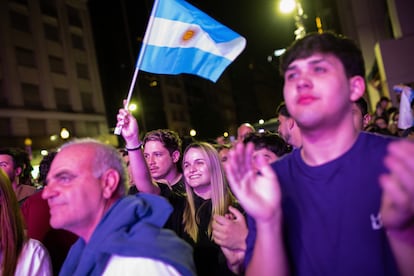
Milei had framed election day as a fight for political survival, an all-or-nothing gamble unusual for a midterm election that typically serves only as a barometer of public sentiment toward the government of the day. But this is no ordinary political cycle for Argentina. Milei came to power two years ago with barely any representation in Congress, without a single provincial governor of his own, and with a team lacking both technical capacity and political experience. He hoped, therefore, that the ballot box would grant him some breathing room in his daily struggle to govern.
And he achieved that — despite the storms. Since June, corruption allegations have dogged his sister, Karina Milei, and he even had to sacrifice his main congressional candidate in Buenos Aires over links to a businessman imprisoned for drug trafficking. The economy began to falter in step with the scandals. With no international reserves, investors fled Argentine bonds and the peso collapsed. Combined with the economic paralysis brought on by austerity measures, public sentiment shifted sharply. Milei then clung to Donald Trump’s promises of help. And in September, his party was defeated in Buenos Aires. The series of calamities could hardly have been worse.
Now, the government can claim to be back on its feet. A restrained Milei has called for building alliances with what he called the “rational” opposition — a move explicitly requested by the International Monetary Fund (IMF), which in April granted Argentina yet another $20 billion loan. It is also a condition coming directly from Washington. For the United States, Argentina is now viewed as an unconditional ally in the region. “I would rather extend a swap line than be shooting at the boats carrying drugs […] coming out of Venezuela,” said Scott Bessent on Sunday.
Attention has also turned to former president Mauricio Macri (2015–2019), a key far-right ally who had distanced himself after tensions with the presidency. Macri voted on Sunday around noon and reminded reporters that Milei “has my phone number” and can call him anytime after Monday. “I’m available to discuss how to ensure governability and contribute to change, but we haven’t talked about ministers. If Milei needs something, he’ll call,” he said at the polling station. Macri’s reference to possible cabinet changes was no coincidence: three current ministers must leave their posts in December to take up seats in Congress.
The rivalry between Milei’s top adviser, Santiago Caputo, and his sister Karina Milei is another burden weighing on his libertarian administration. So far, Milei has kept the dispute — between his chief strategist and the woman who is not only his most powerful official but also his emotional anchor — swept under the rug. But as of Monday, he will no longer be able to postpone addressing it. Each represents competing factions within the government, which at times has been paralyzed by ministers and secretaries fearful of being casualties in the infighting.
In any case, Milei will not be the same after this Monday.

Sign up for our weekly newsletter to get more English-language news coverage from EL PAÍS USA Edition









































