
Nasry Asfura, conservative backed by Trump, takes lead in Honduras election according to early results
With votes from about 43% of polling places counted early Monday, the National Party presidential candidate had 40.54% support in an election marked by distrust and polarization
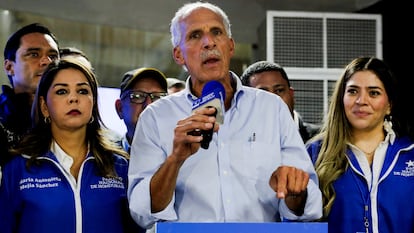

The preliminary vote count in Honduras following the presidential election held on Sunday shows a return of the political right to power in the Central American country. Conservative candidate Nasry Asfura of the National Party (PN), who received the endorsement of U.S. President Donald Trump ahead of the vote, is leading the count with 40.54% of votes and about 43% of polling places counted, according to preliminary results released by the National Electoral Council (CNE).
Second place goes to Salvador Nasralla, of the Liberal Party, with about 38.99% of votes so far, and third place to Rixi Moncada of the governing Libre party with 19.49% of the votes, marking a sharp decline for the democratic socialist movement founded by former president Manuel Zelaya.
Mistrust in the vote count marked the final stretch of Sunday’s general election. The CNE was slow to release preliminary results, despite promising a count three hours after the polls closed at 6 p.m. local time. The three main candidates all expressed their dissatisfaction with the delay, and demanded a response from the electoral authorities. “Let’s not keep the country waiting, on tenterhooks,” demanded Asfura. Nasralla, with his characteristic religious tone, wrote on his X account: “May God protect the will of the people, free us from all attempts at fraud, and keep us steadfast until the last moment.”
After the polling stations closed, tensions flared among the three main parties, which published exit poll results throughout the election day declaring their own candidates the winners. Moncada stated on her social media accounts that “the reports from across the country are excellent. We are winning the election.” Her closest rival, Nasralla, declared victory and claimed he would win with 50% of the votes. “I’m going to be president. Practically everyone here votes for me,” he said.
The CNE will have the final word when it announces the results of the vote count in an election where more than 6.5 million Hondurans were called to vote. Voters were choosing between continuity, represented by the candidate from Libre, and a shift to the right led by both Nasralla and Asfura.
In the days leading up to the election, Asfura received the endorsement of U.S. President Donald Trump, who has also promised to pardon former Honduran president Juan Orlando Hernández, sentenced to 45 years in prison in the U.S. for his ties to drug trafficking. Argentine President Javier Milei has also endorsed Asfura.
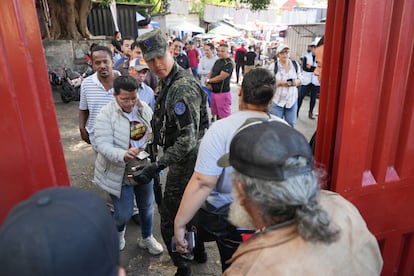
The day unfolded without any major incidents, but in an atmosphere of extreme polarization due to the omnipresent military presence. Honduras remains under a state of emergency, a controversial measure taken by President Xiomara Castro to combat the violence plaguing the Central American country. Castro also assigned the military a function not legally mandated: ensuring the safekeeping of the election ballots.
General Roosevelt Hernández, Chief of the Joint Staff of the Honduran Armed Forces, stated on Friday that he will only recognize the new presidential authorities once the National Electoral Council publishes the official results after counting all the ballots. The military will disregard the data produced by the preliminary results system, known as TREP, which has been heavily criticized by the governing party.
The polling stations opened at seven in the morning, and early on, the three candidates arrived at their assigned voting centers, calling for active voter participation. Voters are also electing the 128 members of parliament and the authorities of the country’s 298 municipalities. President Xiomara Castro voted at noon alongside her husband, former President Manuel Zelaya. “We have already begun a process of rebuilding the country, and that is what is important,” Castro told the press after casting her vote. “These elections are so important for our democracy. What the people deserve is peace and tranquility, to go to the polls freely, and to be able to exercise their right to vote,” the president added.
During the morning, there was a massive turnout at polling stations visited by this newspaper in Tegucigalpa. Jair Rico, 22, worked as a custodian for the ruling Libre party at this polling station, responsible for ensuring the proper delivery of the ballot boxes and that everything proceeded smoothly, including the vote count. “At the beginning, we had some minor interruptions with the biometric system, since the National Electoral Council’s system was a bit slow because data was being entered from all over the place, but it was resolved,” Rico said, referring to the devices that capture the fingerprints of registered voters. “The turnout has been steady; more people are coming in the morning,” he remarked.
Nicolás Carrasco was one of those voters. He and his wife went to the polling station, relieved that the morning was elapsing calmly after a highly polarized election campaign and constant attacks between the presidential candidates. “Instead of focusing on proposals, the candidates insulted each other, aired all their dirty laundry,” he said. Carrasco went to the polls with one worry on his mind: the rampant corruption that plagues his country. “The people wanted the CICIH to be established; it was one of our priorities because there is so much corruption, everything is tainted,” he stated, referring to the international anti-corruption commission, which is moving at a snail’s pace. It was a promise that President Castro left unfulfilled. “I want to be very clear with the media. We did everything in my power to bring the CICIH to our country,” she said on Sunday.
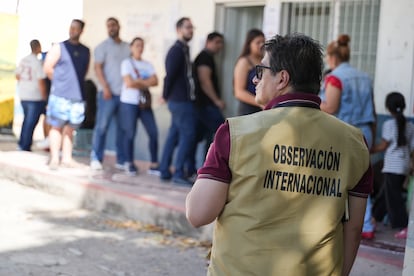
International observers have highlighted the peaceful nature of the vote. The Organization of American States (OAS) Observation Mission deployed 101 observers across the country’s 18 departments to provide comprehensive coverage of election day, reporting no serious incidents. Meanwhile, the head of the European Union Electoral Observation Mission (EOM-EU), Francisco Assis, described the election as a “civic celebration.” The Network for the Defense of Democracy, a Honduran organization, documented 4,427 incidents, including some ballot boxes that were not set up and damaged or incomplete electoral materials. They also reported problems with the biometric system. Representatives of the Network denounced that in some polling stations, military personnel demanded credentials from observers, which is not within their authority.
Honduras voted under the state of emergency that President Castro has imposed as an extreme measure to combat the violence plaguing the country, where gangs and drug trafficking networks exert widespread control. Human rights organizations and local observers had asked the government to relax the state of emergency, fearing that the presence of soldiers at polling stations would discourage voters. At the Peru School in Tegucigalpa, Luis Fuentes, an election observer with the Network for the Defense of Democracy, reprimanded the soldiers at a checkpoint set up at the entrance of the polling center for preventing voters from entering. “I have observed five presidential elections, and there has never been a military checkpoint to enter a school. The classrooms where the voting takes place are empty, but people are outside, in the sun, because the soldiers have positioned themselves there. I don’t think that’s right; it’s counterproductive,” Fuentes said. The soldiers eventually allowed voters to enter, but the observer said their presence intimidates voters. “So much has been said in these elections that we have to be careful, use gloves to handle them cleanly, so that there are no misunderstandings, and the presence of the military generates this type of problem,” he explained.
Sign up for our weekly newsletter to get more English-language news coverage from EL PAÍS USA Edition









































