
Honduras’ Xiomara Castro begins power transition to Nasry Asfura after election standoff
The president describes the conservative politician’s government — who won with the backing of Donald Trump — as a ‘de facto’ administration resulting from ‘monstrous electoral fraud’
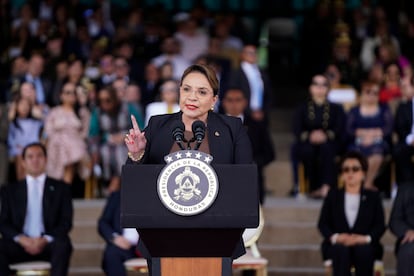

Honduran President Xiomara Castro has reluctantly ordered the start of the transition of power in Honduras to conservative politician Nasry Asfura, declared the winner of last November’s presidential elections after a long and chaotic vote recount process that plunged the Central American country into uncertainty.
“I order that the transition and transfer of power be organized to the de facto government declared by the National Electoral Council [CNE] and the Electoral Court, which failed to count more than a million votes at all three levels of the electoral process,” said Castro, who claimed that Asfura’s victory stems from “a monstrous electoral fraud.”
The decision comes after weeks of political chaos in Honduras, where the ruling party has refused to recognize Asfura’s victory. He won the elections with the backing of U.S. President Donald Trump. The Liberty and Refoundation Party (Libre), founded by Castro’s husband, former president Manuel Zelaya, has denounced massive fraud in the presidential vote and has demanded a new vote count, claiming that electoral authorities manipulated the ballots. Libre’s leadership has described the situation as an “electoral coup,” a characterization echoed by other branches of the state. The National Congress approved a legislative decree ordering the National Electoral Council to count the votes and tally sheets from the November 30 elections. The measure was passed with the participation of only 69 pro-government lawmakers and their allies.
Castro supported the initiative and argued that electoral authorities had “unjustifiably” refused to scrutinize 4,774 tally sheets, “representing the votes of 1,558,689 citizens.” “This omission usurps popular sovereignty by disregarding, without legal cause, the votes of Hondurans who went to the polls, and constitutes a serious violation of the Constitution of the Republic, which I am obligated to uphold and defend,” said Castro.
She also recalled on the social network X that Trump’s statements in favor of Asfura “negatively influenced the development of the democratic process and affected our candidate,” referring to Rixi Moncada, who received just 19% of the vote.
Castro has been forced to shift her stance at a tense moment in Latin America, as Washington has launched a policy of intervention in the region. On January 3, the United States carried out an attack against Venezuela and captured president Nicolás Maduro and his wife, Cilia Flores, generating fear among Central American governments that have taken positions opposed to the White House, such as Honduras and the regime of Daniel Ortega in Nicaragua. On Thursday, the Honduran president toned down the ruling party’s confrontational rhetoric and said, “I reiterate that I will not remain [in the presidency] one day longer or one day less.”
The president announced the start of the transition during a ceremony marking the 144th anniversary of the founding of the Honduran National Police, which she also used as a kind of farewell to the term she assumed on January 27, 2022, when she took office from former president Juan Orlando Hernández. Hernández was sentenced in the United States to 45 years in prison for his links to drug trafficking and was later pardoned by Trump.
“I declare that my love for Central America dies with me,” said Castro. “I wish success to the youth, who are called upon to give life to this country, which I leave with regret for being left in anarchy by the two-party system, and I hope they will emulate my example of acting firmly and never remaining silent against the monstrous electoral fraud that they have unfortunately imposed today,” added Castro in a final effort to discredit Asfura’s administration.
Sign up for our weekly newsletter to get more English-language news coverage from EL PAÍS USA Edition









































