The Mexican prosecutor who let CIA agents into Chihuahua fled in May and remains at large
The investigation into the operation that triggered one of Mexico’s biggest political crises identifies Arturo Zuany as the key facilitator of the El Pinal raid
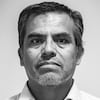
The scandal over alleged U.S. interference in security operations in the Mexican state of Chihuahua has taken another turn. It was not two but four CIA agents who took part in an April anti-drug operation in the community of El Pinal, in the municipality of Morelos, Chihuahua.
Authorities have maintained that the CIA agents played no direct role in the dismantling of the drug laboratory targeted in the operation. But nor were they strangers to staff at the Chihuahua Attorney General’s Office then headed by César Jáuregui Moreno. In the preceding months, they had taken part in activities ranging from training and instruction to operational planning.
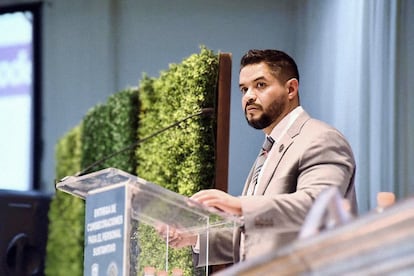
Much of that involvement stemmed from their close relationship with Guillermo Arturo Zuany Portillo, then the state’s special prosecutor for strategic operations, who is said to have given them broad access to the institution. The former official has been missing since mid-May, when he resigned and emptied his office. He is now wanted on charges of unlawful exercise of public office and making false statements to authorities. Zuany, a central figure in understanding the extent of alleged U.S. involvement in Chihuahua’s security apparatus, remains a fugitive.
Details of Zuany’s actions before and after the El Pinal operation are laid out in the investigative file that led to the arrest of César Jáuregui. Jáuregui faces the same charges at the state level and, in addition, a charge of treason brought by Mexico’s Attorney General’s Office.
Sources familiar with the investigation have shared portions of the case file with EL PAÍS. The documents identify Zuany as the key facilitator of CIA involvement in operations conducted by Chihuahua’s Attorney General’s Office, at least six months before the operation that ended in tragedy, leaving two CIA agents and two Chihuahua officials dead, and triggering one of the most serious political crises of the administration of Mexican President Claudia Sheinbaum.
Zuany took office on September 5, 2025, when Chihuahua Governor María Eugenia Campos promoted him from the State Investigative Agency to the Specialized Prosecutor’s Office for Strategic Operations. Both institutions were under the authority of César Jáuregui, who at the time was the head of Chihuahua’s Attorney General’s Office.
Announcing the appointment, Chihuahua’s Attorney General’s Office highlighted his credentials: “Zuany Portillo is a person with an extensive career, particularly in matters related to the investigation of kidnapping and extortion, since he began his career as an investigator in the Anti-Kidnapping Group that eradicated this crime in the state of Chihuahua.”
Just 90 days after taking up the post, however, Zuany became embroiled in controversy when the United States revoked his visa. The move prompted Governor Campos to remove him from office. Two months later, Zuany recovered his visa and was reinstated as head of the specialized prosecutor’s office.
The reshuffle within Jáuregui’s team also brought a new director to the State Investigative Agency: Pedro Ramón Oseguera Cervantes. Months later, Oseguera was killed alongside two CIA agents in the road accident that occurred as they were returning from the operation in El Pinal.

The special investigative unit created by Campos on April 25 to look into the incident spent five months collecting documents, videos, photographs and testimony from 45 officials.
According to the case file, the four CIA agents regularly entered and left Chihuahua, sometimes as tourists and at other times as “embassy personnel,” the term used by Ronald Johnson, the U.S. ambassador to Mexico, when he publicly mourned their deaths in a social media post on April 19.
Investigators gathered documentary evidence showing the agents’ presence from as early as January at the Chihuahua State Attorney General’s Office complex in downtown Chihuahua City. The file also contains images recorded on April 17, when the CIA agents departed for the operation in El Pinal, a community in the municipality of Morelos, more than a 10-hour drive away.
They were wearing tactical gear, not bearing CIA insignia but the uniforms of state security forces. They were armed and carrying equipment cases, as one of them was a drone operator. In one of the videos, according to sources familiar with the investigation, Zuany can be seen arguing with Jáuregui inside the Chihuahua Attorney General’s Office. Neither man took part in the operation in El Pinal, but Pedro Oseguera, the head of the State Investigative Agency, did. He left in a vehicle with two CIA agents, while the other two traveled in escort vehicles.
According to the investigation, the operation took place between Friday, April 17, and Saturday, April 18. The Chihuahua Attorney General’s Office described it as a joint effort involving its Specialized Prosecutor’s Office for Strategic Operations, the State Investigative Agency and personnel from Mexico’s Defense Ministry. Military authorities were reportedly notified only after state agents had reached the area and were asked to provide perimeter security.
In a statement issued on April 19, the Chihuahua Attorney General’s Office said that agents operating in the municipality of Morelos had discovered two “camps” housing six clandestine laboratories used to manufacture synthetic drugs. “It is one of the largest ever found in the country,” Jáuregui boasted during a press conference. He acknowledged that the site was not formally secured until federal authorities were notified and Mexico’s Attorney General’s Office (FGR) took over the case.
Jáuregui made no mention of the presence of CIA agents, or of personnel linked to the U.S. Embassy, during the operation. And despite what authorities described as a major blow against organized crime, the agents encountered no resistance on arrival. The site appeared largely abandoned. They entered, secured the laboratories, alerted federal forces and then left the area under the protection of the Mexican Army.
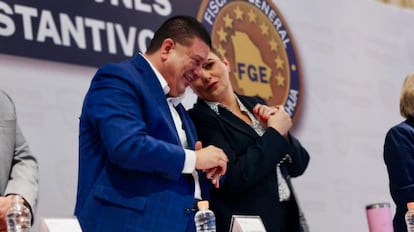
It was on the return trip to Chihuahua that the vehicle carrying the head of the State Investigative Agency and two CIA agents plunged off the road in an area known as Polanco, in the municipality of Batopilas, which borders Morelos.
The vehicle fell about 200 meters down a ravine and, because it was carrying gasoline containers for refueling in the remote mountain region, exploded on impact. One of the bodies was burned beyond recognition. The crash killed CIA agents Richard Leiter Johnston III, 35, and John Dudley Black, 43.
According to the investigation, the other two CIA agents and the personnel traveling in a second vehicle climbed down into the ravine to recover the bodies, which were later flown to Chihuahua City. Zuany allegedly ordered the recovery of the deceased U.S. agents’ personal belongings from the crash site.
Mexican President Claudia Sheinbaum then confronted Chihuahua’s governor, Maru Campos, from the National Action Party (PAN), over the involvement of CIA agents in an anti-drug operation and the fact that it had been carried out without informing Mexico’s federal Security Cabinet.
The incident quickly spiraled into a political crisis between the federal government and the state of Chihuahua, and between the ruling Morena party and the opposition PAN. Accusations of treason flew from one side, while allegations of collusion with organized crime came from the other.
Campos met with Security Secretary Omar García Harfuch and, on April 25, established a special investigative unit to examine the events. Two days later, Jáuregui resigned as state attorney general, acknowledging responsibility for failing to disclose the presence of foreign personnel in the operation.
Zuany remained in office for another two weeks. His resignation was announced on May 13, by which point the investigations were underway and the political dispute had escalated nationwide, with calls for Campos’s impeachment and protests by Morena supporters in Chihuahua.
Since then, his whereabouts have been unknown. Local media reports have placed him in the United States. It was not until October 16, five months later, that Judge Luis Alberto Simental issued an arrest warrant for him, as well as for his former superior, César Jáuregui Moreno.
According to sources familiar with the investigation, however, Zuany has not yet been charged by the FGR with treason, the offense for which Jáuregui is already being held in pretrial detention at the maximum-security Altiplano prison. The two key figures behind the El Pinal operation have effectively vanished from the picture: Pedro Ramón Oseguera is dead, and Arturo Zuany is a fugitive.
Sign up for our weekly newsletter to get more English-language news coverage from EL PAÍS USA Edition