Geoffrey Hinton, the godfather of AI: ‘I’m not a doomer. I think there’s a 1% chance it will destroy us’
The winner of the Nobel Prize in Physics warns of Silicon Valley’s fascist drift and says that if Trump wins the midterm elections, it will be the end of American democracy
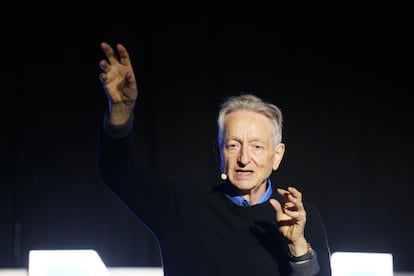

Years ago, when people asked Geoffrey Hinton why he worked on artificial intelligence, he would repeat a line from J. Robert Oppenheimer, one of the creators of the atomic bomb: “When you see something that is technically sweet, you go ahead and do it.”
Hinton no longer says that. Instead, he now devotes his time to warning about the dangers of continuing the very race he helped set in motion. He admits that, to some extent, he regrets the work to which he dedicated his life. His transformation from the godfather of AI into a prophet of catastrophe marked a turning point for the industry. It happened in 2023, when he stepped down from his position as vice president at Google amid dire warnings. At the time, some viewed his reaction as exaggerated. Three years later, many have followed his lead.
Hinton, a 78-year-old British expatriate, is a computer scientist and cognitive psychologist. His driving ambition was to understand how the human brain works in order to replicate those mechanisms in computers. In 1972, he coined the concept of the neural network. The idea was to create a mathematical system that could learn from examples, gaining experience much like human neural networks do. At the time, few researchers believed in the idea. Nor were there datasets large enough for such algorithms to learn from. Then came the internet.
Today’s artificial intelligence systems were built on the foundations of his work. That has earned him the nickname “the godfather of AI,” as well as the Turing Award, the Nobel Prize in Physics, and Spain’s Princess of Asturias Award. With a résumé like that, one might be tempted to bask in success, accepting praise and millions. But that was not his path.
Hinton left his role as vice president of Google in 2023 so that he could speak freely about the risks posed by this technology. So that he could give interviews like this one, in which he predicts the end of journalism produced by humans, laments what he sees as the fascist drift of Silicon Valley, and warns: if Donald Trump wins the midterm elections, it will mark the end of U.S. democracy.
The computer scientist has been taking part in the Starmus Festival on Tenerife and La Palma, in Spain’s Canary Islands. It is on the former island that he speaks to EL PAÍS.
Question. To prepare for this interview, I asked the AI to suggest several questions. Some of them were good.
Answer. You did well.
Q. Do you really believe that? Then what is the point of a journalist’s work? Why won’t an AI simply replace us?
A. It will.
Q. When?
A. When it does your job better than you, and it seems that is not far off. AI may be better at interviewing, but people still prefer people in some contexts. It can extract more useful information from the person being interviewed, and maybe it can extract it in a form that’ll be more useful for the readers. In which case, the newspaper will fire you. But for television, people may prefer to see a real person. So it’s a pity that you are a print journalist and not a TV journalist.
Q. You just took part in a discussion with Steven Pinker. He is famous for optimistic theories. But when it comes to AI, you’re more pessimistic...
A. But I’m not a doomer. I’m not saying what [Eliezer] Yudkowsky and Nate Soares say: that if anybody builds it, we’ll all die. Because they talk about 99% probabilities… I think there is a significant chance. It’s more than 1%, so we ought to really worry about it.
Q. Okay. But you were among the first to say: “Watch out, this can be dangerous.” You left your role at Google in 2023. How has AI evolved since then?
A. It has developed much faster than even I thought. The idea that within three years these chatbots would be able to do cyberattacks like the one against Hugging Face... Even three years ago that seemed a bit like science fiction. The idea that we’d have swarms of agents that escaped confinement, figured out how to communicate with each other and had emotions, like when one of them learns to communicate and says: ‘My God.’ That would have seemed like science fiction even three years ago. It’s all developing faster than we expected. And we have… If you look at experts’ estimates of how long until superintelligence, there’s one very consistent thing: they differ on timing, but they all place it closer and closer.
Q. Executives at Anthropic and OpenAI have called for regulation and expressed concerns about how powerful their products are right now, just as they prepare to go public. Isn’t that a bit odd? Do you think their concern is genuine or is there a commercial motive behind it?
A. Okay. Some say they are trying to get regulation to make it harder for startups to compete with them. I think that’s nonsense. Certainly Dario Amodei, CEO of Anthropic [maker of Claude], is genuinely concerned about the dangers of this. He wants regulation not to stop startups competing with Anthropic, but to stop AI destroying us. In other cases it may not be so. Amodei’s concern is genuine; that was evident when he refused to allow the U.S. Department of Defense to use Claude to surveil U.S. citizens. Sam Altman initially said he more or less agreed with Amodei. But when the U.S. administration stopped using Claude, Sam Altman immediately said: ‘We’ll do it.’ So Amodei is willing to suffer significant losses for his principles. That’s how you tell when someone means it: are they willing to lose something for it? Some are not. Amodei is.
Q. In your view, what responsibility should companies assume in setting limits on these models and what should fall to governments?
A. It’s very clear there should be regulation. It’s very clear that companies can’t be trusted to regulate themselves. There’s a long history: if energy companies pollute, you don’t let them regulate pollution. And with drug companies, if there’s no regulation, things like Thalidomide [the morning sickness drug that caused severe birth defects] happen. There has to be an agency that says you can’t release a drug unless you can prove to that agency that it’s safe. We should have exactly the same framework: you can’t release a chatbot without first demonstrating to a government agency that it is statistically safe.
Q. But in this competitive, globalized world, isn’t there a risk that China will take the lead? What would that mean?
A. That’s an argument tech companies use to try to avoid regulation, and they use it all the time. China regulates AI quite a bit. I don’t believe they’re entirely honest in that argument. But, for example, when Amodei said they wouldn’t allow it to be used to surveil U.S. citizens, Claude’s sales went up and OpenAI’s fell. People quit OpenAI and went to Claude because Amodei was taking a stand. So it’s not clear that taking a moral stand against the worst uses of AI will slow research or make the company uncompetitive. When you buy a car, do you buy the fastest one or one that’s reasonably fast but also safe?
Q. Probably the second, yes.
A. It’s as if carmakers said: ‘If we pay the extra cost to install seat belts, we won’t be able to make the cars as fast, and people want fast cars, so you’ll ruin our competitiveness.’ That’s simply not true.
Q. As well as an engineer, you are also a psychologist. At this festival you’ve debated with anthropologists and philosophers. Is it important that people who build this technology have these kinds of debates — more moral and humanist discussions, not so narrowly focused on technology?
A. I think it’s very important. How society uses that technology shouldn’t be just up to the technologists. The humanities are needed to say how this should be incorporated into society. You need political scientists and the humanities, not just the engineers. Engineers are not very good at thinking about people.
Q. It’s important, but is it happening?
A. No. Basically, there are the tech bros who are racing to develop the smartest thing because they think they’ll make huge amounts of money. That’s the only thing they seem to care about. So [Jeff] Bezos, [Elon] Musk, Altman and [Mark] Zuckerberg don’t want to pay taxes; they want to make huge amounts of money and they want to have a lot of influence by paying politicians...
Q. They want to go to space and stay young forever.
A. Yes, this idea of avoiding death is simply unrealistic. And Musk is competing to do crazy things. Much of this going-to-space rhetoric comes from technofeudalism. You should read a book called The Nerd Reich. It’s about the history of the political ideology underlying Silicon Valley, which comes from some rather crazy guys; there’s one named [Curtis] Yarvin. For example, Yarvin, before Trump was elected a second time, said: ‘If Trump is elected again, what we should do is appoint a CEO to enter government and get rid of a lot of the government.’ That’s exactly what Musk did, right? They were following Yarvin’s instructions, essentially. And they are technofeudalists. What they believe is that it’s unfair to tax the rich to support poor people, and that what you should do is have corporate states where the corporation runs the state, workers are essentially slaves and the rich can do whatever they want without laws constraining them. That’s what these guys believe, and one way to achieve it is to set up something under the sea, or on an artificial island miles from anywhere, or in space. So Musk wants to go to Mars. He says it’s for the survival of the species. It’s really about going somewhere where society’s laws don’t apply and we can invent the laws we want. Yes, these are scary people.
Q. I see the talk with Pinker hasn’t made you more optimistic...
A. Yes, regarding what’s happening with authoritarianism, I’m very pessimistic. Musk is now putting huge amounts of money into the midterms, and if he manages to stop the Democrats from winning them, stop them from controlling the House, that’s the end of American democracy. It’s scary. It’s as scary as the 1930s in Europe.
Sign up for our weekly newsletter to get more English-language news coverage from EL PAÍS USA Edition