
Ulrich Siegmund, the smiling ‘popular kid’ who propelled the far right to victory in eastern Germany
The German politician has given his party a friendly image and an optimistic message, but responds evasively when asked about the Holocaust and Nazism


His constant smile and upbeat demeanor have become his trademark. Ulrich Siegmund, 35, has helped reshape the image of the far-right Alternative for Germany (AfD), moving away from anger and outrage and toward optimistic slogans such as “Everything will be fine,” the tagline of a successful election campaign in which people queued for hours to take selfies with Siegmund and get his autograph.
Siegmund, who was born in the small town of Havelberg in Saxony-Anhalt, in east-central Germany, just three weeks after German reunification in October 1990, has become one of the AfD’s most recognizable faces. With his growing media profile, he could become the first far-right politician to lead a German state since World War II.
But Siegmund did not originally set out to build a career in politics. After completing vocational training as a wholesale and foreign trade clerk, he studied business psychology and business administration. At the age of 23, he founded a company specializing in the marketing of air fresheners and other fragrance systems. Politics, however, had interested him from an early age.
Siegmund joined the Christian Democratic Union (CDU) at 18. Six years later, he left the party and joined the AfD in 2014. Founded only a year earlier, the AfD was then primarily known as an anti-euro party that had emerged in response to the 2008 financial crisis and the European Union’s bailout policies. According to Siegmund, it was the CDU’s handling of the euro rescue measures that prompted him to quit the CDU.
Two years later, in 2016, at the age of 26, he won a seat in the Saxony-Anhalt state parliament as an AfD candidate. Since August 2022, he has served alongside Oliver Kirchner as co-chair of the AfD parliamentary group in the regional legislature. In 2025, he was selected as the party’s lead candidate for the state election held on Sunday, in which the AfD secured 44% of the vote. The party, which Germany’s domestic intelligence agency classifies as clearly far right, fell just short of an outright majority.
One of Germany’s most popular politicians
With more than 670,000 followers on Instagram and 900,000 on TikTok, Siegmund is one of Germany’s most popular politicians. Those who knew him say he was already “the most popular boy in high school” as a teenager. He presents himself as friendly, relaxed and approachable. He tirelessly poses for photos with supporters, and during the election campaign he focused on family-oriented events, town-hall-style meetings and face-to-face encounters with voters, a strategy that has brought him great success.
International media have often described him as the AfD’s “smiling face.” Siegmund is married and has a daughter. His wife, Julia, has occasionally appeared on television. She took part in the wedding-themed reality show Zwischen Tüll & Tränen (Between Tulle and Tears), where viewers followed her search for a wedding dress ahead of her marriage to Siegmund. In 2017, Siegmund left the Catholic Church. He has said that he still carries its values “in his heart,” but rejects the German institution that represents them.
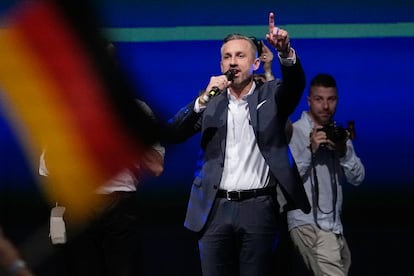
The politician advocates, among other things, for a much more restrictive immigration policy, increased deportations and a fundamental shift in state policy. Among his close associates are individuals who were actively involved in the Heimattreue Deutsche Jugend (HDJ), an organization banned in 2009 for its “affinity with National Socialism.” The group sought to raise children as “National Socialist freedom fighters” and taught minors what it called “racial science.” One of them is Patrick Harr, the parliamentary group’s press spokesman and Siegmund’s right-hand man. For Siegmund, however, these were merely “youthful mistakes” that have long since been consigned to the past.
The politician has also spoken positively about YouTuber Matthäus Westfal, known online as Aktivist-Mann. “There are a lot of good people providing information,” he said. Siegmund appears untroubled by the fact that the livestreamer was on the front lines during the attempted storming of the German parliament in 2020 amid mass protests against Covid-19 restrictions, and is known for his ties to Holocaust deniers.
Then there is Sebastian Schmidtke, a former federal vice-chair of the NPD, now known as Die Heimat, who has also reinvented himself as a livestreamer and was accredited at an AfD federal party conference. Siegmund appears to have a cordial relationship with the convicted neo-Nazi. Moreover, when asked how he personally views National Socialism and the Holocaust, and whether he would describe the years from 1933 to 1945 as “the greatest crime against humanity,” Siegmund responded evasively: “I do not dare to judge it. Because I cannot take the measure of all humanity.”
Scandals don’t seem to hurt him
Nor do scandals appear to have taken a toll on his popularity. Siegmund has been deeply entangled in his party’s nepotism controversy. His father works for an AfD member of the Bundestag from Saxony-Anhalt and had previously been employed by other AfD lawmakers. Siegmund initially defended the hiring of relatives and fellow party members, arguing, among other things, that the AfD struggled to recruit qualified professionals because anyone associated with the party faced social stigma.
Even so, his popularity showed no signs of declining and continued to grow. Perhaps, as Der Spiegel has argued, because “the AfD has long made distrust of state institutions part of its political strategy. Its own media ecosystem reinforces the message: ‘We no longer believe you. We only believe ourselves.’”
Nor did it appear to harm him that he attended the controversial gathering of far-right extremists in Potsdam in November 2023, where participants discussed a blueprint for the mass deportation of millions of people from Germany. The meeting was later exposed by the nonprofit investigative outlet Correctiv.
Siegmund even managed to turn a Der Spiegel cover from late August into a campaign slogan. The cover featured a headshot of the AfD candidate beneath the headline, printed in red letters: “The Most Dangerous Man in Germany.” He mocked the magazine’s portrayal, joking that if he won 46% of the vote, he would reveal how much he had supposedly paid Der Spiegel for the publicity.
Sign up for our weekly newsletter to get more English-language news coverage from EL PAÍS USA Edition









































