
Hammers to the face and amphetamines: hypermasculine looksmaxxing invades the internet
Trumpism’s male beauty standards are driving many young men to follow the dubious advice of influencers who destroy their bodies in the pursuit of looking strong
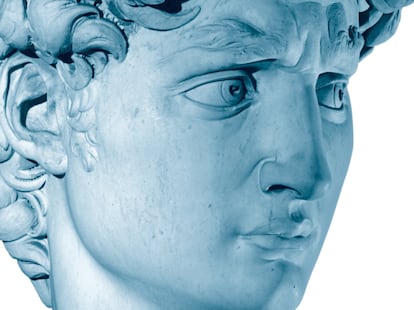

Two years ago, we were asking ourselves here at EL PAÍS if the “normal man” would make a comeback — meaning, whether we weren’t seeing the return to glory of the guy lacking in chiseled abs, generous biceps and a square jaw, represented in today’s cinema by Hovik Keuchkerian and Josh O’Connor and, classically, by legends like Humphrey Bogart and Marcello Mastroianni. That question remains unanswered. But it now seems clear that the hypermasculine physique remains deeply entrenched. Gigantic, gym-sculpted male bodies are dominating our screens, particularly in hits like Rivals and Emily in Paris and of course, in their natural environs: action and superhero movies.
“In media, like comics, where superhuman physiques are rather common, this can be taken to the extreme. From the bulging of muscles, some of which don’t exist, to the squareness of the jawline,” writes Anastasia Salter in Toxic Geek Masculinity in Media (Palgrave Macmillan, 2017). The book emphasizes how the much-coveted hypermasculine physique serves to highlight the traits that separate our cultural concept of men from that of women.
Though traditionally, aesthetic pressure has been linked to women, it seems that it’s impacting more and more guys. The Spanish Society of Aesthetic Medicine says that up to 31% of patients who undergo such treatments are men. From jaws to penises to height, the cosmetic surgery industry ceaselessly exploits male insecurities, as it long has done with those of women. And within these attempts, there are two trends that might characterize the future of how men relate to their own physical form.
So-called “softmaxxing” promotes diets, skincare and exercise routines, a classic and non-invasive approach to changing one’s physique. In contrast is “hardmaxxing”, which includes surgeries (like corrective jaw procedures) and practices like the dangerous — and viral — “bonesmashing”, which literally consists of bashing facial bones to break them, in the erroneous conviction that it will harden one’s features.

The idea that it’s possible to strengthen one’s jawline and shape more prominent cheekbones by fracturing one’s bones stems from a certain interpretation of Wolff’s Law, a biological concept theorizing that healthy bones become stronger through exposing them to mechanical stress. But the problem is that the internet is full of forums in which young men are asking for advice on alleviating their aesthetic insecurities from would-be bone consultants who are open to taking this law literally, and with no supervision from doctors or specialists. This growing community has a name: looksmaxxers, and since the 2010s it has been sharing controversial advice to look as attractive as possible, on message boards that are rotten with macho, if not explicitly incel, energy.
This dangerous trend and the alarm it is provoking in the medical community has arrived to the mainstream press. In The Telegraph, Cameron Henderson writes how it would be easy to think that such opinions pertain merely to a marginal and disagreeable group making noise online, but the truth is that they stem from a primordial blend of internet pathologies: body dysmorphia and a worldview that has been distorted by nihilist hyperindividualism and concerning misogyny. They also represent a growing number of young Americans following in the steps of [misogynist influencer] Andrew Tate, who value appearance and masculinity achieved through hypermasculinity above all, writes Henderson.
Brian Levin, founding director of the Center for the Study of Hate and Extremism at California State University, explains in the Telegraph article that there is a culture of appearance that surrounds angry young men who are disillusioned and increasingly distanced from reality, and who are particularly active on online message boards and social media. There, they come into contact with other individuals with similar issues. “It is increasingly becoming the medium of social interaction for angry and alienated young men,” he says.
“Social media has been fundamental in the manufacturing of aesthetic ideals that stem from a diversity of influences and which, in the anonymity of the internet, have shed their shame,” Naief Yehya, author of the Spanish-language book Sobre la belleza (About beauty; Alpha Decay, 2025), tells EL PAÍS. The narcissistic attitudes that have exploded on YouTube, Facebook and Twitter, he explains, have spread to the semi-underground of unregulated networks like 4chan and Reddit, and even to streaming platforms (which are subject to lax monitoring) like Discord and Twitch. This has led to widespread acceptance of body modifications for aesthetic reasons. “In these spaces, nothing is too extreme. It’s no secret that Elon Musk was self-conscious about his baldness, and one of his most important investments was hair transplants. Male cosmetic surgery, Botox injections, tanning sessions (as well as self-tanners), Ozempic (and other GLP-1 drugs), massive doses of anabolic steroids, and constant concern over testosterone dominate conversations on far-right social media and websites,” says the cultural critic. “While what little exists in terms of accessible healthcare in the United States is being dismantled, the political class is lining up at cosmetic clinics and pharmacies to become the best version of themselves. In the Trump era, being fat or ugly is akin to being sentenced to oblivion and ostracism.”
Gabriel Dridi is a content creator who gives popular looksmaxxing advice to men. Beginning as an adolescent, he began to bash parts of his face with a hammer for a minute every day. His goal was to create micro-fractures in his jaw and cheeks. “I got a permanent swelling, but it looked good,” he told The Free Press in an article published a few weeks ago entitled “The Boys Breaking Their Bones to Be Hotter.” On no small number of message boards, young male internauts share their physical insecurities and their doubts after putting such advice into practice. “I started using methamphetamines a week ago because I wanted to get hollow cheeks, but now my heart is doing weird stuff,” says one recent post on a looksmaxxing forum. From another: “My heart rate has randomly gone up by about 30 beats per minute when I’m just relaxing. I’m a little concerned. Should I see a doctor?”
Looksmaxxers and the far right
Livestreamer Clavicular, whose real name is Braden Peters and whose virtual handle is a reference to the unusual importance that looksmaxxers assign to the width of their collarbone, tells his followers that to get a chiseled jawline, you can beat your face with your fist or a hammer to improve definition. He is among those who promote the consumption of methanphetamines to stay thin. When he spoke to political commentator Michael Knowles, Clavicular called Sydney Sweeney “malformed.” “Her upper maxilla is extremely recessed. She’s got the eyes of doom with no infraorbital support,” he said. This attitude seems directly out of a book, another one of those men who use social media to attack the physique of attractive women, having felt rejected at some point by them. Clavicular is a friend of Tate and of the far right commentator Nick Fuentes. The three appeared in a video together singing the Ye song Heil Hitler on the way to a party. “I am not sorry. I do not apologize for what I did. I would do it again today,” Clavicular later commented. “I would rather have free speech and the ability to make jokes and do content a thousand times over rather than being a little bitch who, you know, has to censor himself.”
As far back as American Psycho, looksmaxxing has been associated with misogyny. While its protagonist Patrick Bateman’s nine-step beauty routine doesn’t seem nearly as extreme today — more and more men are applying Vitamin C in the morning, sunscreen all day, and Retinol at night — the character has become a reference for many guys today. Jaap Kooijman, an associate professor of media studies and American studies at the University of Amsterdam, commented during an interview with CNN that it’s important to keep in mind that the film, which debuted long before the rise of social media, is “based on the same principle of the outside appearance [and] consumer goods masking being empty inside.”
What accounts for the link between the extreme right and the looksmaxxers? Yehya has one idea: “The old cult of fascist physical aesthetic has come back in the form of steroids. Extreme-right regimes are obsessed with the neoclassic and Nordic look. The validation of their ideals of racial purity are founded on beauty archetypes whose attractiveness and strength reflect the image of the group in power’s vitality.”
“In context: fascism is, as Walter Benjamin put it, ‘the aestheticization of political life’,” Yehya continues. “Guy Debord conceived as fascism as an increasingly dominant expression of spectacle that goes beyond propaganda to synthesize the idea of the state in the figure of the leader. What counts in public life is the stage, the exploitation of emotions and the aesthetic unfurling, with protagonists who reflect myths and fantasies, and who are assimilated by pop culture.”
By converting political life into a show, these protagonists take on roles not of bureaucrats or officials, but rather, of stars of a spectacle. “The MAGA aesthetic, which can be seen in everything from Mar-a-Lago faces to pronounced musculature and vaguely Nazi tattoos, has become a dominant characteristic in political debate. From Secretary of War Pete Hegseth, with his high school quarterback physique, to White House deputy chief of staff for policy and homeland security advisor Stephen Miller, with his studiously produced Joseph Goebbels look, to that little ICE Führer Gregory Bovino with his Gestapo trenchcoat, the stars of the reality TV show that is Trumpian power play their roles in its grotesque choreography of raids, corruption, intimidation and dismantling of civil rights we see today,” he says.
Looksmaxxers have an equally “superficial view of beauty, as if it were a kind of rigid mathematics” with a “single, knowable solution,” Thomas Chatteron Williams writes in The Atlantic. But, he continues, they believe this makes it “malleable,” that one can rise to a higher plane of attractiveness with enough “money, effort, and perhaps a willingness to try methamphetamine.” We would have thought it’s unnecessary to append this discussion with the classic “don’t try this at home” — but apparently, it’s worth a mention.
Sign up for our weekly newsletter to get more English-language news coverage from EL PAÍS USA Edition









































