
A marathon of Rob Reiner movies as an antidote to Trump’s authoritarianism
All of the late filmmaker’s works, even his romantic comedies, contain a ‘Capraesque’ message of hope in dark times

The first time Annette Bening visits the White House in Rob Reiner’s political comedy, The American President, she tells the security guard that she feels like she’s in a Frank Capra film. The tribute to the director of It’s a Wonderful Life, Mr. Smith Goes to Washington, and Meet John Doe is no accident: Capra embodied the hope of New Deal America, which emerged from the Great Depression with the wounds of poverty and displacement not yet fully healed, the ghosts of the harvest bums still haunting the backroads of America. Though best known for romantic comedies like When Harry Met Sally, Reiner was also a great political filmmaker, a late 20th-century Frank Capra. Revisiting his films while Donald Trump’s blunders dominate the headlines is an experience as unsettling as it is comforting.
Like the master of Hollywood’s golden age, Reiner sought to portray the dignity of characters who believe they can improve the lives of their fellow citizens, who choose the right path even if they have to pay a price for it; he portrays an America built on immigration and the mixing of cultures, in which solidarity among the weakest builds deep networks of defense against the power of the strongest.
Rob Reiner was murdered on December 14, along with his wife Michelle, in circumstances so tragic they are difficult to imagine—all indications point to his middle son as the perpetrator. Trump’s ruthless and outrageous reaction —the director was always highly critical of Trump’s presidency—reflects the chasm between Reiner’s vision of the country as portrayed in his films and the cruelty of ICE raids against migrants and the megalomania of the current occupant of the White House.
Reiner directed a handful of films about U.S. history: LBJ, about Lyndon B. Johnson; Ghosts of Mississippi, about civil rights, denounced by the MAGA movement; or Shock and Awe, about the Knight-Ridder journalists who refused to swallow the lies with which the George W. Bush Administration justified the invasion of Iraq in 2003. These films are interesting though of varying quality, although they deal with the major issues that continue to fracture the country: the memory of slavery, social injustice, and the importance of a free press capable of standing up to power.
He was also the author of two Capraesque fables: the courtroom drama A Few Good Men, in which he argues that no one is above the law and that nothing justifies state violence—Jack Nicholson’s monologue is one of the most memorable moments in courtroom cinema—and, of course, The American President, the film that spawned the series The West Wing. Both were written by Aaron Sorkin and are instantly recognizable for their dialogue, which always treads the fine line between brilliant and artificial.
The American President tells the story of a widowed U.S. president, played by Michael Douglas, who falls in love with a political consultant, played by Annette Bening, causing his approval ratings to plummet. Douglas portrays a Democratic leader concerned about gun control and climate change, who orders an attack on the headquarters of the Libyan intelligence service but is haunted by the civilian casualties it will cause. Both he and Bening believe that politics is not just about power, but a way to alleviate social injustices and look to the future.
His opponent is a ruthless, power-hungry, venomous Republican politician, played by Richard Dreyfus, who doesn’t hesitate to resort to lies to destroy his opponents. Michael Douglas describes rhis style of politics this way: “He just wants to scare citizens and tell them who to blame.” This line was written in 1995. Listening to it in 2025, its clarity and relevance are striking.
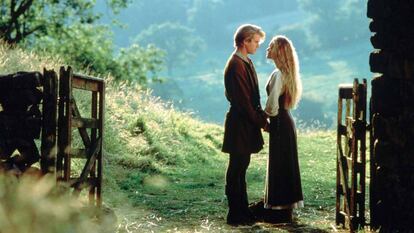
Yet Reiner’s most politically charged films are two of his great classics, The Princess Bride and Stand by Me. Aside from a tale about the power of fiction in the face of very early screen addiction—a boy with the flu is engrossed in playing prehistoric video games when his grandfather shows up and reads him a book that will change his life — the movie is also the story of an evil king who wants to unleash a war on absurd pretexts: “I’ve hired you to help me start a war. It’s a prestigious line of work, with a long and glorious tradition,” says Vizzini, the character in charge of setting things up.
As Stephen King confessed in a beautiful article about Reiner in The New York Times, Stand by Me is a film based on his childhood memories: “I’ve written a lot of fiction, but “The Body” remains the only nakedly autobiographical story I’ve ever done. Those boys were my friends. We never walked along a railroad track to see a dead body, but we did other things. Those kids were my friends. We never walked down a railroad track to see a dead body, but we got up to other stuff. The story was about my reality as I had lived it on the dirt roads of southern Maine.” However, it is also a depiction of the United States before the great upheaval of the 1960s and the trauma of Vietnam (although the Korean War is referenced). Ultimately, the story becomes a vindication of a country where everyone should have the right to a future and to hope.
The boy played by River Phoenix is destined for marginalization. He comes from a dysfunctional family, has run-ins with the law, and everyone—except his best friend—believes he’s destined for prison. In fact, when he steals money from school and then tries to return it, the teacher keeps the cash and accuses him of being the thief, ignoring his remorse. “I never thought a teacher could do something like that. But no one was going to believe me,” the boy recounts. Only the narrator, Stephen King’s alter ego, believes in him: “You can do anything you want.” And indeed, he was able to study, earn a degree, and become a prosecutor. He would end up murdered, senselessly stabbed, while trying to break up a fight in a restaurant.
In these uncertain and dark times that engulf us, Rob Reiner’s films remind us that another future is possible. David Remnick recently quoted, in an article about Trump’s authoritarian drift, one of John F. Kennedy’s last speeches, delivered shortly before his assassination, which undoubtedly applies to the legacy of this great director. “In a democratic society, the highest duty of the writer, the composer, the artist is to remain true to himself and to let the chips fall where they may. In serving his vision of the truth, the artist best serves his nation. And the nation which disdains the mission of art invites the fate of Robert Frost’s hired man, the fate of having “nothing to look backward to with pride, and nothing to look forward to with hope.”
Sign up for our weekly newsletter to get more English-language news coverage from EL PAÍS USA Edition









































