‘It’s the inflation, stupid’: US voters sour on the economy despite economic growth
The Trump administration’s chaotic tariff policy and the war with Iran have driven up prices and eroded families’ purchasing power, widening inequality. Even so, the United States remains one of the world’s fastest-growing major economies and is expected to stay that way this year and next thanks to the AI boom

More than 640 days have passed since Donald Trump took the oath of office at the Capitol and delivered a grandiose inaugural address in which he declared: “The Golden Age of America begins right now. From this day forward, our country will flourish and be respected again all over the world.”
Nearly two years later, if the polls are correct, he is on the verge of suffering a historic defeat in the midterm elections on November 3, driven by voters’ dissatisfaction with the state of the economy. Inflation, tariffs and the war against Iran help explain the profound disappointment that has spread from one coast of the United States to the other. The sentiment has also taken hold in rural areas of the Midwest and the South, including states such as Kansas and Mississippi, where Democrats have not governed for nearly a century. Voter unease over the economy stands in contrast to headline figures that continue to place the United States among the world’s fastest-growing major economies.
A recent survey by the Pew Research Center found that U.S. respondents list the economy as their top concern, followed closely by the future of democracy. What is striking is that public anger has been fueled more by inflation and high fuel prices than by Trump’s outbursts and transgressions, which have contributed to democratic backsliding in the United States.
Beyond those broader reflections, another recent poll by CNBC found that eight in 10 Americans rate the economy as either bad or very bad. In the final stretch of the campaign, surveys published by U.S. media outlets consistently show that households disapprove of Trump’s handling of the economy.
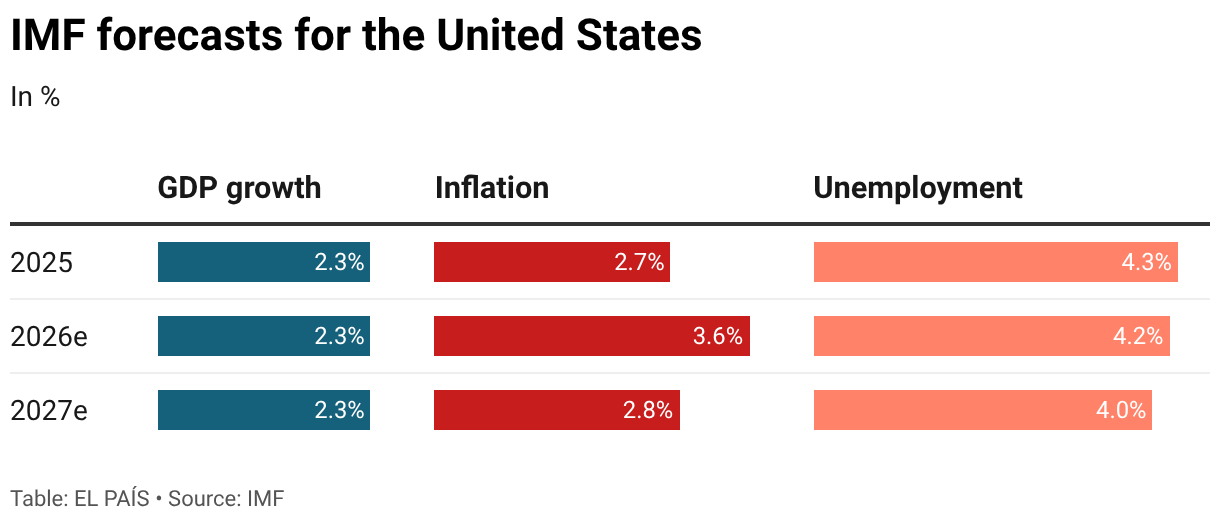
The mood in the United States points in one direction, but the macroeconomic data paint a different picture. The U.S. economy is growing at 2.2%, and forecasts from the International Monetary Fund (IMF) and other international institutions rank the country among the world’s fastest-growing major economies, buoyed by the boom in artificial intelligence.
Riding the wave of artificial intelligence
“In the United States, activity is being supported by very strong consumption, which in turn is being propelled by a solid labor market and ongoing wealth gains for households, especially from recent increases in financial asset valuations,” Nigel Chalk, director of the IMF’s Western Hemisphere Department, said a few weeks ago. “At the same time, we are seeing an acceleration in technology-related investment in the United States, which has offset a slowdown in other types of investment, particularly in structures investment.”
The United States has shown remarkable resilience since the pandemic. Its economy has continued to expand steadily despite the turmoil caused by Trump’s tariffs and the war against Iran. The unemployment rate has remained anchored at around 4.2%, a historically low level. And although job creation has slowed, owing to tighter immigration policies and the impact of artificial intelligence, the labor market remains healthy, a source of reassurance for Federal Reserve officials.
“Had someone told me a year ago that the United States would be embroiled in a war with no clear exit in the Middle East, that oil prices would be above $100 a barrel, that interest rates would rise sharply and that inflation would exceed 3%, my outlook for the U.S. economy would have been, at best, fairly pessimistic,” reflects Jared Franz, an economist at Capital Group. “However, consensus growth forecasts put it above 2%, clearly ahead of other developed economies worldwide.”
According to Franz, forecasts for the United States have underestimated the country’s prospects and that growth will exceed expectations, propelled by a strong labor market that has consistently outperformed forecasts, the solid financial position of households, and the extraordinary level of corporate investment in artificial intelligence.
Large companies are posting record profits, while financial markets are trading at all-time highs. The S&P 500 has gained nearly 15% over the past year, while the technology-heavy Nasdaq has risen almost 20%, driven by tech companies competing in the breakneck race for artificial intelligence through massive spending on microprocessors and data centers across the country.
Americans who have enough savings to invest in the stock market, roughly half the population, are reaping the benefits of those gains. The problem is being felt by the other half of the country.
The affordability crisis
So what’s happening with the U.S. economy? “It’s the inflation, stupid.” One might borrow and adapt the famous line of James Carville, the strategist behind Bill Clinton’s 1992 presidential campaign that popularized a slogan still widely remembered today. More than three decades later, public frustration stems from the rising cost of groceries, higher fuel prices, soaring health insurance premiums and elevated interest rates, all of which are eroding household income.
Economists have increasingly embraced a term to describe the phenomenon: affordability. The word refers to the loss of purchasing power and the growing difficulty families face in paying for basic necessities.
Suzanne Roberts Moritz is picking pumpkins on a farm outside Cedar Rapids, the second-largest city in Iowa. She is 60 years old and, despite retiring from her job as a schoolteacher five years ago, has had to return to work to make ends meet. Suzanne is a perfect example of the affordability crisis gripping the United States.
“Gas has shot up; it costs me $250 every time I want to go see my daughter and grandchildren, who live in North Carolina,” she says. “Every time I go to the supermarket, I notice everything is more expensive — health insurance, all the bills…”
Although Trump repeatedly insists on the campaign trail that inflation is under control, prices continue to rise. Inflation stood at 3.7% in September, according to the Bureau of Labor Statistics (BLS). Data from the same month showed average hourly earnings rising by 3%, a trend that has persisted since the beginning of the year and suggests that households have lost purchasing power. For families that have seen their cost of living rise by 30% since the pandemic, it is the final straw.
“Affordability and cost-of-living pressures define the 2026 midterm election cycle,” says Deepak Puri, head of Deutsche Bank’s U.S. investment office. “Nearly half of registered voters cite the cost of living as the single most important factor influencing their vote, while 74% believe their cost of living is moving in the wrong direction. Rising housing, health care and food costs continue to affect household sentiment, with 59% of Americans doubting that their family’s standard of living will improve.”
In an article published in September in the Economic Policy Institute, Heidi Shierholz and Josh Bivens argue that “the U.S. economy is the richest in the world, yet the gap between what it could deliver to working families versus what it actually delivers is maddening.”
“This gap is driven by inequality,” the article continues. “Average incomes can only rise faster than incomes at the middle if some groups — the ultra-rich in this case — see strongly above-average growth.”
In other words, wealth is being distributed unevenly and is widening existing inequalities. The boom in the technology sector and the surge in financial services, where multimillion-dollar salaries are commonplace, are further exacerbating the gap.
This situation is reflected in a Pew Research study, which found “more than four in 10 Americans had trouble affording a basic necessity in the past year.” “Overall, 70% of U.S. adults say they have cut back on spending for extras — such as eating out, streaming services or other entertainment — in the past year. And 54% say they have not been able to save money for the future,” it reported.
The war with Iran and diesel prices
Gbenga Ajilore, chief economist at the Center on Budget and Policy Priorities, argues that two factors weighed heavily on the economy during the first half of 2026: “The Trump administration’s chaotic and harmful tariff policy, and its war with Iran, which led to the closure of the Strait of Hormuz, the destruction of energy infrastructure in the region, and high oil prices.”
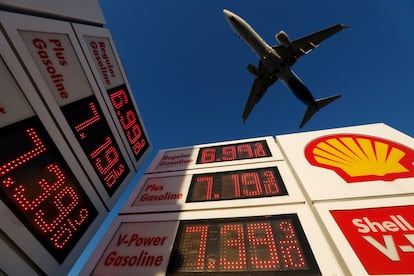
Since Trump ordered the bombing of Tehran in late February, energy prices have surged. The closure of the Strait of Hormuz has been felt at gas stations across the United States. The price of gasoline has risen by more than 45% in a country where people routinely travel long distances, while diesel prices have climbed nearly 80%, hitting farmers and truckers particularly hard. By late September, a gallon of diesel had reached $6.52, an all-time high. Gasoline prices have remained above $4 a gallon for months, a price many families cannot afford.
“The energy crisis and rising crude prices significantly impacted real household incomes in the first half of the year, only partially offset by an unusually large season of tax refunds,” says Michael Pearce, chief U.S. economist at Oxford Economics. “The effect of still-elevated prices will persist. Gasoline prices affect low- and middle-income consumers more because they spend a larger share of their incomes on fuel,” adds Pearce, who predicts that the war with Iran will deepen the K-shaped divide between high- and low-income consumers.
The economic toll of Trump’s tariffs
Trump’s protectionism has done little to ease the strain on the economy. Ordinary Americans have borne the brunt of the White House’s chaotic tariff policy. The Republican president imposed sweeping tariffs on countries around the world in the spring of last year, but they were struck down by the U.S. Supreme Court. He eventually reworked the entire trade barrier regime, but the result has also driven up costs for U.S. producers, who must pay tariffs on the raw materials they import. Thousands of small businesses are suffering the consequences of Trump’s trade policy.
“U.S. voters are angry about the economy, about prices and about insecurity. And they have linked their difficult domestic situation to the Trump administration’s international policies. Public opinion directly connects tariffs to high prices,” says Heather Hurlburt, associate fellow for North America at the think tank Chatham House.
However, according to James Knightley, chief economist for the U.S. at ING Research: “The U.S. economy continues to perform well, although this hides growing divergences between sectors.” He adds: “High-income households continue to spend strongly, driven by the substantial increase in their wealth in recent years, while middle- and low-income households are hit by slower income growth and high inflation.”
In an effort to stimulate consumption, Trump last year signed into law a package of tax incentives that included tax cuts for large corporations, self-employed workers and families. The so-called Big Beautiful Bill, as Trump himself dubbed it, has provided some relief, but it has also brought other problems into view.
Last summer, U.S. public debt surpassed the $40 trillion mark amid concerns over financing costs. That corresponds to debt equivalent to 124% of GDP and reflects a public deficit that has spiraled out of control. Last year it exceeded $2 trillion, the equivalent of 7.1% of GDP. The Congressional Budget Office estimates that the budget deficit will reach 8.5% of GDP this year because of higher spending on the war with Iran and the tax cuts contained in the Big Beautiful Bill.
“The tax cuts Americans were promised — which were tilted heavily to the top to start — are being overwhelmed by higher prices and higher health care costs for most families,” said Steve Wamhoff, federal policy director at the Institute on Taxation and Economic Policy (ITEP). “When you look at the full picture rather than tax cuts in isolation, the result is striking: the typical American in every income group is paying more, except that the richest 1% is the one group that comes out ahead.”
Beyond economists’ concerns about the country’s fiscal outlook, inequality is increasingly being felt by ordinary Americans. Inflation, fueled by the conflict in the Middle East, has prompted the Federal Reserve to raise interest rates, while investors have pushed up Treasury yields to 5.3%, their highest level since before the financial crisis that brought down Lehman Brothers.
As a result, mortgage rates and consumer borrowing costs for purchases such as cars and other goods have surged. The average rate on a 30-year mortgage in the United States has climbed to 7.4%, its highest level since 2023, according to data from Freddie Mac.
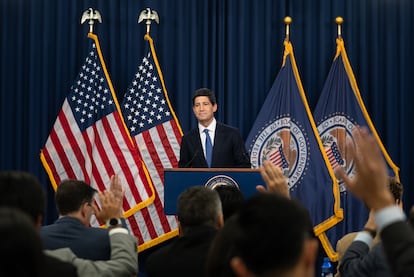
All of this ultimately affects consumer spending and household confidence. Yet much depends on where one stands. For Kevin Warsh, the chair of the Federal Reserve appointed by Trump, “the American economy appears to be strengthening.”
“Consider the geopolitical landscape of shocks and uncertainty, and you begin to appreciate the resilience of the U.S. economy. Given that resilience, and the potential for even greater performance, an attitude of optimism is exactly what I heard inside the FOMC these last two days,” he said at the Fed’s most recent meeting a month ago.
But he acknowledged: “For more than five years, inflation has been running above target [...] The plain fact is that inflation is too high and has been for too long.”
The AI boom: Between bubble fears and a new economic paradigm
Artificial intelligence is driving the largest economic transformation in history. Never before has so much money been committed in such a short period of time to developing a new industry, not even during the railroad boom of the late 19th century or the dot-com era. According to a recent study by Stijn van Nieuwerburgh published by the Brookings Institution, investment by the major AI labs is expected to reach $10.3 trillion by 2032, equivalent to 3.6% of GDP.
The U.S. Data Center Map, which tracks activity across the sector, lists 5,098 facilities and projects nationwide: 3,172 operational, 400 under construction, and 1,199 planned, with a combined capacity of 395.1 gigawatts. Goldman Sachs estimates that AI investment alone will amount to 1.9% of U.S. GDP this year.
The sector is already having a visible impact on the economy, but it has also generated social unease over the effects of these facilities. "Most capital spending, which could reach $800 billion this year, is going toward the construction of massive data centers," notes Jared Franz, an economist at Capital Group. "This level of investment gives a strong boost to the U.S. economy. In fact, I believe we are underestimating the potential impact of the AI boom.”
Franz believes GDP growth could be underestimated by between 0.5 and 1 percentage point. Major companies are engaged in a frenzied investment race that has produced some of the most spectacular stock market debuts in history. Analysts have begun warning about the risk of a bubble, pointing to an ecosystem of highly leveraged companies with close ties to one another.
Policymakers, however, are pinning their hopes on the substantial productivity gains that artificial intelligence could deliver once the industry reaches full maturity.
Sign up for our weekly newsletter to get more English-language news coverage from EL PAÍS USA Edition