How Trump could challenge or undermine the midterm election results
From pressure on election officials to ballot seizures and the possible deployment of federal agents, experts outline eight scenarios that could unfold in the final days before the vote on November 3

Election officials, activists, voting-rights lawyers, legal experts and other watchdogs of U.S. civil society have spent the past year and a half warning about what they describe as a campaign by U.S. President Donald Trump to undermine confidence in the conduct of free and fair elections. Their concern is that he is laying the groundwork to overturn the outcome if it does not favor the Republican Party.
With less than 10 days to go before the midterm elections, that campaign has entered its final and most intense phase, despite a string of setbacks in the courts, which have repeatedly struck down Trump’s attempts in recent months to change the rules at the last minute. At the same time, the U.S. president has also won some isolated victories.
Last week, which ended with a preemptive lawsuit by the Justice Department seeking to challenge the results in Alaska should Democrats prevail, offered examples of both trends. While a California judge ordered a halt to a federal investigation into alleged widespread voting by noncitizens (a conspiracy theory repeatedly debunked), Washington State’s Supreme Court ruled that New Hampshire may not accept student IDs as a valid form of voter identification.
To identify the main threats facing the November 3 election, EL PAÍS consulted about a dozen election experts and voting rights specialists. The aim was also to assess which of those risks are the most serious.
The experts agree that the U.S. system is prepared to withstand the attacks of a president who has consistently refused to accept defeat at the polls. They all describe Trump’s effort as “unprecedented” in U.S. history, and they point to one overriding reason for concern: the last time Trump lost, a mob of his supporters, galvanized by his false claims, attacked the Capitol in an effort to stop the peaceful transfer of power. The experts who spoke to EL PAÍS therefore find themselves in a difficult position, caught between the duty to warn and the responsibility not to alarm voters so much that they become discouraged from participating.
How serious those threats become will depend largely on the results of the election, which polls currently suggest will favor Democrats. Broadly speaking, they fall into three categories: measures undertaken before Election Day, efforts that could affect voting itself, and post-election scenarios if the vote count proves lengthy or contentious.
The White House insists that all its maneuvers have a single purpose: “to safeguard electoral integrity and promote security in the democratic process.”
Undermining public confidence
Since emerging on the political scene a decade ago, Trump has done more than perhaps any other politician with a global platform to undermine public confidence in the electoral system. The U.S. system, with its complexity, thousands of jurisdictions, slow vote counts, and vast geographic scale, lends itself to suspicion. Yet elections in the United States have repeatedly been shown to be secure.
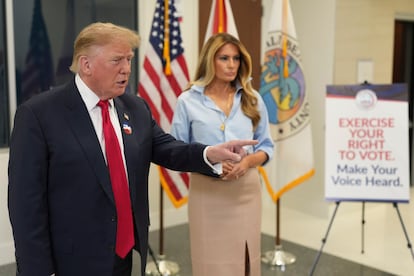
Trump has relentlessly spread claims of widespread voter fraud, often with the help of allies such as Elon Musk — except when, as in 2024, he emerged victorious. He has pushed to redraw electoral districts in ways that benefit his party. He has directed the FBI to seize ballots cast in the 2020 election, which he lost to Joe Biden, and has unsuccessfully sought access to voter-registration records. He has alleged irregularities involving voting machines and vote counting. And he has cast doubt on both mail-in voting and early voting, despite spending much of last week urging his supporters on social media to vote by mail and casting an early ballot himself on Saturday in Palm Beach, Florida, alongside his wife, Melania Trump.
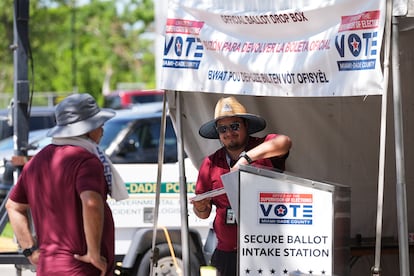
The Supreme Court — despite its Trump-aligned conservative majority — twice struck down his efforts to restrict mail-in voting, just as claims of widespread voter fraud and systemic failures in vote-counting machines have repeatedly been debunked. None of that has stopped Trump from continuing to promote those false claims and from pushing for a bill, stalled in the Senate, that would make it harder for millions of Americans to vote. He has also called for the “nationalization” of elections, even though under the U.S. system election administration is a shared responsibility of states and counties.
The theatrical operations launched by his administration, such as last week’s arrests in California of people accused of voting illegally, fit into a broader strategy that in many ways encompasses all the others: undermining faith in democracy and discouraging citizens from participating in it.
“That is the main danger of this contest,” says Jasleen Singh from the Brennan Center, a nonpartisan authority on election law. “It will have been a success [for Trump] if people stay home [on November 3] and do not vote.”
Threats and pressure on officials
Since 2020, being an election official has become one of the most dangerous jobs in the United States. That year, Trump pressured a secretary of state, Brad Raffensperger of Georgia, to “find” the votes he needed to overturn his defeat, while dozens of election workers, many of them unpaid volunteers, received death threats and intimidating phone calls.

This year, the Trump administration has suggested it is willing to punish officials who do not follow its directives with fines or even jail time, although experts again agree that such measures would exceed the federal government’s authority.
Counties and states controlled by both parties have spent months preparing for every conceivable scenario, from natural disasters to familiar threats that have surfaced in past elections, including attempts to seize voting machines and foreign cyberattacks. They have also prepared for newer risks and, if necessary, to resist intervention by Trump and his allies, who have replaced a long-standing relationship of cooperation with election officials with one marked by hostility.
“In these elections, the greatest threat does not come from foreign adversaries but from the White House,” Colorado Secretary of State Jena Griswold warned in a recent conversation in Washington. “We have updated all our contingency plans and hired staff. We have integrated the attorney general’s and governor’s offices into crisis‑simulation drills so they can learn to manage pressure and anxiety. We also have top‑tier lawyers ready to join the fight.”
During its most recent legislative session, Colorado’s Democratic-controlled legislature approved a law barring any presidential candidate from appearing on the ballot if, as Trump has floated, he seeks a third term in 2028.
An unlikely state of emergency
The idea of exploiting a pretext to declare a state of emergency and either suspend the elections or invalidate their results has been circulating for months in the more radical corners of Trumpism. Asked in an interview with Time about that possibility, Trump replied: “I don’t rule anything out or in.” Despite those remarks, the experts consulted for this article do not consider such a scenario likely in the midterms.
Benjamin Hovland, who was dismissed in July from the Election Assistance Commission (EAC), recalls those comments. He argues that, once again, this is part of the strategy: “to sow uncertainty, make Election Day look chaotic, and cause people to disengage.”
Hovland was fired shortly after a Supreme Court ruling gave the White House broad authority to remove officials from independent agencies. His dismissal was part of Trump’s dismantling of the EAC, the body charged with assisting state and local election authorities in administering elections.
Since returning to power, Trump has also scrapped the cybersecurity program responsible for monitoring potential foreign interference, such as the efforts that targeted the 2016 election. That did not stop him, however, from singling out China in a televised address from the Oval Office in July, in which he revived long-discredited claims about the 2020 presidential election.
Federal agents at polling places?
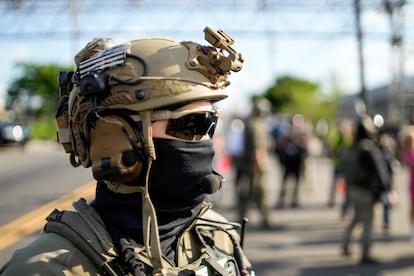
For months, both the president and senior officials, including Homeland Security Secretary Markwayne Mullin and FBI Director Kash Patel, have repeatedly declined to rule out deploying agents from Immigration and Customs Enforcement (ICE) or the FBI to polling places on November 3.
The stated rationale is that such agents would help ensure the smooth conduct of the election and prevent voting by undocumented immigrants, which successive investigations, including federal ones, have found to be exceedingly rare. In practice, however, their presence could deter many immigrants, especially Hispanic voters, from going to the polls, even if they are legally in the country. After a year and a half of Trump’s aggressive anti-immigration campaign, many would have reason to think twice before showing up at a voting center.
“Something like that would be completely illegal,” warns Singh from the Brennan Center, adding that a judge would stop such a deployment immediately. “Civil‑rights and legal organizations like ours are ready to respond to that eventuality.”
Trump’s army of observers
The Justice Department has recruited a force of 1,000 “election observers” to be deployed across the country on November 3. The role itself is not new. What is new is the scale: in the 2024 election, the Biden administration deployed 594 such monitors.
Their job, explains Jonathan Diaz of the Campaign Legal Center (CLC), a voting‑rights organization, vaguely resembles that the work done by monitors who oversee elections in foreign countries: “They observe, and if they see a problem, they follow up with local authorities.” “Given the aggressiveness of this administration and its willingness to violate the Constitution and the law, there is great concern about how those monitors will behave in the midterms,” Diaz says.
The law prohibits them from intimidating or harassing voters. Even so, the plan to station them around the country (though they would cover only a small fraction of the thousands of races taking place that day), has drawn criticism from Republicans as well. Wyoming Governor Mark Gordon objected in August when a handful of those observers sought to interview voters during the state’s primary election. The Justice Department representatives ultimately had to leave.
Seizure of voting machines and ballots
False claims about voting machines were a defining feature of the 2020 election and are likely to resurface on November 3. Last week, voters across the country reported on social media what they described as unusual behavior by voting machines. According to those accounts, a voter would select one candidate and the machine would record a vote for another, though not necessarily a Democratic candidate. Similar incidents have occurred in previous elections and, according to experts, are not necessarily indicative of mass fraud.
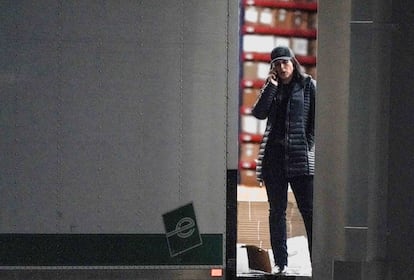
Hovland, the election official dismissed by Trump, notes that “more than 98% of Americans vote with a paper ballot or with a system that produces a physical record.” He adds that voting machines are subjected to “pre-election testing” and “post-election audits.” “Manual sample recounts are also performed to ensure the equipment is working properly,” he says. “There are numerous safeguards, but that has not stopped false narratives about alleged failures from spreading.”
Acting on those suspicions, the Trump administration could seek to seize voting equipment or confiscate ballots it considers questionable, as the FBI did in January in Georgia’s Fulton County, ground zero of the Big Lie surrounding the 2020 election. Ten months later, it remains unclear what federal agents were looking for. Even less clear is what, if anything, they found.
Lawsuits challenging the results
The Alaska lawsuit, which the Justice Department justified on Friday by arguing that two candidates have nearly identical names, Republican Dan S. Sullivan and independent Dan Sullivan, may be the first of many. Alaska’s Supreme Court has already resolved that issue, suggesting that the lawsuit may be aimed less at winning in court than at laying the groundwork for questioning the results in the event of a defeat.
“It’s absurd, baseless,” says lawyer and federal‑policy expert Aaron Blacksberg. “It’s a desperate attempt that can only be called political theater. It shows how desperate they are, throwing spaghetti at the wall to see what sticks. No judge will find merit in it.”
In 2020, lawsuits also poured in after Trump embraced the false claim, which he continues to repeat, that Democrats had stolen the election from him. The difference is that then it was campaign lawyers bringing those cases because Justice Department officials refused to do so.
Attorney General Todd Blanche has given ample indication that this time will be different and that he is willing to place a department traditionally expected to operate independently of the executive branch at the service of Trump’s political strategy. On Friday, Trump openly acknowledged that he had personally requested that the Alaska lawsuit be filed.
In Trump’s second term, which he began by pardoning 1,600 participants in the attack on the Capitol, he has also appointed dozens of election deniers to key positions. Among the most prominent are Homeland Security Secretary Markwayne Mullin, FBI Director Kash Patel and Deputy Attorney General Harmeet Dhillon. These are positions with the power to refuse to accept midterm results or to obstruct their certification.
“There are challenges in every election,” warns Kathy Boockvar, who served as Pennsylvania’s Democratic secretary of state and now runs Athena, a consultancy that works to protect voting rights. “The only time there weren’t any was in 2024, because those who usually question the results won. The threats have been evolving [for a decade], but the American people can have faith that the system is designed to withstand them, that the courts will rise to the occasion, and that officials will defend their rights come what may.”
What if Congress does not recognize the winners?
This is the least likely scenario of all — “almost bordering on science fiction,” according to Diaz from the CLC. Under the U.S. system, which is governed by rules dating back centuries, several weeks pass between Election Day, held on the first Tuesday after the first Monday in November, and the day newly elected members of Congress are sworn in. In 2020, Trump used that interval to fuel the movement that ultimately culminated in the attack on the Capitol.
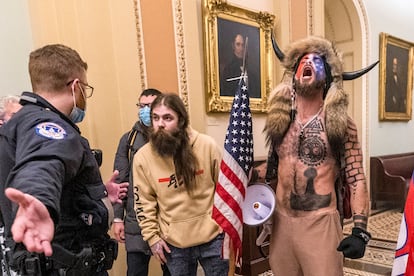
This time, that date falls on January 3, 2027. Some analysts worry that Trump could pressure Republican leaders on Capitol Hill, where the party currently controls both chambers (control it could lose in the midterms), to refuse to recognize the legitimacy of some Democratic lawmakers elected in November.
Diaz believes that if, by then, the states have certified all election winners, a process that all experts stress will extend well beyond election night, the matter “will be resolved.” After saying that, Diaz pauses and adds: “Although anything is possible.”
And on that point, everyone agrees: if this campaign, and the decade of U.S. politics that preceded it, has demonstrated anything, it is that with Trump, you never know, no matter how many scenarios you try to anticipate.
Sign up for our weekly newsletter to get more English-language news coverage from EL PAÍS USA Edition