
Trump uses national address to revive false claims of 2020 election fraud and exaggerate China’s role in his defeat
The president declassifies information, some of it already public and inconclusive, including CIA files on Venezuela. The Republican is on a crusade to cast doubt on the midterms, in which his party is widely expected to lose ground
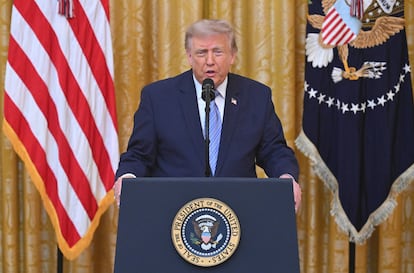

Donald Trump, leader of a country at war and facing rising living costs, addressed the nation Thursday night to speak about the elections… from six years ago. It was not merely an attempt to settle scores over a personal defeat; the president of the United States, whose unpopularity has reached record levels, spoke with his eyes fixed on the vote that will take place in just under four months. These are the midterm elections, and polls predict a Democratic victory. In the best-case scenario for Trump, he is trying to prevent that outcome; in the worst case, he appears unwilling even to acknowledge that it is likely.
The Republican thus revived one of his oldest and most recurring obsessions: the false claim that his opponent at the time, Joe Biden, stole the 2020 election from him, despite Biden winning by a margin of seven million votes. Trump did so during prime time (9:00 p.m. Washington time) and in a format traditionally reserved by presidents for the most solemn occasions: addressing the nation from a position of authority during the gravest crises, or highlighting the most momentous moments in a shared history.
On Thursday, that solemnity served as a platform to raise the specter of foreign interference in the 2020 election and to exaggerate its effects. In a speech lasting just under 30 minutes, delivered in a somber tone while reading from a teleprompter only hours after firing one of its operators for allegedly using insider information to profit from betting on presidential speeches, Trump announced the “immediate declassification and release of critical intelligence revealing shocking vulnerabilities” in the electoral infrastructure system. “No country can be great without fair and honest elections,” he declared.
The president promised major revelations assembled by something called the White House Transparency Task Force. These were published under the title Election Integrity on the presidential website, which crashed while Trump was speaking. An initial review of the heavily redacted documents, some of which were already known, such as those relating to an old lawsuit involving polling places in Muskegon, Michigan, suggests that they demonstrate China’s efforts to influence the election and the Chinese government’s skepticism toward Trump. However, they do not prove that those efforts played a decisive role in his defeat. During his speech, the president himself did not go so far as to draw that conclusion.
The most substantiated accusation was directed at Nicolás Maduro, the president of Venezuela, who is imprisoned in New York following his capture in Caracas in January. The batch of documents includes a six-page CIA file concerning “a specific plot to do a big number in favor of the corrupt Maduro regime in Venezuela,” Trump said. Ironically, the South American country’s 2020 election was the only one Trump explicitly described as “rigged” during his speech. It remains far from proven that the Venezuelan government could influence the U.S. electoral system, despite the persistence of that conspiracy theory.
Trump focused much of his speech on China, employing his classic “squid ink” tactic: making numerous alarming-sounding accusations to muddy the waters. He accused Beijing of carrying out “what is believed to be the largest compromise of election data in history,” claiming that China had “illegally obtained” the records of “220 million American voters.” According to Trump, that information includes names, addresses, phone numbers, political party preferences, and other sensitive data needed to register to vote.
He also accused Beijing of bribing journalists critical of the Republican candidate at the time so that they would write against him because, he added, China preferred that he not win. Chinese leaders, he claimed, considered they knew he was “wise to them” and feared he would impose additional tariffs on them.
Trump also spoke of a conspiracy involving members of the “deep state,” one of his favorite conspiracy themes. He described them as “a group of very well known people” and accused them of working “to actively suppress and downplay information about the extent of China’s sinister election meddling.” Trump called on his administration to “investigate how and why such crucial information was hidden, to fire those involved in the cover-up and to file criminal charges, if appropriate, against those people.”
Trump also cited among the documents, produced by the CIA, the FBI, the National Intelligence Council and the Cybersecurity and Infrastructure Security Agency (CISA), a Department of Homeland Security analysis commissioned from an unreliable private firm, which estimated that approximately “278,000 non-citizens” were registered to vote in the general election. That estimate runs counter to earlier studies, including official government analyses, of a problem that has become an obsession for the Trump administration but that experts say is rare.
“This intelligence underscores why we must take urgent action to ensure that our own system can never ever be hacked or compromised like it was in the past,” Trump said.
Thursday’s address was met largely with indifference, even by many on the right. Trump nonetheless reiterated several of these proposals after months of efforts aimed at what he sees as the scourge of election fraud. Critics and voting-rights advocates, however, argue that these measures are designed to make voting more difficult and to undermine confidence in free and fair elections. Some also warn that Trump could seek to invoke emergency powers to influence the electoral process.
Since returning to power, Trump has issued executive orders designed to make voting by mail more difficult; has said the time has come to “nationalize elections,” even though the Constitution assigns responsibility for administering them to the states; has sought to obtain voter-registration data from state authorities; and has removed Democratic members of the U.S. Election Assistance Commission. Nearly all of those initiatives have run up against the courts.
Push for reform
Yet on no issue is the president investing more political capital than his campaign to pressure congressional Republicans into passing a sweeping electoral reform package known as the SAVE America Act, which would tighten voter identification requirements and introduce new measures aimed at preventing non-citizens from voting. Trump used Thursday’s address to urge his allies on Capitol Hill to get the legislation passed by whatever means possible before the midterm elections. For now, however, the bill remains stalled in the Senate, where it does not have the supermajority needed to advance.
The subject of the speech had been clear for days. Speaking to reporters at the White House on Tuesday, Trump promised what he called “really big news.” “It doesn’t get bigger because without free and fair elections, you don’t have a country,” he said.
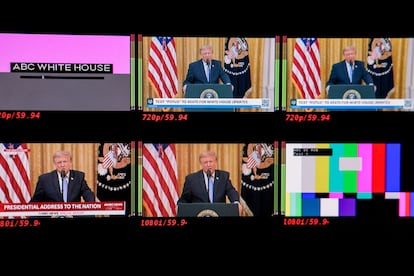
The expectation that Trump was about to address the nation in order to repeat false claims about election fraud led several major U.S. television networks, including NBC, CNN and ABC, to refuse to air the speech live. It was not the first time that such a thing has happened. In 2022, some of those same networks also declined to carry a Biden speech on threats to democracy, deeming it “too political.”
Anonymous sources had told major news outlets earlier in the week that a White House meeting had been held on Monday at which Trump was briefed on the findings of a recent FBI investigation based on a review of old election records. After hearing the results of that inquiry, Trump decided to announce the address himself on his social media platform, Truth Social.
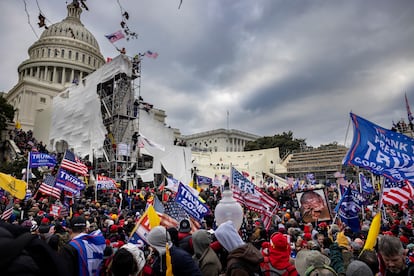
U.S. intelligence agencies investigated the 2020 election and concluded in 2021 that, while Iran, Russia and China had attempted to influence the race, there was no significant foreign interference in the voting process and no manipulation of vote-counting machines. Those claims, repeatedly rejected by the courts, were nevertheless promoted by Trump and his inner MAGA circle in the weeks leading up to the January 6, 2021, assault on the Capitol by a mob of Trump supporters who embraced the conspiracy theory that came to be known as the “Big Lie.”
A clear victory
Trump has never raised objections to the outcome of the 2024 election, which he won decisively. But his fixation on the defeat four years earlier has only intensified with time. A man who has never seemed inclined either to move on from failure or to acknowledge it, Trump continues to repeat the false claim that he actually won in 2020, including at international gatherings such as NATO and United Nations meetings.
After returning to power, Trump instructed his first Director of National Intelligence, Tulsi Gabbard, who resigned in May, to investigate vote-counting machines in Puerto Rico, an inquiry whose findings have yet to be made public. Gabbard also travelled to Georgia to seize thousands of ballots preserved from that election for a fresh review. The Trump administration has likewise revisited the results in other states the party lost in 2020, including Wisconsin and Arizona. Yet no place embodies Trump’s frustrations more than Fulton County, home to Atlanta, where the president is scheduled to travel next week.
Republican politicians have voiced their displeasure, both publicly and privately, with Thursday night’s address to the nation. For many of them, reviving the ghosts of a disputed election while voters face high gasoline prices, their party leader’s poor approval ratings and an apparently open-ended war with Iran is hardly the message they need as they prepare to stand for re-election in November.
Sign up for our weekly newsletter to get more English-language news coverage from EL PAÍS USA Edition









































