
Rufus Wainwright, singer: ‘I don’t know Bad Bunny’s music so well, but my God, I want to sleep with him so badly’
The New York artist is touring Spain. In the midst of Pride he collected the Muestra T Award for his commitment to LGTBIQ+ rights: ‘We gay people are slaves to our freedom. PrEP and Grindr are double-edged swords’
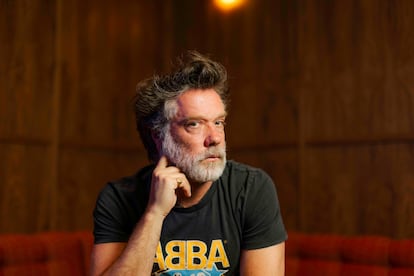

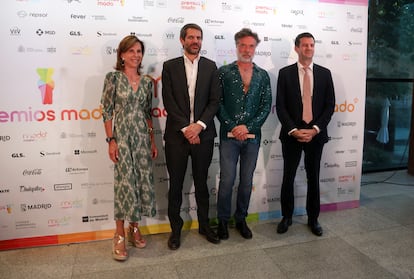
Around this time of year, Rufus Wainwright (Rhinebeck, New York, 52) is usually on holiday in Montauk, the idyllic Long Island beach where the rich and famous—including Robert De Niro, Paul Simon and Ralph Lauren—spend the summer. The singer-songwriter and composer and his husband, the producer and artistic director Jörn Weisbrodt, have a cabin in Hither Hills, a sought-after area with quiet streets near the beach. But this year Wainwright has decided to spend the summer touring Europe and the United States. On Monday he made a brief stop in Madrid to attend the MADO Awards gala.
In the heart of the Spanish capital’s Pride week, Minister of Culture Ernest Urtasun presented him with the Muestra T Award in recognition of his artistic career and his commitment to LGTBIQ+ rights. On July 2, the artist and activist was scheduled to resume his performances in Valencia, Ferrol, Murcia, Sallent de Gállego, Helsinki, Los Angeles, New York, Boston, Philadelphia, Atlanta, Chicago… He has shows scheduled through January 2027, although he is constantly adding dates to a calendar that seems endless.
Question. On Monday you received an award for your commitment to the community. At what age did you realize you were gay?
Answer. I was very young. I was probably 12 when I accepted it in my heart and my mind. I didn’t tell anyone then, of course, because it was a dramatic time and my parents weren’t ready.
Q. Your parents were artists. How did they take it?
A. Sadly, my mother [Canadian singer-songwriter Kate McGarrigle] died many years ago. We had an incredible relationship. I was fascinated by her and she was fascinated by me. It was the classic relationship between a mother and her gay son. With my father [American singer Loudon Wainwright III], on the other hand, I had a very distant relationship. I found it hard to connect with him. That said, they were terrible parents. My mother threatened to kick me out, so for a while I pretended not to be gay. I tried to deceive her and she knew I was deceiving her. My father simply didn’t want to know. I suppose they were worried about AIDS, which was then decimating the gay population. Deep down, I suppose they had a lot of fear and many cultural and religious prejudices.
Q. In general, we gay people are the last to realize we’re gay. I mean, other people seem to know before you yourself become aware of it.
A. That’s interesting. My father always knew I was gay; my mother, however, was in denial. When I was 14, my father sent me to stay with Penny Arcade in New York. Penny was a personality on the art scene; she would hang out with Jack Smith and Andy Warhol. She taught me what I needed to know about the gay community. My grandmother, who had been very poor and raised in a strict, conservative Christian environment in Georgia, was the one who supported me the most. She, the humblest of us, understood me better than my more sophisticated relatives. One day she called me and said: “Rufus, I know you’re gay and I’m fine with it.” The least expected person turned out to be the most understanding.
Q. Who was the first man you fell in love with?
A. My first crush was Rick Schroder. I fell in love with him watching him on TV. I think he’s involved in the MAGA world now, but back then, at 12 or 13, he was adorable. My first real love was the French tennis instructor I had at a summer camp. Jeffrey Epstein attended the same camp, the Interlochen Arts Camp in Michigan. Fortunately, I had no dealings with that Satan.
Q. And were you lucky with the instructor?
A. No, it was unrequited. He broke my heart.
Q. Earlier you mentioned your parents’ fear of AIDS in the 1980s. Did you ever fear dying from HIV?
A. For 10 years I thought I was going to die of AIDS. I couldn’t even bring myself to get tested. Whenever I had a fever or a spot, I would tell myself: “That’s it, I have AIDS.” I started having sex at 13. I had sex with strangers in parks, in clubs, anywhere… I was a victim of abuse in London. I’m still dealing with it, but that experience helped me stop. For many years I stopped having relationships. It was probably the best thing I could do in 1987. The fear of death, and accepting it, was part of my youth.
Q. Today’s younger generations have been freed from that fear thanks to PrEP, pre-exposure prophylaxis.
A. Young people are freer than we were, but they also face more problems: artificial intelligence, the environmental crisis… There are many very dark pressures on today’s youth.
Q. You’ve been with your partner almost 20 years. Did you imagine you would end up married and a parent?
A. No, I didn’t imagine it. I always thought I would die like an Oscar Wilde character: very young and ruined.
Q. Do you believe in monogamy?
A. I believe in the freedom for each person to do what they want. I have a lot of respect for monogamy. There is a beauty, an almost sacred quality to it. But I also think there is a sacred quality in polyamory. I’m a liberal person. The thing about the gay world is that we have a lot of freedom, but also many servitudes. We are slaves to our freedom. It’s a complicated matter. PrEP and Grindr are double-edged swords.
Q. You have a teenage daughter. Are you worried about her future?
A. I try to be optimistic. I feel we are in a moment of great change in which humanity will have to redefine itself. My daughter will be part of that. Maybe we are living through one of the most exciting moments in history. But, as in any battle, the forces of evil are also at work. There is a lot at stake.
Q. You had your daughter in a very natural way, with a childhood friend [Lorca Cohen, daughter of Leonard]. What do you think about surrogacy?
A. Surrogacy is not my business, but I would like to say that there are many children who need parents and to be adopted. Although I haven’t done it, I think adoption is a noble and incredible act.
Q. “If Trump wins the elections, it will be the end of the world,” you said in 2016. Trump has won elections twice.
A. I wasn’t wrong; it was the end of the world. The world as we knew it ended at that moment and now we are in another world. Trump is an evil man, but you have to thank him for something: he has shown us a perverse power system that has existed for a long time and that was hidden. He has made the bad actors visible, and for that we must thank him.
Q. Is there any politician you admire?
A. Mark Carney, the prime minister of Canada. I like how he confronts Trump. I also like some Spanish politicians, but don’t ask me for names. Here in Spain there are real debates about things that matter.
Q. Are you afraid to speak out in the United States?
A. I speak. I don’t feel afraid, although maybe I should. I’ve heard very terrifying things. I’m focused on the midterm elections right now. If we don’t retake Congress, we’ll have a problem because there’s no one checking what the Republicans are doing. If Trump wins other elections, I would probably consider leaving the United States.
Q. Have you distanced yourself from friends because of politics?
A. I’ve lost some friends, wealthy friends who fell into Trumpism. I’ve had to stop seeing them.
Q. You’re American but also Canadian. Is the United States still the promised land for immigrants?
A. I want to believe so. I still believe the concept, the idea, the philosophy of America is incredible and must be defended. I still believe in the American dream, although we are in the middle of a battle to save that dream.
Q. Right now your country is fighting three wars and it doesn’t always seem to be on the right side.
A. War is the most horrible thing in the world, but it’s helping to awaken many Americans. A lot of people are angry. The war in Iran is like an unfortunate remedy; it’s like chemotherapy for the United States.
Q. Spanish audiences adore you. Why do you think that is?
A. They have always supported me in everything, my compositions, my operas. My mother had a theory about it. She said Spaniards love me because I come from a folk tradition and Spain has a very strong connection to folklore, popular culture and the guitar. I have an almost Celtic connection with Spain.
Q. You’ve collaborated with and covered great artists such as Leonard Cohen, Joni Mitchell, Burt Bacharach, Paul Simon. Who would you like to collaborate with?
A. I had the chance to meet Björk. We went out partying briefly. Sometimes we write to each other. She sends me eighty emojis in one message. I’d love to collaborate with her. She’s a cultural icon.
Q. Have you heard Rosalía?
A. Of course. She sings beautifully and what she’s doing is incredible.
Q. And what do you make of the Bad Bunny phenomenon?
A. I don’t know his music so well, but, my God, I want to sleep with him so badly. He’s so gorgeous and seems so comfortable around gay people. He’s one of those straight guys who you know is straight because he is comfortable around gay people. You know what I mean? That makes him so much sexier even...
Sign up for our weekly newsletter to get more English-language news coverage from EL PAÍS USA Edition









































