
It’s been 50 years since the ‘most important concert of all time’... and everyone who saw it would fit inside Bad Bunny’s ‘casita’
On June 4, 1976, the Sex Pistols played a concert in Manchester before a handful of members of the emerging local scene. It would change the course of rock music
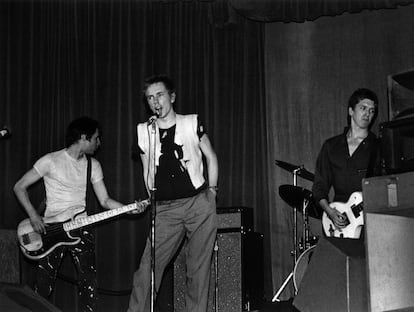

At a time when tens of thousands of people flock each night to see Bad Bunny in Madrid and share millions of videos capturing his every move, it feels strange to think that on this very day, exactly 50 years ago, a concert took place that was likely attended by fewer people than those dancing each night in the Puerto Rican star’s casita — and yet may have changed popular music forever.
A gig recreated in at least two films (24 Hour Party People and Control) and named by NME as “the most important concert of all time.” We are talking about the Sex Pistols’ concert on June 4, 1976, at the Lesser Free Trade Hall in Manchester.
Half the boomer population of that northern English city claims to have attended the seminal punk show. But, as David Nolan notes in I Swear I Was There, the canonical book on the concert, it is relatively easy to clear up one of rock history’s great mysteries: how many people actually went to see a bunch of nearly unknown lads from London that hot Friday night in Manchester?
According to the city’s municipal archives, ticket sales generated a total of £14. At 50 pence a ticket, 28 tickets were sold. The confusion — and the ever-shifting number of supposed attendees — is partly explained by the fact that the Pistols played another show in the city a few weeks later. The select club of spectators that legend has placed in that room — including Bernard Sumner and Peter Hook (Joy Division and New Order), Morrissey (the Smiths), Marc E. Smith (The Fall), and Tony Wilson (Factory Records) — was most likely split between the two dates.
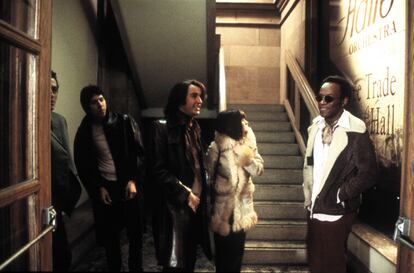
What is known is that the men who brought the Pistols to that venue were Peter McNeish and Howard Trafford, two Manchester lads who were fed up with the glam rock they heard at university. In a northern city like theirs, the way to learn what was happening in London was to read the British music press, which applied Fleet Street’s taste for hyperbole to popular culture.
On February 18, 1976, they read a review in NME, written by Neil Spencer, about a band that had opened for Eddie and the Hot Rods at London’s Marquee club. It said that they had played a cover of The Stooges’ No Fun, and that when someone in the audience complained they couldn’t play, a member of the band replied: “So what?” The article spoke of sex, violence, and anarchy. “We’re not into music, we’re into chaos,” the band said.
That review changed their lives — and their names. They became Pete Shelley and Howard Devoto, and began to sense a path forward for the band they were putting together, The Buzzcocks. They had a friend’s car at their disposal that weekend and drove to London to see the Sex Pistols. They caught them live on February 20 and 21, and, asking around for their manager, were directed to 430 King’s Road, where Vivienne Westwood and Malcolm McLaren ran the boutique Sex, around which the fledgling London punk scene revolved. The rest is history.
On June 4, Johnny Rotten, Steve Jones, Glen Matlock and Paul Cook — the Sex Pistols — played in the small upstairs room of the Lesser Free Trade Hall what may have been the most important of the 124 concerts they performed before imploding on stage on January 14, 1978, at the Winterland Ballroom in San Francisco — an event that symbolized the official death of the original era of punk.
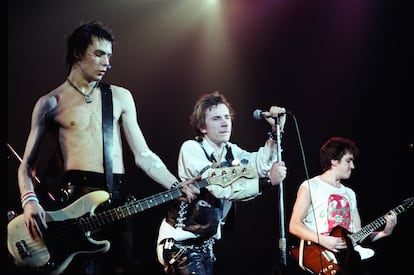
In truth, the epiphany experienced by the members of the four Manchester bands transformed by the Pistols’ shows in the city (The Buzzcocks, Magazine, Joy Division and The Fall) was more aesthetic or philosophical than musical. They did not replicate their sound, but they did adopt their attitude. That night 50 years ago, the Pistols broke the traditional relationship between audience and band. It was no longer about admiring virtuosity or an elaborate stage production. They showed a direct path for anyone who wanted to express their discontent. A new way of understanding rock was born — one that would go on to shape decades of English music and, by extension, music around the world.
But that concert also speaks to how myths are made: layers of truth and fiction that settle over decades. All that remains of the show is a homemade poster, a bit of Super 8 film, a few photographs, and a ticket that, incidentally, mistakenly lists the year as 1076.
Fifty years later — though it feels like 950, as the ticket suggests — pop continues to create myths. From Johnny Rotten to Bad Bunny, from Vivienne Westwood to Marta Ortega. As for journalists, we remain determined to find “the most important concert of all time.” But this time, with far less room for myth, it is witnessed by hundreds of thousands of people live — and tens of millions more through the screens of their phones.
Sign up for our weekly newsletter to get more English-language news coverage from EL PAÍS USA Edition









































