‘Mi casa es su casa’: The architecture that explains Puerto Rico
Bad Bunny’s casita is at the center of his concerts on the ‘DebÍ Tirar Más Fotos’ world tour. It’s a symbol of home, but also of an entire community
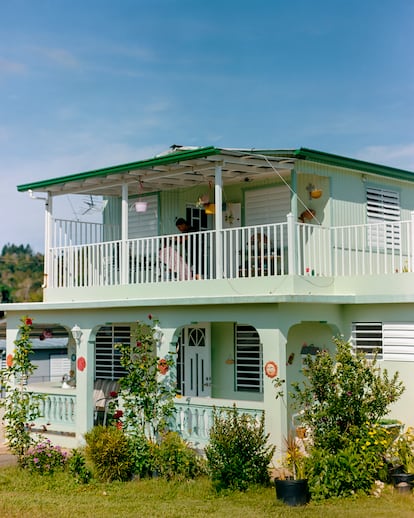
It’s not a house: it’s a casita. The diminutive of casa — Spanish for “house” — is important. Not because it minimizes or diminishes what it describes, but because it implies affection, intimacy, and family. In the Caribbean, diminutives have the ability to smooth over complex topics.
In these parts, you don’t ask for a favor: you ask for un favorcito, a little favor. You don’t boast about having a huge sailboat (even if it really is): you simply have a tiny boat. And you don’t go out for a meal; instead, you grab a little something, even if you’re referring to a banquet. So, when the complete stage setup for Bad Bunny’s concert residency — titled No me quiero ir de aquí (“I don’t want to leave this place”) — was unveiled last summer in San Juan, Puerto Rico, it was only natural that everyone started calling it la casita, or “the little house.”
It’s true that its dimensions support the nickname: it’s about 42 feet wide and 42 feet deep, with an 11-foot ceiling. The model is as wide as the real house that inspired it, but less deep.
However, that affectionate diminutive has much more to do with the emotional and historical weight of the structure than with its appearance.
The casita first appeared in the short film (directed by Arí Maniel Cruz and Bad Bunny) that accompanied the release of the album titled Debí Tirar Más Fotos (2025). It stars filmmaker and actor Jacobo Morales — a key figure in Puerto Rican culture — and tells a story about the near future, in which the displacement currently taking place on the island is evident. The Puerto Rico depicted is one in which there are no Puerto Ricans, something that a certain political force today desperately longs for.
The original house was found by designer and art director Mayna Magruder Ortiz in the municipality of Humacao, in the southeast of the island. It was initially intended for the film, but later on, Bad Bunny’s team decided to incorporate a replica of the house into the world tour’s stage design instead. The creative process behind this decision — like almost everything that the singer’s inner circle works on — is a closely guarded secret. This isn’t only to maintain the element of surprise, but also to avoid pushing viewers and listeners toward a specific interpretation. The team also typically requires collaborators to sign confidentiality clauses in their contracts, which is why neither of the two creators of the set piece — Magruder and Rafael Pérez Rodríguez, in charge of construction and logistics — can give interviews.
When asked for comment, the artist’s team explains: “The casita is Bad Bunny’s intellectual creation, open to everyone’s interpretation through his short film.”
During Bad Bunny’s concert residency — which ran from July to September 2025 — the casita sparked all sorts of conversations. First, its location and the visual obstruction it created for part of the audience caused discomfort; then people debated its role as the setting for the concert’s second act, which followed a first part that took place in a rural setting, with native trees, traditional instruments, flamboyant costumes, and typical island dances.
At the beginning of each show, perreo and le lo lai — reggaeton and jíbaro music — merge as interchangeable expressions of the same emotional register, whether festive, melancholic, or defiant. Then, inside the casita, came what most consider the best part of the show: the selection of classic perreo tracks — or, more precisely, the most sexual, the most explicit, the most down and dirty. In other words, when Bad Bunny stepped into the casita, everyone knew it was time to perrear for real. The third act returns to the original stage, now centered on salsa and the full orchestra.
Months later, the casita began touring the globe on the artist’s world tour. For instance, it was installed on the stage of the Super Bowl LX halftime show this past January. And, wherever it’s set up, it’s met with the same reaction: everyone wants to go inside.
Those lucky enough to receive a coveted invitation can enter the little model house to dance on its balconies and experience the concert from that perspective (it fits about 30 people inside, while the roof can hold 20). There, they can feel like they’re at one of those classic parties in Puerto Rico, the kind of celebration that’s usually advertised as a small gathering of family and close friends, but ends up filling the entire road with more strangers than acquaintances. Still, in that moment, everyone feels like family.
While the focus is on the casita, the guests are — so to speak — family, while the rest of the concertgoers effectively become friends of friends, distant cousins, or neighbors who show up at the party somewhat uninvited, but end up dancing in the middle of it all, helping out in the kitchen, and watching the night go by in a rocking chair on the balcony. The little set piece thus manages to convey the intimacy of a house party within the massive scale of a concert that brings thousands of people together in a stadium.
One of the surprises of each concert night has been discovering who will be in the casita. Figures such as Ricky Martin, Kylian Mbappé, LeBron James, Lionel Messi, Penélope Cruz, Javier Bardem, Salma Hayek, Pedro Pascal, Karol G, Cardi B, Young Miko, Jessica Alba, Alix Earle, Diego Boneta, Belinda, Austin Butler, Loreto Peralta, Bárbara de Regil, Ana de la Reguera, J Balvin, Natanael Cano, RaiNao, Eladio Carrión, Félix Tito Trinidad, Miguel Cotto and José Piculín Ortiz — among others — have all been in the set piece, in addition to a long list of influencers and key figures in popular culture.
As they dance around — and as the show moves in and out of the structure — guests can see artwork by Puerto Rican artists like Lorenzo Homar and Alexis Díaz, sit on the sofa to watch one of the screens installed inside, order a drink in the kitchen (which doubles as a bar), or wander around the area where the DJ is playing music. Outside, there are lots of plants, typical of the island’s home gardens. At times, Bad Bunny comes and goes, dances with the crowd, sits and sings in the balcony chair, and climbs onto the roof and walks across it (something much appreciated by concert-goers whose view was obstructed by the prop house). He jokes around with the concert’s key character — Concho the toad — about how he’s gotten a little carried away with his “little party,” which has now become a massive bash.
At the peak of the concert, the audience is invited not only into the intimacy of the space — “I invite you to my casita,” the singer declares — but also into the liberating, transgressive energy of dancing with complete abandon. Whether one comes back up from that level of intensity is another matter.
However, the love affair with the little house was put to the test on September 17 of last year. That was when a lawsuit was filed against the artist and several production companies by the owner of the original house that inspired the casita: 84-year-old Román Carrasco Delgado. The grounds for the lawsuit were unjust enrichment and breach of contract, with Carrasco Delgado seeking damages. It was alleged that the project’s scope was never explained to him and that his signature didn’t reflect his clear understanding of the terms of the contract, which he signed for the use of the property as the central setting for the short film. Meanwhile, the production company maintains that the process for reaching an agreement regarding the use of the property was transparent.
After an attempt at an out-of-court settlement failed, Carrasco Delgado continues to seek $5 million in damages for harm to his economic interests and an additional $1 million for emotional distress, since — according to the legal filing — his daily life has been disrupted by the constant flow of curious visitors who come to look at his property.
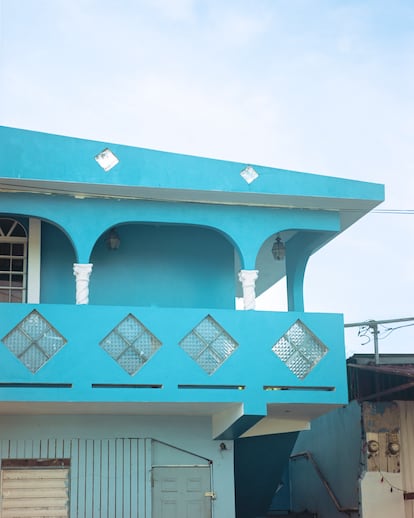
The casita — built as an artistic project — not only represents something essential in Caribbean architecture. It has also awakened collective memory, while revealing the power that architecture has to open urgent social conversations. For many from the region, the casita doesn’t simply resemble the one where they grew up, where they went to visit their relatives in the countryside, or where they went to live in a new development: it’s also a symbol of hope. An entire generation thought that they could improve their lives through concrete, only to crash against the reality of a government unable to sustain those promises. In the end, the concrete turned out to be nothing more than cardboard.
The original structure behind this style of house was built by adapting the floor plan of a home in Levittown, one of the first housing developments inaugurated in Puerto Rico. This suburb would become the place that thousands of Puerto Ricans would return to, after years of migration to the mainland United States. It’s also a symbolic place for the working class, who believed in the worn-out project of an unincorporated territory. They either left the countryside for the city, or brought the city’s aesthetic back to rural life.
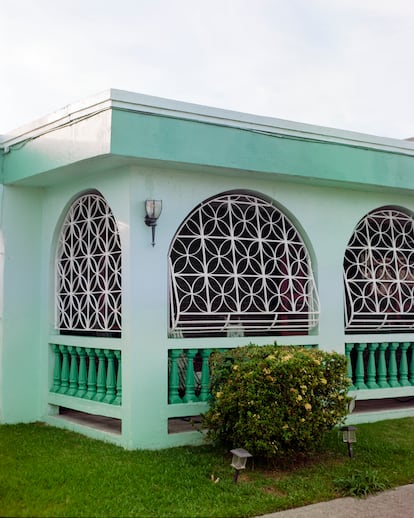
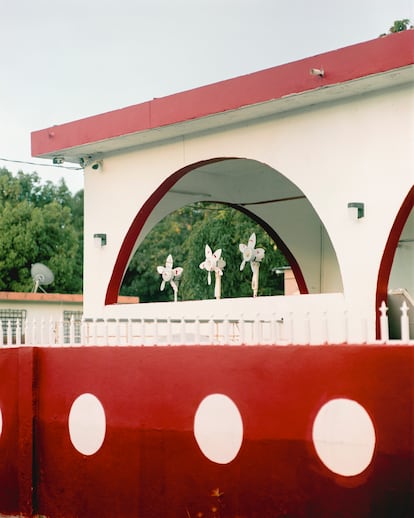
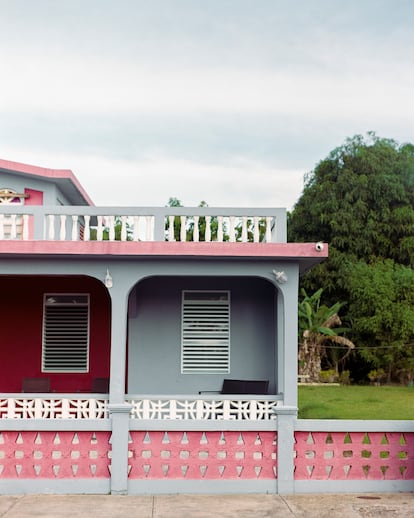
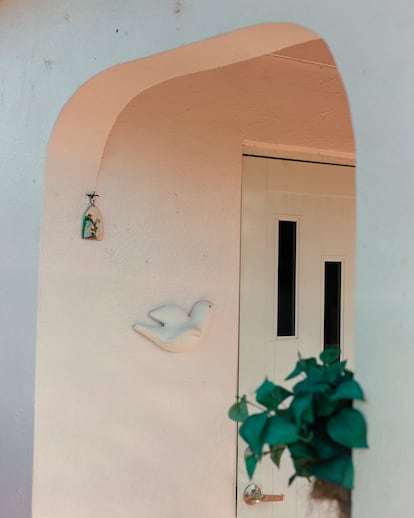
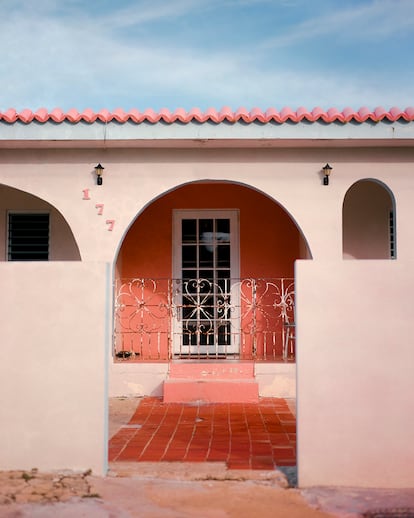
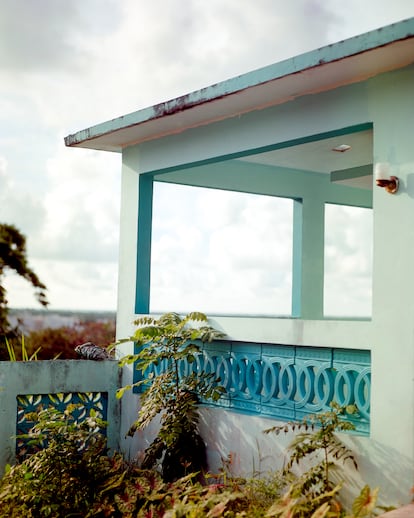
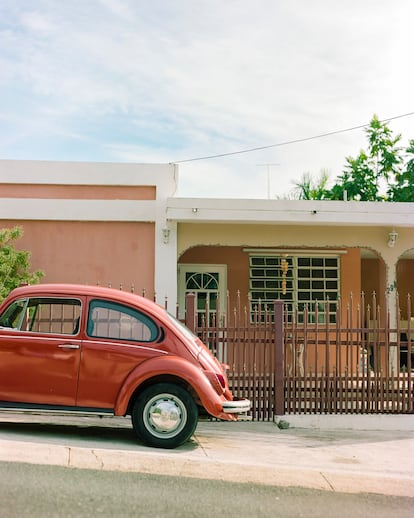
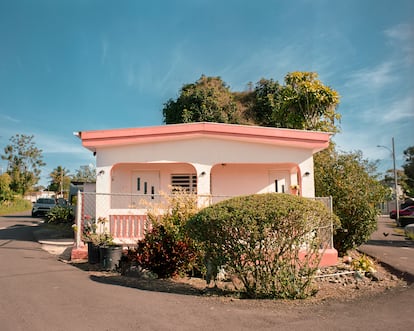
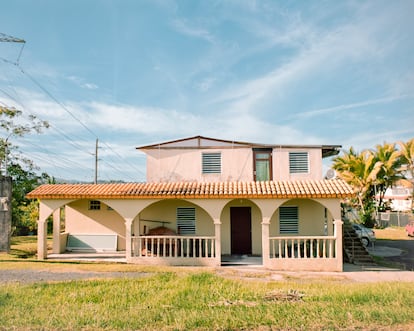
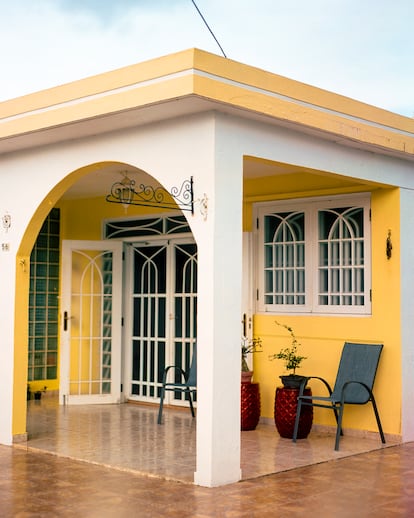
The casita is one of those universal metaphors for a homeland, but rendered in its most intimate form and through a Caribbean lens: bright colors, open balconies, Miami‑style jalousie windows for the climate and for keeping secrets. Above all, it is an invitation to what a house has meant in Latin America — a place where doormats say mi casa es su casa, and mean it.