
Benito is here to stay: Bad Bunny declares his love for Puerto Rico at the start of his 30 concerts on the island
The artist reclaims his identity with a residency at the Coliseo arena in San Juan that he will share with more than half a million fans
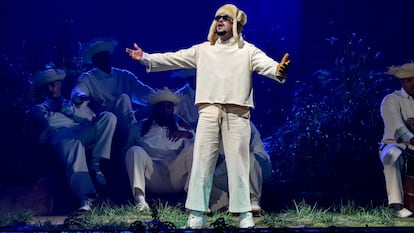

Panting, Bad Bunny, dressed in a light pink suit and a pava, a traditional Puerto Rican straw hat, watches silently from the stage as 18,000 fans applaud him. The ovation seems to last an eternity until the Puerto Rican megastar, who by now has transcended the reggaeton label, finds his voice again and whispers into the microphone: “Thank you, thank you, thank you.” He has just concluded the first weekend of his artistic residency in his native Puerto Rico, a series of 30 concerts in which he not only celebrates the rich culture of the small Caribbean island but also denounces the sociopolitical reality faced by its residents, besieged by gentrification and corruption, among many other ills.
No me quiero ir de aquí (I Don’t Want to Leave Here) is the name Benito Antonio Martínez Ocasio has chosen for his residency at the Coliseo de Puerto Rico arena, located in the island’s capital, San Juan, where more than half a million fans will arrive over the next three months. It’s also a declaration of intent. Continuing the theme of his latest album, DeBÍ TiRAR MáS FOToS (I should have taken more photos), released last January, the 30 shows — tickets for which sold out in just four hours six months ago — are a vindication of Puerto Rican identity, of the broken soul of a people who refuse to give up what’s theirs in the midst of a crisis of excess tourism and gentrification that is causing the forced displacement of its people.
Puerto Rico is a U.S.-controlled territory whose inhabitants are American citizens but who cannot vote in presidential elections and lack significant representation in Congress. The island has an insular government, which, along with the federal government, has fostered the gentrification of local communities, providing tax breaks to investors and tourists in exchange for moving there. The consequence? The island is becoming less and less habitable for locals. This reality, along with several natural disasters, such as Hurricane Maria, which killed more than 4,000 people in 2017, poor local government management — several officials have been formally accused of corruption — and Washington’s indifference, has caused thousands of Puerto Ricans to emigrate in search of better opportunities. Currently, the Puerto Rican diaspora in the United States doubles the number of Puerto Ricans residing on the island: more than six million live abroad, compared to the 3.2 million who remain. For this reason, the territory is known as “the emptying island.”
Bad Bunny himself — the most-streamed Latin artist on Spotify worldwide in 2024 — has refused to leave his birthplace despite being, undeniably, the biggest global superstar of the moment. With these concerts, the 31-year-old singer lends his clout to convey the collective sentiment of his fellow Puerto Ricans: the desire to remain in their homeland and celebrate their customs. In fact, the first month of concerts, in July, is exclusively for Puerto Rican residents. Those tickets could only be purchased in person, at various points of sale that his team set up across the island. There are nine shows this month, a total of about 160,000 tickets, so only 5% of the island’s population could attend, but even so, Martínez Ocasio wanted to prioritize his own.
The other two months — August and September — are open to the general public on and off the island. In total, it is estimated that No Me Quiero Ir De Aquí will contribute more than $200 million to the local economy and create over 3,600 jobs, according to local government data. It will also attract 600,000 tourists: in addition to concert tickets, more than 80,000 stay and VIP experience packages and 30,000 hotel rooms were sold.
Bad Bunny will not be performing any additional concerts in the United States as part of his world tour, which will take him to Latin America, Europe, Asia, and even Australia this year and next. The singer indicated last month in an interview with Variety magazine that he considered it “unnecessary” to perform more concerts in the continental U.S., given that his fans have had many opportunities to see him perform in the country during previous tours. However, Bad Bunny invited those who wanted to see him on his home island to attend the residency, with which he seeks to promote more sustainable tourism that protects local cultural heritage.
The brands and organizations with which his team has partnered over the past few months have launched guides to direct visitors to different spots on the island they should visit, such as locally owned restaurants or businesses, to support the local economy. Discover Puerto Rico, the official tourism promotion site, recommends that visitors opt for eco-friendly accommodations and food options that focus on local products and producers. Various municipalities have also launched immersive experiences, from guided tours to dance classes, to celebrate Puerto Rican traditions.
Host of Puerto Rican culture
Each night of the residency feels both like a gift to those Puerto Ricans who have clung to their homes and a tribute to those who, with their hearts in their throats, had to leave. For Shakira, a 29-year-old Puerto Rican who emigrated to Virginia in 2024, “returning home for this show isn’t just going to a concert,” it’s reliving her entire life in a single night. She’ll attend an August performance. “This album, and from what I’ve seen of the show, takes you by the hand through a thousand memories. And truly, I think only another Puerto Rican can understand what that means,” she says over the phone. “I know that when it’s my turn to experience it, what I’m going to feel is a jumble of emotions: some beautiful, others painful, because no matter how much you say you get used to it, being away from home always weighs on you.”
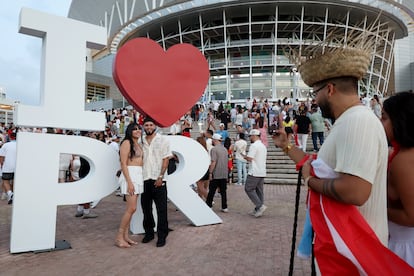
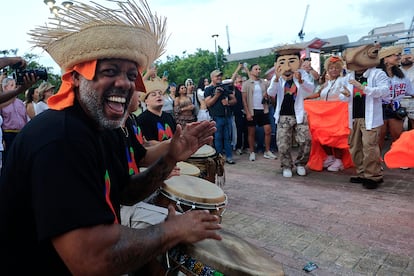
Before entering the venue, fans are greeted with a festival that both those lucky enough to have secured tickets and those who didn’t can attend. The venue features food and drink stands, live traditional music, dancers, a DJ spinning reggaeton (the island is, after all, the birthplace of this genre), people playing dominoes, and even picas, typical gambling games seen especially at the town’s patron saint festivals.
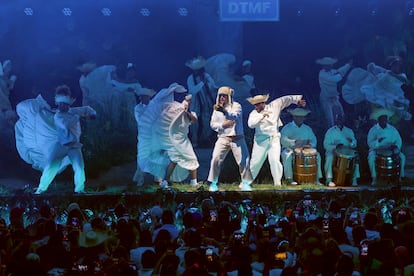
Most of the attendees, ranging from children to adults, are dressed in white, red, and blue, the colors of the Puerto Rican flag, while carrying hundreds of straw hats of various sizes. Many carry straw hats identical to the one Martínez Ocasio wears during the concert, which he always prides himself on — he even wore the hat at the elegant Met Gala in May — as a tribute to the jíbaros, the peasants who have historically cared for the island’s lands and are considered guardians of Puerto Rican customs. The women also dressed as jíbaras, with the typical long skirts and a flower in their hair, either a maga, the national flower, or a poppy.
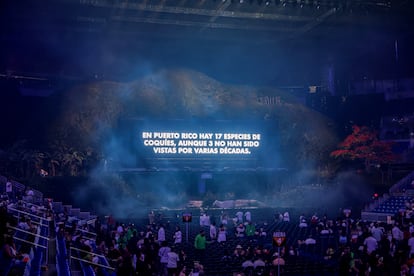
The interior of the arena itself has been transformed. The bathroom doors have been painted to resemble the iconic and colorful houses of Old San Juan. But the real show is on the main stage, which is now a field surrounded by a mountain. On the left side is the banana grove next to the two white plastic chairs that traveled the world on the cover of the album DeBÍ TiRAR MáS FOToS. In the center, there’s a flock of chickens that are fed corn before the show begins and then removed. And on the far right, there’s a red flamboyan tree, which, although not native to Puerto Rico, is considered a cultural symbol on the island.
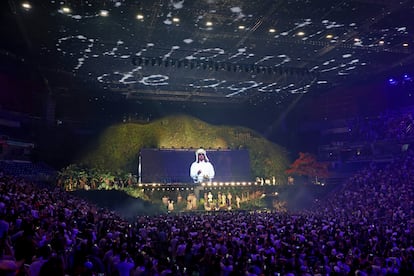
Facing the mountain rising in the background is a large screen on which, in the hour before the concert, a series of messages about Puerto Rico, its history, culture, and resilience are projected. “Puerto Rico is an unincorporated territory of the United States, but it has its own flag, culture, and identity,” reads one; “Puerto Rico has two indigenous musical genres: bomba and plena,” adds another. These two traditional rhythms are central elements of the concerts, as they were on the album. Although Bad Bunny has warned that each night will be different from the last, the first three performances kicked off to the sound of bomba, a musical style created on the island by enslaved Africans during the Spanish colonization.
The night begins with Afro-Puerto Rican musician Julito Gastón searching for his drum. Desperate, he searches through the vegetation on the stage until he finally finds it. “My bad, they’ve taken everything from me, and all I have is this drum. It’s my being, it’s my everything,” he admits to the audience. “When my drum plays, Borinquen is happy,” he adds, invoking the name the Indigenous people of this land gave to Puerto Rico before the arrival of the Spanish.
Gastón takes a seat and beats his drum, kicking off the concert. The stage fills with dancers dressed as jíbaros and jíbaras, and Bad Bunny launches into ALAMBRE PúA (Barbed wire), a previously unreleased song with bomba rhythms that, after being presented exclusively at the first three performances, was released on all music streaming platforms this Monday. The video for the new song, in fact, shows the residency’s stage.
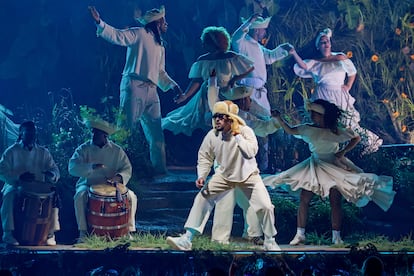
From that moment on, the audience is immersed in a three-hour journey through various Puerto Rican musical genres, as well as different stages of Bad Bunny’s career. From the aforementioned bomba and plena to other typical sounds, Martínez Ocasio performs songs like Amorfoda, released in 2018, or Si Estuviésemos Juntos, from his first album of the same year, to more recent tracks like KETU TeCRÉ or EL CLúB, from his new album.
Pure reggaeton is reserved for the second stage: a pink and yellow house, typical of the local suburbs, built at the far end of the arena. It comes complete with a marquee — a carport or garage — where so-called marquee parties have always been held in Puerto Rico: parties with family or friends where people dance, eat, and drink. But this isn’t just any house; it’s Bad Bunny’s, and his marquee party is attended by stars of the caliber of LeBron James, who attended the first concert last Friday.
Throughout the first weekend, Puerto Rican reggaeton artists like Jhayco and the duo Jowell y Randy will arrive at the venue to get the crowd dancing with songs like Safaera (2020), Tití Me Preguntó (2022), and EoO (2025). “Reggaeton is yours,” Bad Bunny reminds the audience. On the first night, Martínez Ocasio paid tribute to all the reggaeton artists, producers, and DJs from Puerto Rico. He read a list of their names and spent almost three minutes going through them all, while the venue erupted in applause.
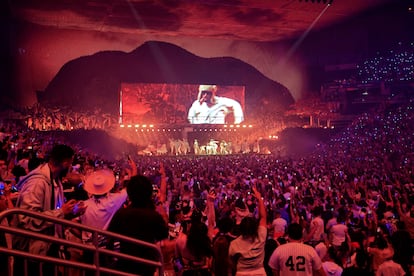
Jorge, a 34-year-old Puerto Rican who attended the concert that night, describes it as “a very unique experience in the sense that it’s very rare to see so many different aspects of Puerto Rican culture consolidated in one space over a three-hour period.” “On an emotional level,” he adds, “it’s very moving to see different generations sharing, and also to know that those who made all this are from here, where there aren’t as many spaces to creatively express our roots and our own experiences.”
The first performances culminate back on the main stage with another tribute, this time to the great Puerto Rican salsa singers. Along with a band of young musicians called Los Sobrinos and Los Pleneros de la Cresta, Bad Bunny performs songs from Baile Inolvidable to La Mudanza, both from his latest album, as well as a salsa version of Callaíta (2019). The night culminates in a collective catharsis when the ceiling of the entire venue is illuminated with a giant Puerto Rican flag. Here, the single-starred flag floats alone, unimposed by the freckled gringo. And the blue of its triangle is sky blue, not navy blue.
Sign up for our weekly newsletter to get more English-language news coverage from EL PAÍS USA Edition









































