
From libertarian dream to political weapon: How the far right appropriated the crypto wave
Leaders such as Trump, Milei and Bukele raise these assets as a banner to attract disenchanted citizens while profiting from their popularity
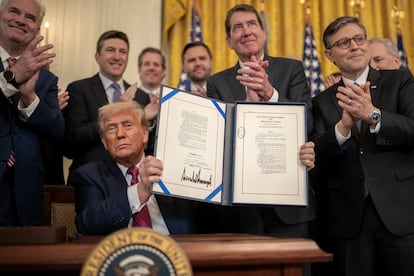
On the night of January 17, 2025, shortly before Donald Trump’s inauguration in the Oval Office, the Andrew W. Mellon Auditorium was celebrating. Amid tuxedos and evening gowns, the first Crypto Ball took place, an exclusive event where crypto-linked entrepreneurs and public officials gathered to welcome the Republican tycoon. The industry was counting down the hours to greet an administration that promised it a golden age. The joy soon turned to euphoria: that same night, Trump became the first cryptobro president of the United States by launching his own memecoin.
The Republican’s return to the White House brought cryptocurrencies into the mainstream: the leader of a superpower doing multimillion-dollar business in that industry legitimized the investment in the eyes of the general public. Shifting from real estate to this new asset has proved a gold mine for the magnate, who last year declared income of more than $1.4 billion (over €1.2 billion).
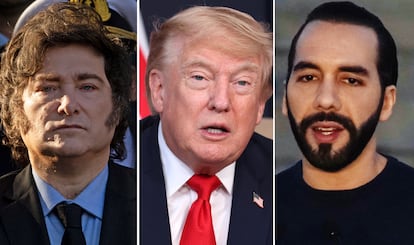
But Trump has not been the only far-right leader to gamble on this market. He was not even the pioneer. El Salvador, under Nayib Bukele, was the first country in the world to adopt bitcoin as legal tender in 2021, a project it had to reverse last year to secure a loan from the International Monetary Fund (IMF). Argentine President Javier Milei promoted another memecoin, $Libra, a month after Trump, which turned out to be a scam. And the British politician Nigel Farage, leader of Reform UK, also proposed deregulating cryptocurrencies and creating a bitcoin reserve fund modeled on the one proposed by Trump in the U.S. He now finds himself on the ropes after revelations about gifts from a crypto billionaire convicted of fraud.
“The myth of absolute freedom preached by Milei or Bukele is part of a new cyber-libertarian wave dominated by the far right,” says Paolo Gerbaudo, senior researcher in social sciences at the Complutense University of Madrid. “Cryptos attract the far right because they represent the power of wealth that refuses to be regulated by political authority.”
In theory, however, the crypto world should be apolitical and free of ideologies. Bitcoin was born in 2008 inspired by the ideas of the cyberpunks, activists from the 1990s who saw cryptographic technology as a way to protect the privacy of their communications from governments and large corporations. As the world sank into the worst financial crisis in decades, caused by excesses in the financial sector, this new currency emerged, designed to operate outside banks and intermediaries. That anti-system rhetoric — distrust of the state and the promise of quick prosperity — does align with the ideology of part of the new populist right and of authoritarian leaders who have appropriated the iconography of this universe in their political discourse and made it their banner.
The 2008 financial crisis shattered many promises and unleashed a social discontent that endures today, worsened by the housing crisis, precarious work and the erosion of purchasing power across generations who feel the system has failed them. Leaders such as Trump or Milei have been better than anyone at reading that frustration. “In this climate of anger, cryptocurrencies become an especially useful tool because they present themselves as an alternative to the system and sell the idea that it’s possible to climb economically without following its rules,” says Javier Carbonell, director of Future Policy Lab.
Economic opportunism
Ideology alone, however, does not fully explain the marriage between the crypto world and the far right, authoritarian sphere. There is a far more pragmatic matter at play: money. Political parties and candidates in countries as different as the U.S. and El Salvador have found in the industry a gold mine to finance their campaigns: in Washington, the crypto lobby has thrown itself fully into the midterm elections and has contributed nearly $190 million.
This is not a new trend: these assets have been used for years as a tool to finance extremist movements. The U.S. leads the way, but in recent years Europe has gained ground and has come to receive half of these flows, mainly destined for white supremacist, nationalist and antisemitic groups, according to a Chainalysis report.
Cryptocurrencies have ceased to be a marginal phenomenon and have become a tool serving extremist objectives. The U.S. has embraced stablecoins — stable cryptocurrencies issued by private entities whose value is pegged to a currency such as the euro or the dollar — as a new channel to reinforce the global hegemony of the greenback. This is what Tobias Boos, a researcher at the University of Vienna, calls crypto-mercantilism.

These leaders’ approach to the crypto universe does not always stem from a deep conviction about the technology or its potential economic or social benefits, but rather from its narrative usefulness. “Crypto or artificial intelligence carry an idea of modernity: the belief that if we develop them, we will be at the vanguard of progress. In El Salvador that narrative works as a propaganda tool, but the question is: for whom?” asks Boos.
Bukele presented his project as a solution to improve financial inclusion in a country where in 2021 barely 40% of the population older than 15 had a bank account. The aim was to build an alternative financial system based on cryptocurrency, but adoption was limited. Over time, the official discourse shifted toward the idea of modernizing the country and becoming the Silicon Valley of Latin America, attracting crypto industry giants such as Tether, issuer of USDT, the largest stablecoin on the market, which moved its headquarters to the Central American country in 2025.
Power and social media
The rebellious, anti-system spirit of cryptocurrencies has faded over 15 years, giving way to a sector that already displays influence within the gears of power. The crypto industry, led by Coinbase, managed in January to block a U.S. bill to regulate the crypto market, the Clarity Act. The company’s rejection of the draft forced lawmakers to sit at the negotiating table to align with the interests of the sector and those of traditional banking.
The alliance between cryptocurrencies and major political leaders is also transforming the very nature of politics, which is increasingly provocative. The memecoins launched by Donald Trump and promoted by Javier Milei — which caused multimillion-dollar losses for thousands of investors — are one example. So is Dogecoin, the prototypical memecoin backed by Elon Musk, whose influence even inspired the name of a U.S. government agency created to promote efficiency, DOGE. “It is the irreverence of internet culture facing a politics perceived as dull, overly regulatory and bureaucratic,” Gerbaudo says.
But that complicity does not end with a few tweets. It has reached one of the pillars of the state: the currency. The rise of stablecoins — digital versions of the dollar issued by private companies — shifts monetary power toward private actors. And the proliferation of memecoins with no real utility creates what the Complutense University researcher calls an economy of fraud. “What purpose does such a currency serve if not to benefit its issuer? The striking thing is that 10 years ago we would have called it a financial crime, while today we tolerate it as if it were free market,” he insists.

The normalization of these dynamics would be hard to understand without the role of social media. The crypto universe rests on the desire to belong to something bigger: digital communities that share codes, narratives and expectations. Platforms like X or Telegram thrive in a context marked by a crisis of intermediaries, explains political scientist Eduardo Bayón. “It is related to lack of expectations, political disengagement, the crisis of the media and the growing tendency to get information through social networks,” he says. “In these environments, what predominates is an extreme discourse of individualism and radical libertarianism, conspiratorial theories and a specific vision of economic success.”
In a world where the social elevator is broken, the promise of getting rich quick has found fertile ground. That is the breeding ground for part of the so-called finfluencers, financial content creators who present speculative investment as a route to economic advancement accessible to anyone. In Spain the case of Álvaro Romillo, known as Cryptospain, became famous: he promised minimum returns of 20% a year and ended up accused of fraud, belonging to a criminal organization and money laundering. Romillo also financed the European Parliament campaign of Se Acabó La Fiesta leader Luis Pérez, Alvise. But now those endorsers are joined by figures such as Trump or Milei, who with a few tweets can move millions of dollars.
The pursuit of economic success at any cost serves as the common thread of many of these narratives. And the central promise of cryptocurrencies connects directly to that aspiration: quick riches. This new ecosystem embodies the concept of homo speculans, developed by Aris Komporozos-Athanasiou, professor of sociology at University College London, in his book Speculative Communities. For the scholar, the financial crisis marked the transition from homo economicus — a rational individual who calculates costs and benefits — to a more imaginative subject who, faced with an uncertain future, has nothing left but to speculate, something that ceases to be exceptional. “The greater the uncertainty we perceive, the more we tend to speculate,” he sums up. Trump, Milei, Farage or even Bukele did not create this subject, but they have learned to speak its language.
Sign up for our weekly newsletter to get more English-language news coverage from EL PAÍS USA Edition









































