
Cristina Stolhe, photographer of the fleeting: ‘You can’t control time, and that’s life’
The artist, who gained recognition on Instagram for her ability to capture unexpected fragments of reality, is showing her second solo exhibition in Madrid

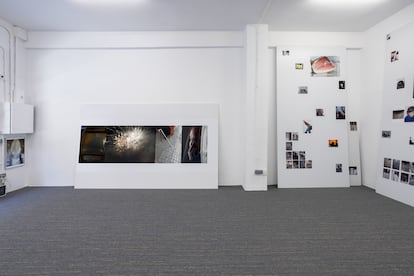
On stepping into Madrid’s El Chico gallery this summer, visitors could be forgiven for thinking they have come to the wrong place. That, for a while, the space has been handed over to a fashion designer and turned into the backstage area of a runway show. The large panels leaning against the walls seem to point in that direction: they closely resemble the boards typically found behind the scenes at such events, listing available looks, the collection’s inspirations or details of the set design.
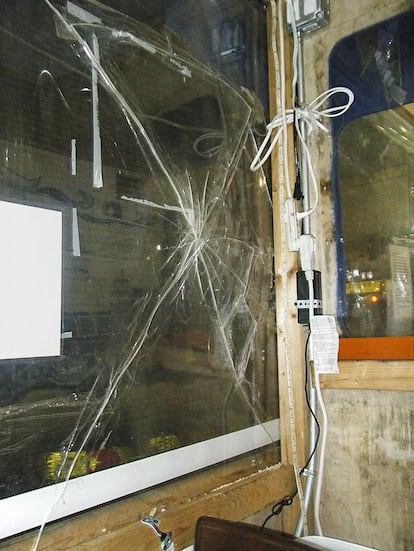
A closer look, however, quickly dispels that impression. The images attached to the panels are not conventional fashion photographs but rather strange fragments of reality. Pictures that seem accidental at first glance, yet reveal a highly distinctive gaze: that of Cristina Stolhe, 33, one of the most promising photographers of her generation — and also one of the most difficult to pigeonhole.
Stolhe resists labels. Even the title of the exhibition, No Te Preocupes Si No (Don’t Worry If Not), part of PHotoEspaña’s Off programme, embraces that ambiguity. Its boundary-crossing character is reflected in photographs that appear almost inadvertent — fleeting moments that very nearly never happened at all.
“The exhibition comes from where I find myself at this moment,” Stolhe says. “I’ve been taking photos for a long time, but in recent years I’ve started working in fashion. Brands ask me to do the same kind of work I was already doing, and they give me a great deal of freedom.”
Her new solo exhibition — following a previous show at the same gallery in 2022 — plays on that duality. “It’s an exercise in honesty about where I am, about accepting these two identities, the two worlds I move between,” says the photographer.
Stolhe says the idea of displaying her photographs — printed in album-sized formats — on panels like those used behind the scenes at fashion shows stems directly from her own experience in the industry, working for brands such as Loewe, Miu Miu and Hodakova. Yet there is an unexpected twist: only one of the photographs on display comes from those commissioned fashion shoots. It is also the only one that is framed.
The rest are arranged across large white panels leaning against the walls, sometimes overlapping and at times revealing unsettling blank spaces. “The backstage is an image of life,” she says. “I’ve always photographed life, the everyday, what interests me, a moment that slips away.”
The notion of backstage also points to the ephemeral, the transient. These purely functional spaces are usually dismantled once the main event is over. “I try to speak about everything that is present and happening while you are missing it. You can’t control time. And that’s life. That’s where the exhibition title comes from,” she says.
The exhibition brings together photographs from different periods, with no rigid formal or technical rules: there are images shot on analogue cameras alongside snapshots taken on a cellphone. One piece is even a photograph of another photograph displayed on a computer screen. For Stolhe, the object of fascination is not photography itself but the image.
“I use the iPhone a lot, and different digital cameras,” she explains. “At first I did that because I couldn’t afford to work in analog. I was studying and working, and I started looking for other digital cameras that worked for me and became interested in experimenting with them. I’d save up to buy a big camera, and end up selling it because it weighed me down. With a large SLR, I couldn’t be quick, and it also didn’t go unnoticed. I use what works for me. Besides, each camera has its own density, color, and texture. That interests me more than what I might add or retouch in post-production.”
In a room at the back of the gallery, she has created a kind of altar devoted to the prehistory of her photographic career: an image of the artist herself holding a point-and-shoot camera, alongside three photographs taken during a school trip to the Valley of Cuelgamuros (formerly the Valley of the Fallen), a vast monument outside Madrid commissioned by dictator Francisco Franco after the Spanish Civil War. Several of them feature the classic accidental finger obscuring part of the frame.
“I like the mistake,” she says. “When I was preparing the exhibition, I found a photo of myself as a child with a point-and-shoot. I was 12, I was already a bit emo, and it surprised me to see that I’m still the same person. Really, nothing has changed that much.”
At a time when photography is caught between competing currents — from the challenge posed by AI and the new digital pictorialism enabled by editing tools, to the cult of analogue photography and the visual overload of Instagram and social media — Stolhe describes her practice in disarmingly simple terms: “I take photos.” “That urge to photograph anything hasn’t changed over time,” she says.
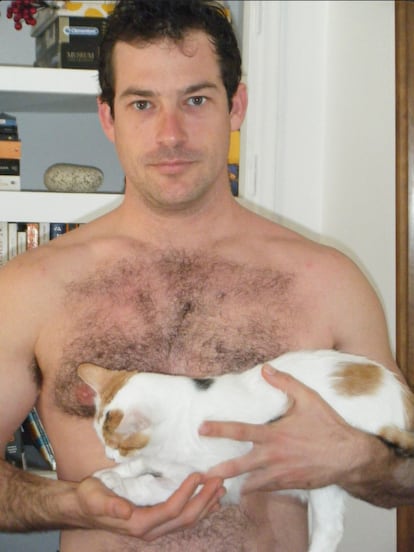
The Spanish photographer first gained attention through a hypnotic Instagram feed. She says she is perfectly comfortable with the proliferation of images and the saturation of visual culture, particularly because so many of those images carry meaning. The exhibition includes portraits of friends and photographs of strangers. Details, unusual angles, moments of glare and overexposure. On the gallery’s front window, a photograph of her grandmother’s hand serves as a reminder that images are not merely collections of pixels: this particular photograph, this very print, has been with her for years, still bearing traces of the adhesive tape once used to attach it to a wall.
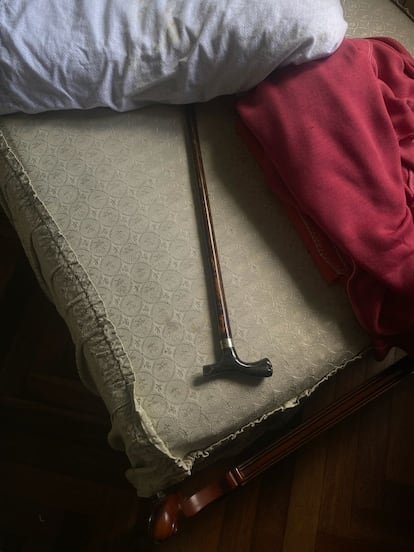
There are also series of images that, as she puts it, “became series without meaning to.” Photographs of coffee cups, oranges, airplane windows and walking sticks. “I’m very obsessive, I’m always looking for the same thing. I’ve never been a purist of photography. For me, what matters is memory, and I remember every photograph I’ve taken,” she says.
There are playful elements, too. The floor of El Chico Gallery does not normally feature the striped carpet currently installed there — a nod to the flooring at the Paris airport the photographer frequents. The installation even reproduces the imperfections of the original, including sections where the pattern fails to align properly.
In a way, it’s an invitation to be carried away by curiosity — to trust the impulse of seeing. “It’s a celebration of my chaos and my identity: my archive, my self, my younger self, my cameras, the ones left behind, life,” she says. “It’s my reality. If you see something, you see it. And if not, don’t worry.”
Sign up for our weekly newsletter to get more English-language news coverage from EL PAÍS USA Edition









































