
100 years of Leica’s compact camera: The click that revolutionized photography
The German company celebrates the first century of the diminutive apparatus that transformed the way professionals and amateurs alike take photos
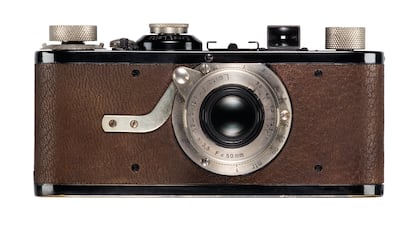

Among the historic photos of the 20th century, one finds Robert Capa’s dying Republican soldier of the Spanish Civil War, Cartier-Bresson’s man leaping over a puddle, the passionate Times Square kiss between a sailor and a young woman in celebration of the end of the Second World War, the little girl in Vietnam fleeing with her skin covered in napalm burns, and Alberto Korda’s portrait of Che Guevara. What they all have in common is that they were taken with a Leica camera. A small, compact, revolutionary device; the Leica I, with its 35-millimeter film (also called the 24x36, a reference to its frame size), was first presented by German businessman Ernst Leitz II on March 1, 1925 at the Leipzig Trade Fair, which was renowned for its technological innovations. The camera’s success was immediate among photographers and amateurs, not only due to its size, but also its optical quality. Since then, Leica cameras have captured some of the most momentous happenings on Earth.
From June 25 to 27 on the outskirts of the German town of Wetzlar, home to just over 50,000 inhabitants, the Leica company — which invited this journalist to join — celebrated 100 years of the camera in Leitz Park, the building complex that serves as a Disneyland for the brand’s faithful following. Construction on Leitz Park began nearly 20 years ago and was completed in 2018. Last year, it was visited by some 60,000 people.
During the celebrations, it was full of photographers, tourists, Leica staff, the business community and journalists — around 800 guests in all, many of them hailing from Asia, and particularly, Japan. The land of the rising sun is an important market for Leica, being the only place where it sells its smart phone, as the product awaits a European release. Nearly all the visitors carried their camera with them, some hanging theirs from a shoulder like an Hermès bag, with a touch of fetishism. Indeed, representatives from the luxury firm have served as consultants to Leica in the past.
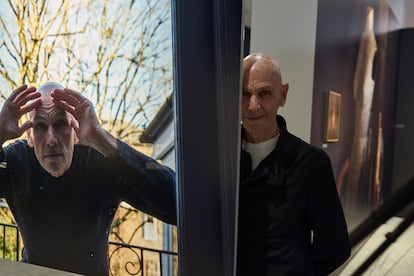
The centennial’s packed scheduled included an exhibition of a master of color, Joel Meyerowitz. The affable 87-year-old New Yorker signed books and posed for photos with his admirers. There was also a small collection of images by another Leica fan, the British musician Jamie Cullum, who performed at a gala dinner on Thursday the 26th.
That night, before dessert was served, guests were treated to a projection of the nearly final version of the documentary Leica: Witness to a Century by director Reiner Holzemer, in which renowned photographers share their Leica practice. In addition to Meyerowitz, the film features Steve McCurry and the recently deceased Sebastião Salgado. It has its fair share of surprises, as when it reveals former The Police guitarist Andy Summers’s Leica passion. Watch for its release in movie theaters and on streaming platforms.
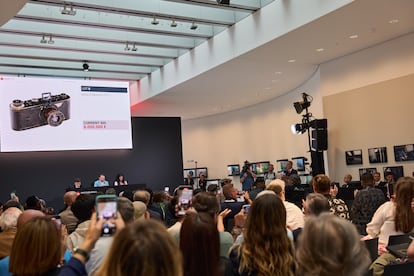
The building that houses Leica’s cultural center in Leitz Park is shaped like a film reel canister when seen from the sky. It features exhibitions, including a selection of iconic photos that were taken with a Leica, and glass cases that contain different models from throughout the brand’s history. On Friday the 27th, one of its two yearly auctions took place. Its star was a Leica I prototype from 1923, which an anonymous buyer acquired by telephone for $8.4 million.
A few feet away, the Leica Store sells the latest models, as well as others from more than a half-century ago for those who like a retro touch and can pay the price — for example, a 1958 apparatus sells for $41,000. There are photographic accessories, home movie projectors, watches (“this one is manufactured entirely in Germany,” shares a seller in regards to a model that costs $17,500) binoculars and telescopic lenses.
Karin Rehn-Kaufmann oversees Leica’s 28 galleries located around the world and the interactive Ernst Leitz Museum in Wetzlar. In a conversation with EL PAÍS, she says that the latter space’s goal is for anyone “over the age of 10 to be able to find something interesting”. To that end, it houses numerous touch screens that tell the story of the business, detail photographic processes, color effects and even “a digital dark room, where you can bring photos you took on your phone,” she explains. In the Leica galleries there are talks and presentations. Two more locations will open in coming months.
Members of the “Leica community”, as Rehn-Kaufmann calls it, have several reasons behind their passion for the cameras. Aside from the lens quality is their elegant design. One must remember that in 2010, when Steve Jobs presented the iPhone 4 to the world, he said, “Glass on the front and back, and steel around the sides. It’s like a beautiful old Leica camera.” Rehn-Kaufmanna says that the cameras manufactured today “still feature the design elements of the older models.”
And what do professional photographers find so special about their Leicas? Aside from those previously mentioned, the brand’s cameras have been used by Kertész, Robert Frank, Bruce Davidson and Elliott Erwitt. Shutterbug and camera collector José Luis Mur, owner of Fotocasión, a well-regarded Spanish store, says by telephone that after its launch, the Leica “was imitated by all its competitors, there have been up to 300 copies.” Not to mention, its photographic images have been replicated to the point that they have become the “universal format”.
Mur adds that these days, Leica’s quality can be found in other cameras, meaning that “today it is more of an elitist cult object.” “Perhaps professionals use other cameras, and the Leica is for enjoyment. But before, when one had a Leica in their hands, it was thought that they were going to take better photos.”
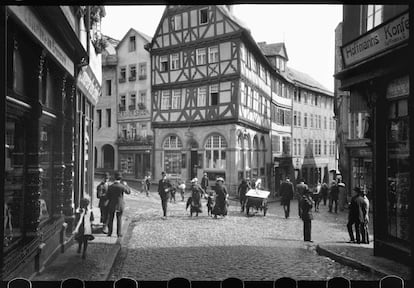
For the past three years, the Leica complex has also been home to an archive that is accessible via guided tour. In its displays sit objects that harken back to the history of the brand, like the first photograph taken by a compact camera in Wetzlar, back in 1914. It was shot at an intersection by its inventor, the engineer Oskar Barnack, who worked at Leica.
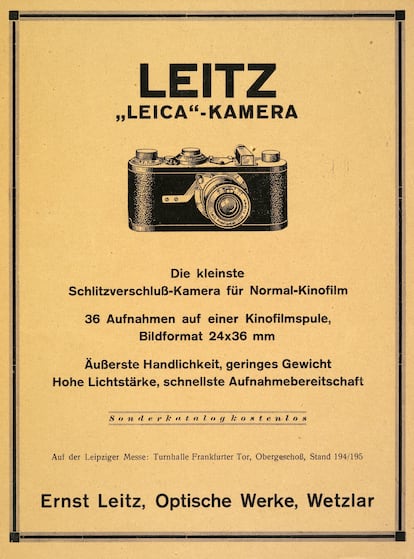
Here too is the brand’s first advertisement, published in a photography magazine; also, a 1920s instruction manual for the camera with an image of a woman on the cover, indicating that the product was meant to be used by a diverse public. All one had to do was look through the lens and click to shoot.
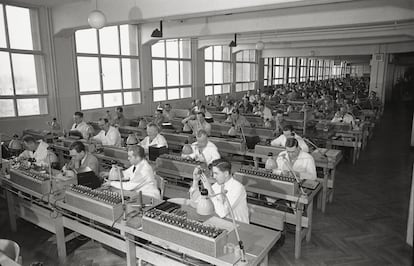
That accessibility explains why the impact of the 1925 launch was so enormous. For photographers, it meant going from carrying around a bulky camera to slipping one into their pocket that could be discreetly used in difficult situations. In just a year, around 1,000 were sold. In 1929, 16,000 were manufactured.
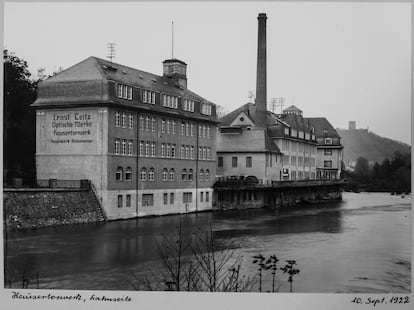
The Leica — its commercial name came from a blending of “Leitz” and the German “kamera” — was manufactured in Wetzlar because ever since 1849, the town had been home to a lens factory built by the waters of the Lahn River that had proved to be particularly suitable for use in the polishing process. Twenty years later, the company was renamed after its owner, Ernst Leitz. At the time, the firm manufactured microscopes and starting in 1907, binoculars.
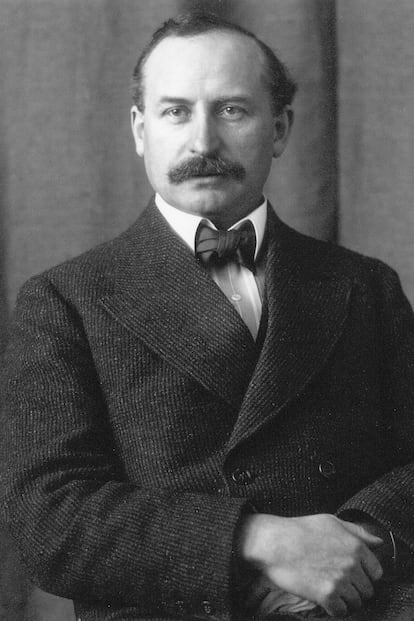
Then came a technician who was destined to put a twist on the Leica story. Oskar Barnack was a photography aficionado whose asthma made it too tiring for him to carry around the enormous wooden apparatuses with glass plates used for shooting in those days. Barnack set about building a small and compact camera that could use movie film, which had already been invented, with the tweak of changing its direction from vertical to horizontal.
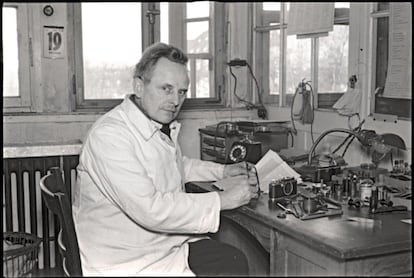
Barnack successfully tested his invention while the town of Wetzlar was experiencing flooding, but World War II, with its German defeat and subsequent difficult era for the country, led to delays in the product’s commercial release. During that trying time for the company, Ernst Leitz II, the founder’s son who had taken over the firm’s leadership, proclaimed: “I hereby decide: we will take the risk.” And they did, presenting their new product a few months later at Leipzig.
Later, in the first years of Hitler’s command, Leitz saved some 200 Jews from the Holocaust, giving them money and a ticket to sail to another country. He also gave each one of them a camera. But the Nazis needed businesses like Leica and the products it made. Leitz became a member of the Nazi Party in 1942 and contributed to the Third Reich’s arms projects. However, his humanitarian work was recognized by the United States in 2007.

Back at Leitz Park, Rehn-Kaufmann recognizes that the firm also went through difficult times when digital photography became popular in the 1990s. “The company didn’t believe in its importance,” she says. Furthermore, when the current owners took over Leica in 2004, they were “unaware” of its true financial situation. “Then came the 2008 financial crisis, which made everything more difficult,” she says. “But here we are!”
During the event in Wetzlar, there was much discussion, and with good reason, about what artificial intelligence will mean for photography. Leica’s CEO Matthias Harsch said at a press conference that for the company, “the authenticity of an image is what is most important.” That’s why one of the latest models incorporates into each photograph a certificate (they call it a “content authenticity initiative”) that guarantees that it has been taken by a person, not generated by AI. Rehn-Kaufmann adds, “I don’t think that people are going to take photos of their family or a wedding with artificial intelligence. AI needs photographs for its training, and we have them.”
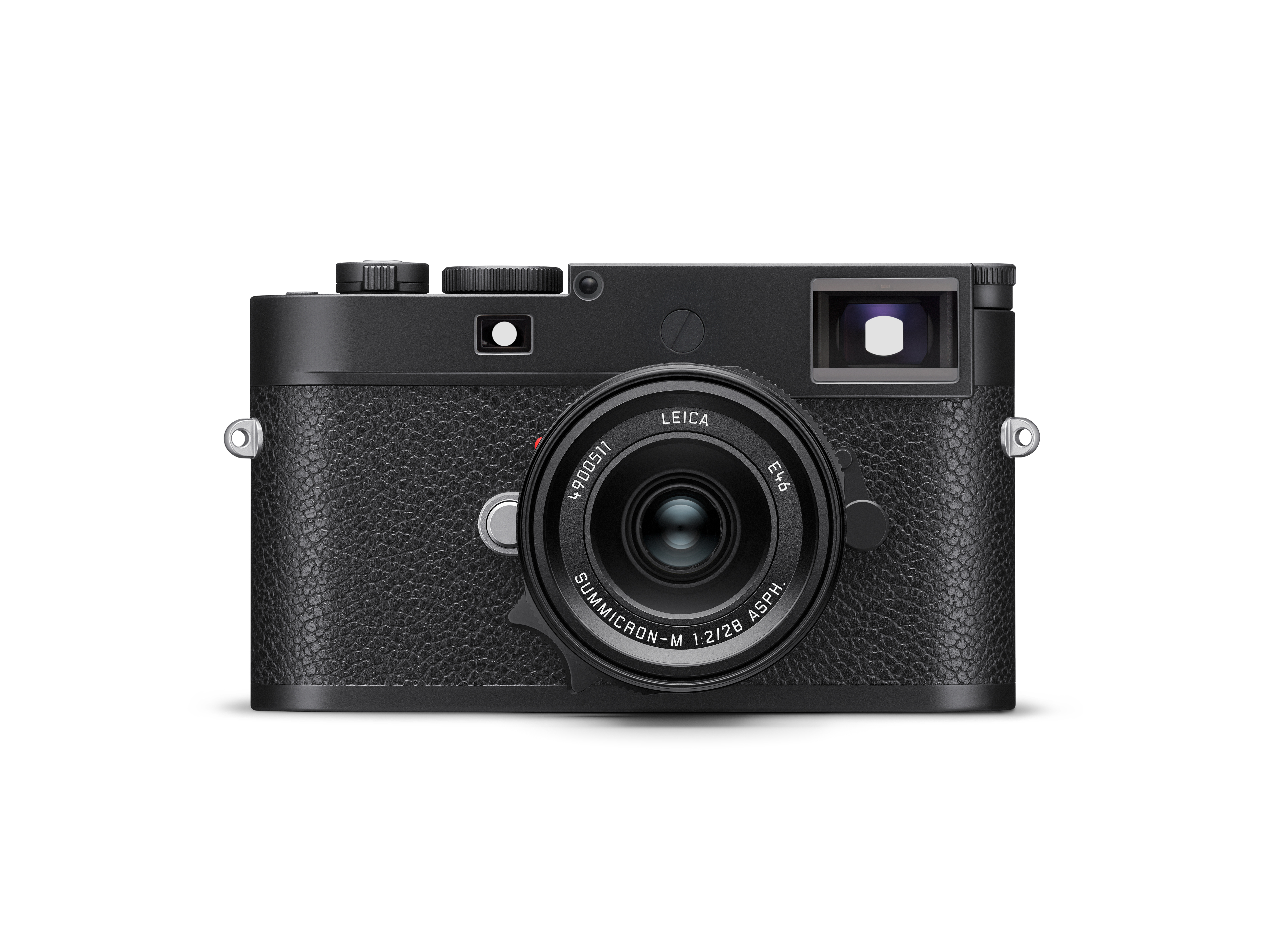
And the cameras? Do they have a future beyond the pros? “Of course,” says Rehn-Kaufmann. “The entryway to photography is taking photos with a phone, but when someone really likes photography, they realize that smart phones have their limits.” That there will still be photographs in the future, taken with a variety of apparatuses, seems clear. Also, that we will still be excited to see what we’ve captured with our click. This sensation is summed up by a photographer in the centennial documentary: expect nothing, prepare for everything.
The book of the century
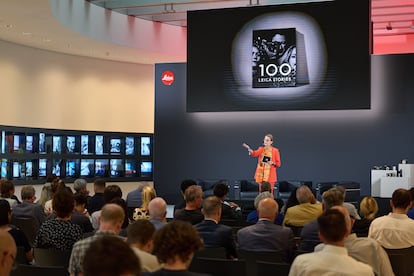
Among the celebrations of the Leica camera’s first century in Wetzlar at the end of June was the presentation of the book 100 Leica Stories. The precious 322-page volume tells of the making of historic photos that were taken by a Leica. With more than 170 photographs, the book features anecdotes related to the camera told by its fans, as well as the tale of the company’s trajectory, different models, and technical highlights.
Sign up for our weekly newsletter to get more English-language news coverage from EL PAÍS USA Edition









































