
From Twitter to X: The most polarizing social network still dominates 20 years on
The platform marks two decades of existence with more users than in the blue-bird era, despite evidence of its contribution to global disinformation
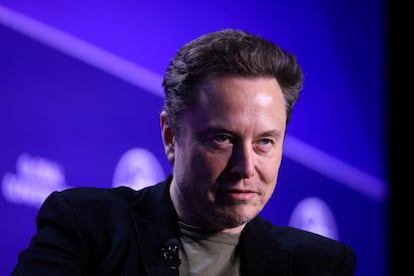

Today marks 20 years since the launch of Twitter. Over that time the platform has changed dramatically — far beyond replacing the blue bird with a white X on a black background. After buying it in 2022 for $44 billion, Elon Musk relaxed the rules, reinstated accounts that had been suspended for breaking them, and fired the content moderators (along with about half the company’s staff). He decided the users themselves should do the moderation through so-called community notes, which add context or flag falsehoods in posts. That system has proven unable to ensure truthful content circulates. Everything fits in X’s jungle, including child pornography. Musk’s arrival marked the start of a profound transformation that includes the launch of a paid service and that — judged only by user numbers — has worked.
X is now a platform that spreads misinformation, as several studies show; that gives greater weight to far-right proclamations and that has changed its algorithm to prioritize the most polarizing content. It is also Musk’s mass-reach toy, which he uses to whip up racist pursuits, as happened recently in Belfast; to publicly attack whom he sees fit; or to boost electoral campaigns, such as the one that returned Donald Trump to the White House. The only time the South Africa–born magnate has been forced to backtrack was earlier this year, when he made X’s generative AI tool, Grok, stop creating hyperrealistic nude images from real photos. And if he reversed course, it was because the whole world turned on him.
the bird is freed
— Elon Musk (@elonmusk) October 28, 2022
Despite this major mutation, X still attracts 585 million monthly unique users. That figure, provided by the company itself, is substantially higher than when it was called Twitter: before Musk bought it, it had about 370 million users, although it had once flirted with 400 million. The numbers have improved.
Why do users keep trusting X despite its evident transformation? The first reason is size — inertia. For a social network to be interesting, there has to be a worthwhile community. On Twitter everyone was there. When it mutated to X and the far-right shift became evident, many left. But others did not. “Governments and political parties have chosen, despite the degradation of this platform, to keep their profiles on X to report their activities or express their opinions,” says Carmela Ríos, a journalist and expert on social networks and disinformation. “A significant part of politics has stayed on X, which has created a circle around which political conversation is then built, a conversation that everyone participates in, even if it isn’t always very civil.” That, in turn, has had consequences. “X’s consolidation has ended up elevating rude politicians, aggressive polemicists and even liars. In other words, those who know how to row in the algorithm’s favor.”

The difference between X and the Twitter of 10 years ago is vast, but we may also be amplifying it unconsciously. “One should ask first whether that Twitter we now miss ever existed,” says Ekaitz Cancela, an economist and researcher with the Technopolitics group at the Open University of Catalonia. “We assumed social networks represented the democratic promise we saw in Spanish town squares in 2011 or in the Arab Spring. We forget that back then, it also went hand in hand with harassment and the fast pace of life, and that it was based on the very same business model of making money off our data. What remains of that is, above all, nostalgia.”
Ríos offers another key that may explain the success of today’s X: “It is a highly ideological, very entertaining instrument in which extremist and provocative content of all kinds gets preferential placement in any user’s timeline, whether they want it or not. It’s no longer fit for calm conversation, for finding information in an orderly way, or for following the evolution of an emergency in real time, like major wildfires,” she says. “And yet, X retains a journalistic DNA, mainly because the other social networks have failed to fill the gap, where it is still harder to find good information.”
No other platform has managed to develop an environment like Twitter-X’s; it reigns in the microblogging space — short-text publishing (with images, video, or audio). Meta, owner of the two largest social networks in the world (Facebook, with more than three billion monthly active users, and Instagram, which is approaching three billion), tried with Threads, its version of Twitter, but it never took off. Bluesky, which grew thanks to users exiled from X, has never passed the 40-million mark, 14 times smaller than Musk’s network.
just setting up my twttr
— jack (@jack) March 21, 2006
It’s not easy to outshine X. “In the digital economy, generating excitement isn’t enough. What matters is keeping people connected for as long as possible. When hate and violence are glorified across all social media platforms, the promise of a less biased alternative isn’t enough,” says Cancela. “Bluesky replicates Twitter’s architecture without breaking away from its political economy of attention: it needs to grow, retain users, and, sooner or later, monetize the attention it accumulates.”
X’s algorithm has made it an important machine of disinformation — and one that many autocratic leaders like. Strange as it may seem, that can be positive for some groups. “Unlike Signal, X is little restricted worldwide. It is used by very heterogeneous profiles and raises fewer suspicions. There are still academics who use it to communicate in repressive environments, for example people affected by the genocide in Gaza,” illustrates Lorena Jaume-Palasí, an expert in ethics and legal philosophy applied to technology and founder of Algorithm Watch and The Ethical Society. The fact that it offers access to unfiltered information is a window for places where media are controlled by the administration.
A recent study by IAB, the world’s largest association of communication, advertising, and digital marketing, notes that many users still get their news from X; others stay because they do not want to cede such an important space to voices from the extremist spectrum; and a third group remains because they enjoy watching or participating in political dramas or fights played out via tweets. “X has turned polarization into a new form of entertainment, a sort of American Wild West saloon where you can choose to sit quietly behind the piano with a whiskey or grab a parlor chair and join the brawl,” Ríos concludes.
Sign up for our weekly newsletter to get more English-language news coverage from EL PAÍS USA Edition









































