
The Federal Reserve defies Trump with a unanimous rate hike six weeks before the midterms
In his first major decision as Fed chair, Kevin Warsh raises interest rates by a quarter point and signals another increase before year-end
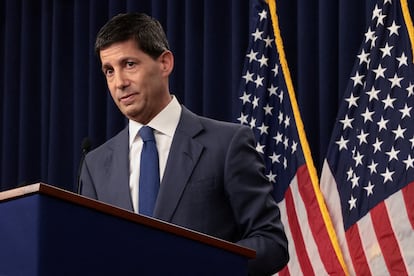

Kevin Warsh has been chair of the Federal Reserve for just four months, but this Wednesday will be remembered as the day he showed that he and his fellow governors, not outside forces, are the ones truly steering U.S. monetary policy. The Fed has done exactly what U.S. President Donald Trump did not want it to do under any circumstances: raise interest rates just six weeks before the midterm elections, in which Republicans risk losing control of Congress.
With this move, Warsh, a conservative billionaire appointed by Trump, has shown that he is serious about his commitment to fighting inflation, even if it means harming the electoral interests of the man who chose him in the belief that he would comply with his desire to make the United States the country with the lowest interest rates in the world. That has not been the case.
The increase is modest, at 25 basis points. The federal funds rate now stands in a range of 3.75% to 4%. But it is a powerful signal: it is the first rate hike in more than three years. The last came in July 2023. With this decision, Warsh’s Fed is underscoring its determination to bring inflation under control after more than five years in which prices have failed to move anywhere near the central bank’s 2% target.
The decision was also unanimous, ending a year marked by dissenting votes among members of the Board of Governors. That unanimity lends additional weight to the move and strengthens the Fed’s position against the criticism it is almost certain to face. One of the loudest critics is likely to be Trump. On Tuesday, he attacked the Supreme Court, particularly the three conservative justices he appointed during his first term, for ruling against his attempt to alter mail-in voting rules just weeks before the November 3 election. The three justices defied him, and now Jerome Powell’s successor, another Trump appointee, has done the same. Powell, too, eventually became a frequent target of Trump’s attacks.
Another significant takeaway is that Fed officials do not expect this to be the last increase. All but two members of the Board of Governors believe interest rates will need to rise again before the end of the year. Four policymakers anticipate two additional increases, according to the Fed’s latest projections. Warsh, who is reluctant to offer markets guidance about future decisions, does not participate in that forecasting exercise.
The Fed justified its move in a statement arguing that economic activity continues to expand at a solid pace despite heightened uncertainty, partly driven by geopolitical developments. “Job gains have kept pace with the workforce, and the unemployment rate has changed little. Inflation remains elevated. Today’s policy action will support a timelier return to the Committee’s 2% goal. The Committee will deliver price stability,” the statement said.
The rate hike came as no surprise to economists or to financial markets. Warsh had already signaled such a move at the Jackson Hole symposium in August. At the time, he said: “It’s the Fed’s job to make sure that inflation expectations do not get unanchored. [...] We must be confident that underlying inflation is moving to our objective, clearly and at sufficient speed. Otherwise, we have work to do. That’s our job.”
A few days later, inflation data appeared to vindicate those arguing that the U.S. economy needed some cooling. Employment figures remain strong, but consumer prices in August held stubbornly at 3.4%, still a long way from the Fed’s 2% objective.
Trump’s threats
In recent days, Trump has escalated his attacks on the Fed, whose independence from the executive branch has been upheld by the Supreme Court. The president warned that unless interest rates were cut sharply, he would move to halt a significant portion of U.S. trade.
“LOWER THE RATE OR I’LL STOP TRADING WITH COUNTRIES WITH WHICH WE HAVE A DEFICIT, which the U.S. Supreme Court, in its ridiculous and very costly Tariff decision, strongly acknowledged ‘the President’ has an absolute right to do,” Trump said in a rambling post on his social media platform, Truth Social. Later that day, speaking from the Oval Office, he complained that other countries enjoyed lower borrowing costs than the United States and called on the Fed “to be patriots.”
Meanwhile, the war in Iran, which shows no signs of a near-term resolution, and the widening conflict involving Yemen’s Houthi rebels have kept oil prices above $100 a barrel, pushing up gasoline prices in the United States and threatening to fuel further inflationary pressures.
Before Friday’s decision, several analysts had warned that if Warsh wanted to preserve the Fed’s credibility as an institution capable of acting free from political interference, he had little choice but to raise rates. Doing otherwise might have pleased Trump and perhaps provided a modest boost to long-term growth prospects, but it would have pushed the goal of bringing inflation under control further out of reach and, above all, dealt a serious blow to the central bank’s independence.
Sign up for our weekly newsletter to get more English-language news coverage from EL PAÍS USA Edition









































