
Claire-Louise Bennett: 'Difference, chance and risk should be at the heart of the experience of love, something almost impossible in a world of dating apps'
The acclaimed British writer returns with ‘Big Kiss, Bye-Bye,’ a novel about desire, identity and the mysteries of attraction
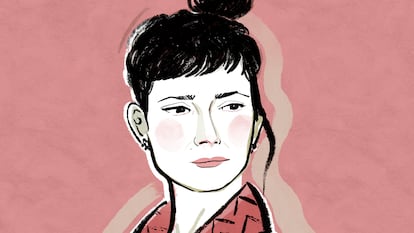

Claire-Louise Bennett has said she is fascinated by the ways we exist in other people’s minds, by what we become when we are reduced to an idea. Perhaps that is why her fiction is always filtered through a consciousness: someone obsessively searching for a way out, or for a place in the world. Is love a kind of compass? Can it give shape to the self, each time in a different way?
Bennett thinks it should, but she also believes we are increasingly preventing it from doing so. Dating apps are no help, she says. In her latest novel, the intense, labyrinthine and deeply interior Big Kiss, Bye-Bye, she asks how love places us before a mirror and reveals the parts of ourselves we would never admit are also there. And something like that can only be reached, as Anaïs Nin might have put it, through the mystery of what draws us to another person when nothing has been agreed in advance.
At her home in Galway, Ireland, Bennett, who is also the author of Checkout 19 and Pond, answers the video call. She is seated at an enormous table. It is covered with notebooks and crystal spheres. Nearby, she says, there is even a glass penguin. And the mug from which she occasionally takes a sip still contains some of the Yogi Choco tea she made for herself a little while ago.
Question. Big Kiss, Bye-Bye is a long conversation between two lovers that recalls both the obsessive prose of Thomas Bernhard and the stream of consciousness of Virginia Woolf. In that conversation, Xavier functions as a kind of totem, a looming presence against which the narrator defines herself, sketching an outline of who she is and making herself real. To what extent is love a kind of existential compass?
Answer. I love the image. Yes. Without a doubt, it is. I deeply believe that love is an existential experience. I read Alain Badiou’s In Praise of Love a long time ago and felt he was right about everything. At the center of the experience of love should be difference, chance and risk — elements that today, in a world dominated by app-mediated dating, are practically impossible. Today’s world encourages us to think in terms of compatibility. We look for someone who fits us, who reaffirms who we already are. That very conscious way of approaching relationships can be quite transactional, like shopping, because it forces us to define in advance what we are looking for in a partner, what we expect from a relationship and what our limits are. Love is the opposite. Love is the great revealer.
Q. In what sense?
A. Love reveals who we really are. It shows us things about ourselves we would never have dared to imagine, much less admit. That is why attraction that arises in real life has such enormous force and, at the same time, is so unsettling. Anaïs Nin was terrified of being fixed into a stable, defined personality. She wanted to flow, to be always transforming, and for her love, made that perpetual motion possible — that existential expansion. Her stories and novels show how intimate encounters can uproot you, turn your world upside down, take you far from whoever you think you are at that moment. What today might be dismissed as mere romanticism is, in reality, what makes love a deeply singular experience. After all, it is the most powerful force there is, provided one has the courage not to try to manage or direct it.
Q. In your case, writing itself also seems to function as a compass, a way of finding your path through words and through what words construct: fragmentary scenes, memories seen from a single perspective, disorientation, something mutable and therefore open to transformation. Would you say that’s true? What are we, really? Everything we might yet become, or everything we have been?
A. Sometimes I feel I do not have a self, at least not in a strict sense. What I am is a place where very diverse forces orbit — and sometimes conflict —: archetypes, psychic patterns, impulses and memories both personal and collective, and many other things. There is a huge part of what I am that is completely unknown to me. And yet I know those unknown elements exert a huge influence on my everyday life. It is tempting to use writing as a way to make sense of that chaos and learn to navigate it, but the satisfaction it offers is only superficial. That is not what I am looking for. Samuel Beckett said the artist’s task is not to clarify things, but to find a way to make room for disorder. I completely agree.
Q. Is that why your writing has this quality of being unreliable, of constantly transforming itself?
A. Yes. My writing follows a winding path, full of false starts, dead ends, and overgrown landscapes. And, every now and then, small clearings appear where there is a sense of respite, immediacy, and communion. The thing is, I don’t write to affirm anything. I write by denying, subverting, and undermining. And that’s because, although we need to place some faith in reality in order to keep on living, deep down I don’t believe that what we call reality actually exists.
Sign up for our weekly newsletter to get more English-language news coverage from EL PAÍS USA Edition









































