
Warsh says the Fed will not tolerate persistently high inflation
The Federal Reserve chair reiterates in Congress his commitment to bring price growth back to the 2% target
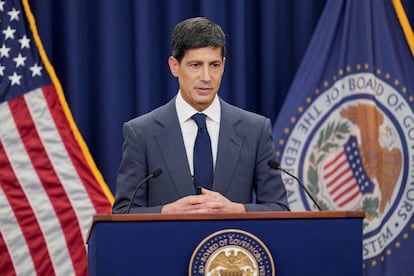

Kevin Warsh is a man who does not like surprises. The Federal Reserve chair is determined to stick to the script, and on Tuesday he delivered a speech that leaves little room for interpretation. The U.S. monetary policymaker appeared before the House Financial Services Committee to stress that he will not tolerate persistent inflation and reiterated his commitment to rein in price increases after five years of inflation above the Fed’s 2% target.
“Members of our committee have no tolerance for persistently elevated inflation. And we share a resolute commitment to restoring price stability,” Warsh told lawmakers at the Semiannual Monetary Policy Report to Congress. Later, in response to questions from legislators, he said that the Fed wants price changes to be more limited.
Although he has spoken out against forward guidance—the strategy of signaling future Fed moves—Warsh peppered his remarks with messages of firm commitment to fighting inflation. “Sixty-three months of inflation above target have been an unfair burden. It has acted as a tax on the American people and businesses. We plan to eliminate that tax. That means we need a regime change in policy and a fresh look at practices, some of which have worked and others that have not,” he insisted.
Most analysts expect at least one interest-rate increase before the end of the year, according to the probability tool compiled by FedWatch. In fact, markets had feared a rate hike as early as this month at the June 29 meeting, but Tuesday’s strong June inflation reading sharply reduced that likelihood.
The new Fed chair emphasized that the United States is “at a hinge point in history.” He said the decisions made now will determine whether the country can achieve standout growth in the future. “The Fed’s number one objective is to get monetary policy right—or as near to it as we possibly can. That is our clear and constant aim, the star we steer by. And if we get policy right—and we will—the inflation surge of the last five years will be a thing of the past,” he told members of Congress.
The new chair also said he has created five task forces to improve the central bank’s internal functioning. “The purpose here is to equip the Fed to make better decisions in monetary policy and to put these years of high inflation behind us,” he said.
Institutional independence
Warsh’s arrival at the Fed came amid controversy over Donald Trump’s attacks on the previous chair, Jerome Powell, which threatened the central bank’s independence. The president had demanded lower interest rates. Warsh, traditionally viewed as a monetary-policy hawk with a combative stance toward inflation, softened his rhetoric during the past year while the president opened up the selection process to replace Powell.
Analysts are trying to decipher which Warsh has taken the reins at the Fed: the hawk determined to fight inflation with decisive rate hikes, or the one inclined to placate Trump. Those doubts were reflected in questions from Democratic lawmakers, who repeatedly pressed Warsh on his independence from the White House. “We’re honored to be independent,” Warsh said as lawmakers asked what he would do if Trump attacked him for disliking his monetary policy.
The chair acknowledged the difficulty of conducting monetary policy at a time when many things are happening that are “beyond our control,” such as the war with Iran. Warsh also stressed that the Fed will not shirk responsibility.
Division over persistent inflation
His remarks came the same day that June’s inflation data were released. Prices fell that month for the first time in six years: the monthly price index had not declined since the start of the Covid pandemic. Annual inflation eased to 3.5% after rising to 4.2% in May, helped by lower gasoline prices.
The early-June agreement on a U.S.-Iran cease-fire restored traffic through the Strait of Hormuz and normalized oil prices, which had surged after hostilities began in late February. However, tensions have flared again and the two countries have resumed attacks and blocked the strategic waterway, which foreshadows further inflation spikes and new challenges for the Fed.
Still, Warsh repeated that the Federal Reserve should focus on core inflation, which excludes the most volatile items in the shopping basket such as energy and food. Core inflation in June held steady at 2.6%, three-tenths of a percentage point higher than in May.
Warsh’s cautious stance comes amid pressure for the Fed to raise interest rates to contain inflation, which, he acknowledged, has been above target for five years. At the same time, voices within the Fed calling for a more forceful response to rising prices are growing. Christopher Waller, a member of the Fed’s board, said Monday that if prices remain above target the institution will have to act.
Beyond that debate, Warsh, a 56-year-old economist and attorney from Albany, NY, expressed optimism about the U.S. economy’s performance, describing a picture of moderate household consumption growth, steady improvement in manufacturing output and a real estate sector that has yet to take off and remains lagging.
The impact of AI
He also sounded upbeat about the labor market’s evolution. “America’s labor market appears broadly stable. Job creation has kept pace with the workforce. The unemployment rate is low and has changed little over the past year. We’re seeing relatively few layoffs, only slight variance in the rate of job vacancies, and solid growth in nominal wages,” he said.
He added that “the most striking feature of the economy right now is business investment,” referring to the boom in the artificial intelligence industry, with multimillion-dollar investments to build data centers to power their models. “We don’t know the extent to which the economy will benefit from the AI buildout. Yet it seems inevitable that what is now called ‘AI investment’ will soon be called just ‘investment’,” he said, suggesting it also poses risks because of the high concentration of capital in a sector that has committed more than $650 billion just for this year.
Sign up for our weekly newsletter to get more English-language news coverage from EL PAÍS USA Edition









































