
Kevin Warsh, poised to usher in ‘regime change’ at the Federal Reserve
The new head of the financial institution will chair his first meeting to decide the path of interest rates. He is also expected to change the Fed’s narrative and communications
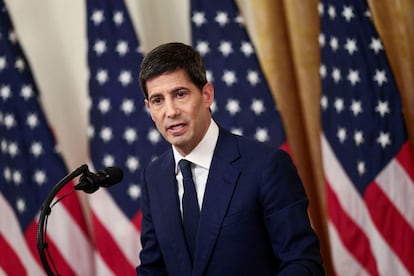

His time has come. Kevin Warsh will this week chair his first meeting of the Federal Open Market Committee (FOMC), the body that sets interest rates, after his official appointment as chair of the Federal Reserve in mid‑May. The candidate chosen by U.S. President Donald Trump to lead the central bank has long awaited this moment. Warsh arrived at the Fed with a simple, precise playbook: he made clear to anyone who would listen that he favors lower interest rates, a smaller balance sheet and less transparency in communications. He called that strategic shift a “regime change.”
The new Fed chair takes office at a complicated moment. Inflation has rebounded in a way that runs counter to his theory that borrowing costs should be cut because, in his view, “the advent of artificial intelligence is a significant disinflationary force.”
His theory collides with reality. Prices climbed 4.2% in May, the highest level in three years, driven by higher energy costs as a result of the U.S. and Israel’s war with Iran. And although the new chairman says attention should be paid to core inflation, which excludes the most volatile components such as energy and food, that measure rose two tenths of a point in May to 2.9%, above the Fed’s 2% mandate.
The meeting comes three days after Donald Trump, on Sunday — his birthday — reportedly secured a peace agreement with Iran. Although the pact is fragile and still has significant loose ends to be resolved, it has helped push down oil and natural gas prices and sparked a rally in financial markets.
So Warsh’s debut comes amid opposing forces. But he is not the only decision‑maker in the room. If he wants to complete the strategic shift he foreshadowed during his Senate confirmation hearing, he must persuade the other 11 voting members of the FOMC. He faces the task of building consensus at a moment when the board of governors is more divided than ever between those who favor action to fight inflation and those who believe financing costs should be reduced. And he must do so on a board that—contrary to tradition—still includes his predecessor, Jerome Powell, who has remained as a governor and become a bulwark against a Trump eager to push rates down.
Until this weekend, the market had been wagering on an imminent rate hike to confront the inflation rebound, but after the peace agreement, analysts expect the Fed will leave rates unchanged for the rest of the year within the current range of 3.5% to 3.75%, according to investor odds compiled by FedWatch. “The main risk to watch is a possible disconnect between a committee leaning toward a more restrictive stance and a chair whose own views on inflation appear more constructive,” warns Tiffany Wilding, an economist at PIMCO, the world’s largest active fixed‑income manager.
Although Trump relentlessly pressured Jerome Powell, Warsh’s predecessor, to cut rates aggressively, the new chair can take a calmer approach. At Warsh’s swearing‑in ceremony the president removed some of the pressure: “I want Kevin to be totally independent [...] just do your own thing and do a great job,” he told him. With that endorsement, Warsh appears to have bought some time before the White House occupant resumes the attack. “Markets will watch Warsh’s statements closely; he should adopt a firm inflation message to reassure economic actors about the Fed’s independence,” says Sebastian Paris Horvitz, head of research at LBP AM, owned by LFDE.
But beyond setting the price of money, Warsh has other concerns. He has pledged to overhaul communications. He believes the central bank gives too many clues about its next moves, which constrains its future actions. That is known as forward guidance, a communication strategy introduced during the 2008 financial crisis to help markets anticipate moves when rates were at rock bottom. Analysts will be watching the Fed’s Wednesday statement and Warsh’s subsequent press conference. Everything is expected to be shorter and more concise, because the new chair has already made clear he does not think the Federal Reserve should condition itself by revealing its intentions.
“Warsh has confirmed he will hold a press conference after the June meeting, although it remains unclear whether he will keep that format for every meeting. A return to quarterly press conferences, as was the case before 2019, is a plausible future outcome, although June is probably too soon for that change,” Wilding of PIMCO says.
On Wednesday the body charged with safeguarding the dollar’s stability is scheduled to publish its Summary of Economic Projections (SEP), in which the 19 FOMC members (the 12 voting members and seven other state bank governors) set out their forecasts for growth, inflation, employment and the path of interest rates. Analysts speculate that Warsh will ask to remove the dot plot, the chart that summarizes the 19 governors’ outlook on monetary policy for upcoming quarters.
“The main event of this week’s FOMC meeting will be the press conference,” says Sue Hill, an analyst at Federated Hermes. “It is likely the dot plot will take on a somewhat more restrictive tone, potentially projecting no monetary policy action for the rest of the year. Yes, it is likely the FOMC will drop language suggesting a tilt toward easing. But all eyes will be on what Warsh says and, importantly, on what he does not say,” she adds.
Whatever Warsh’s role, this Wednesday he will have a different style and tone from Jerome Powell, who will remain a member of the Fed’s board after Trump’s crude attempt to have him prosecuted. It remains to be seen what role Powell will play in this new era. “Warsh’s promised regime change may take some time to play out,” Hill admits.
Sign up for our weekly newsletter to get more English-language news coverage from EL PAÍS USA Edition









































