
Jonathan Haidt, social psychologist: ‘The possibility of AI taking over most jobs is very real’
The author says that, in developed countries, there is widespread discontent with social media. He also warns that Big Tech companies shouldn’t have access to children
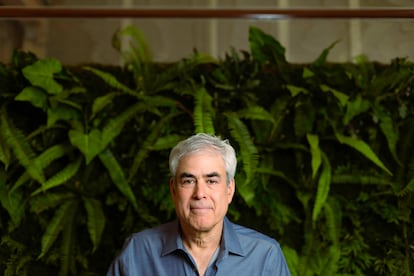

Jonathan Haidt, 62, believes that the human psyche is composed of a great elephant — made up of emotional, libidinal and intuitive processes — and a small rider (reason) who tries to guide the animal and acts as its press officer. The rider’s job is to rationalize and justify the elephant’s positions to the world.
Based on this idea, the New York-born author has attempted to understand the clash between political stances in an increasingly polarized world. He writes about this conflict in The Righteous Mind: Why Good People Are Divided by Politics and Religion (2012).
Haidt is a social psychologist and a professor at New York University (NYU). His first book, The Happiness Hypothesis: Finding Modern Truth in Ancient Wisdom (2006), seeks to reclaim the idea of well-being in a psychological field focused on treating distress. In the text, he explores doctrines such as Buddhism and Stoicism, many of whose principles are applicable to people who are lost in the contemporary malaise.
His latest book is titled The Anxious Generation: How the Great Rewiring of Childhood Is Causing an Epidemic of Mental Illness (2024). It has caused quite a stir, confirming what many suspected: that technology is ruining the psyche and socialization of young people.
Haidt came to Madrid to speak about these issues at the Rafael del Pino Foundation. He took the opportunity to visit some high-ranking politicians, including Spain’s Prime Minister Pedro Sánchez and the leader of the opposition, Alberto Núñez Feijóo. “Both agree that it’s necessary to raise the minimum age for access to social media,” Haidt notes. He supports not allowing its use until the age of 16.
Question. Are you a techno-skeptic?
Answer. Yes. I started out as a techno-optimist, a product of the 20th century. One of my earliest memories is the Moon landing. I always wanted to be an astronaut or a scientist. As a social psychologist, I’ve been interested in how technology changes the way we live, think and relate to each other: problems have arisen, but we’ve solved them. So, I’m open to the idea that technology can improve the world.
Q. But?
A. I think [some] technologies like social media or AI can have such profound effects that we may not be able to adapt.
Q. It seems that, nowadays, technology controls us, not the other way around.
A. Exactly. When the iPhone came out, it was an incredible [kind of] Swiss Army knife with a flashlight and calculator, but it wasn’t designed to make us use it all the time. Then, social media and notifications arrived… and [that] incredible tool [suddenly] became the centerpiece of the attention economy. That’s when it became detrimental to humanity.
Q. They sold it to us as “freedom,” but it was actually a very long leash.
A. It’s an invention you can’t break free from, even if you try; you feel compelled to return. It [feels] like servitude.
Q. We didn’t live on the internet before.
A. Steve Jobs said that computers were bicycles for the mind. The early internet seemed like a miracle: we saw that it could topple tyrants in the Arab Spring.
Q. But?
A. But then, the dark side appeared. With Cambridge Analytica, we saw that networks could be used for manipulation. We saw that they were becoming harmful. And so, we began to ask ourselves, “What have we done to young people and to ourselves?” Today, in developed countries, there’s a sense of discontent with social media and technology.
Q. Children today won’t know what the world was like without the internet; they might think that being addicted to mobile phones is the normal way to live.
A. Childhood has been reprogrammed. Humans evolved to live in the savanna and the forest, climbing trees, in a natural world. It’s not good for kids to grow up with a screen; they need to explore, touch, run, look people in the eye.
Q. You’ve focused on the effect of technology on children. But shouldn’t we also limit social media for adults?
A. Adults are also harmed, of course. But I’ve focused on young people for two reasons. The first is that the harm is greater during puberty, [meaning that] delaying social media use can have enormous benefits. Second, adults need social media; it’s useful for them. But kids really don’t need it. They wouldn’t miss out on anything.
There’s a third reason: companies shouldn’t have access to children. If adults choose to gamble or do drugs, that’s their choice. We let them make bad decisions. But we shouldn’t allow companies to hook children [to their products].
Q. What has happened with artificial intelligence?
A. At first, ChatGPT was fun; it didn’t [work] very well. We expected it to grow slowly… but it grew faster and faster. Its capacity doubles every three or four months. The possibility of it taking over most jobs is very real. That’s why it’s causing resistance: Western societies used to be technology-friendly, but not anymore. The U.S. is the most anti-technology society of all, even among university students, who always supported these innovations [in the past].
Q. Sometimes it makes me angry to see parents give smartphones to very young children, just to keep them busy. What should I do?
A. You can’t say anything to them. But I always tell policymakers that they urgently need regulations and public health campaigns against the so-called “digital pacifier.” We have evidence of the harm that technology does to young children, and yet we consider it normal to give tablets to children under five and [to have] strollers with screens attached to them. This hinders proper brain development.
Q. Does emotion matter more than rational thought today?
A. It’s always been that way. There are only very specific conditions where that’s not true. Are you familiar with those gigantic machines in physics labs, where they can create plasma? You can create other forms of matter under very specific conditions. In that way, universities and investment funds aim to prioritize rational thought. Outside of those contexts, emotions are what drive the world.
Q. Is something similar to cancel culture on the left happening on the right today?
A. Yes, certainly with ideas that originated within the far left, such as the concept of “microaggressions.” Academics who studied the concept warned that it could be adopted by the right. And this has come to pass.
Q. It seems that religious and spiritual expressions are making a comeback. Why?
A. I know that among young people, especially young men, at least in the U.S., we’re seeing this resurgence. Men aren’t choosing some form of progressive Protestantism, but rather Catholicism or the Orthodox Church… harder, more restrictive options that demand greater sacrifice. I think it’s because young people are lost in a pit of anomie and meaninglessness, desperate for moral guidance; [they want] something to give structure to their world.
Sign up for our weekly newsletter to get more English-language news coverage from EL PAÍS USA Edition









































