
Magical thinking, extraterrestrials and the Devil himself: why spirituality is back
From a look at neo-Pentecostalism to alternative therapies, new books explore how rationalism appears to be giving way to faith


No more gods, no more fairies, no more magic. The dawn of the Enlightenment implied the displacement of religious ideas, superstitions and all supernatural belief. Reason-led scientific knowledge would guide civilization towards progress. Max Weber called this process the “disenchantment of the world,” as its steam engine flattened prophets and goblins alike.
In a way, everything worked out — after all, technological progress brought with it increasing material well-being (in some places, at least). But even if we are surrounded by smartphones, microwave ovens, and men on the Moon, a need for communing with the transcendent remains at the heart of being human. Today, we are witnessing not only a resurgence of religiosity and spirituality, but also the proliferation of pseudoscience, conspiracy theories, and even debates about the return of extraterrestrials.
A recent survey by the Spanish pollster 40dB, carried out on the occasion of the Pope’s visit to the country this week, finds that religiosity is growing among Gen Z men 18 to 27 years old. In general, this group is the most open to non-material realities — but while men are opting for traditional religion, women prefer alternative or non-ecclesiastical spiritualities like yoga and astrology. Several new books analyze this phenomenon.
“It was thought that the process of secularization was going to erase all traces of irrationality, but the fact is that part of life is irrational, that which has to do with the imagination, intuition, even falling in love,” Manuela Cantón, an anthropologist of religion and author of La imaginación en llamas [Imagination on fire] — a trip from urban beliefs of the Great Beyond to Mexico’s Santa Muerte, from Roma evangelism in Spain to Haitian Vodou rituals — tells this publication. A spirituality that is less tied to religious institutions, more personal and personalized, seems indicative of an era in which we can select from infinite options at Starbucks and on Netflix. “There has been a displacement of the term ‘belief’: nowadays what is important is the lived experience, the personal search. There has been a New Age appropriation of Christian elements,” says Cantón.

Certain recent cultural products have arrived with a mystical twist, from the Christian mysticism of Rosalía’s Lux tour or the Sufism that infuses Oliver Laxe’s film Sirat. “In Spain there is an anti-clerical tradition, and also a rejection of the national-Catholicism that was fundamental to the Franco dictatorship,” says Cantón. “But right now, there is a certain dissolution of that stigma.” The big news is the expansion of evangelical options, specifically neo-Pentecostal faiths, which have been accused of broadcasting ultra-conservative ideals and a vision of the economy based on individual success tied to divine will: the theology of prosperity. “Neo-Pentecostalism is very aggressive on political and economic issues. It wants to build the Kingdom of God on Earth right now,” says Cantón.
They’re here...
Earth, such religious leaders say, has been visited by celestial beings. U.S. President Donald Trump recently directed officials to declassify files on UFOs and “extraterrestrial life”. So far, this has not led to any bombshells, through as usual, Trump has included no end of ambiguity and obfuscation in his statements (if only for his own entertainment). “Belief in extraterrestrials is an alternative to religion. That is being facilitated by the transition from analogue to digital technology. Infrastructure is changing: now, we can take a photo or video of an extraterrestrial and post it on social media. This is an immediate and shareable form of religion,” Diana Walsh Pasulka, author of American Cosmic: UFOs, Religion, Technology (Oxford University Press), wrote via email.
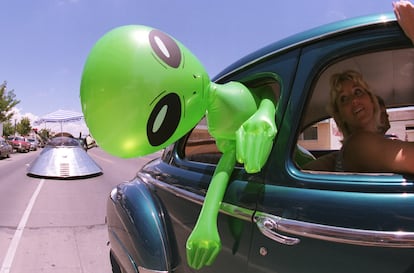
The religion historian attributes interest in extraterrestrials not only to conspiracy enthusiasts, but also to the new religiosity associated with the scientific and business elite, from NASA engineers to Silicon Valley millionaires. Similar to transhumanism, which attempts super-longevity and even immortality through technology, belief in aliens can be akin to a form of salvation and hope in a hyper-technologized and disenchanting world.
“The reason why we have not totally embraced rationalism, as individuals nor as cultures, is that it doesn’t tell the whole story,” she says. Walsh Pasulka points to Martin Heidegger, who, at the start of the 20th century, returned to a classic philosophical query: “Why is there something, rather than nothing?” a question popular among children and anyone else immersed in existential doubt. “Rationalism cannot answer that question. But spirituality and religion do offer responses to similar questions, which is why people turn to them,” says the historian.
Magical overthinking
“Right now, there are the perfect ingredients for the irrational to become mainstream,” says journalist Marta Sader, author of Espiritualidad líquida. Misticismo pop in la era del yo [Liquid spirituality. Pop mysticism in the me era]. Those perfect components are precarity, self-exploitation, loneliness — “the unfulfilled promises of capitalism,” she calls them. Her book describes a constant search for healing, coupled with our perennial necessity to feel special. Liquid spirituality is practiced by the contemporary citizen; lax, syncretic, catering to the tastes of the consumer, and with none of the rigor of what Sader describes as “pure spirituality.” She uses that term to refer to the kind of faith that has been practiced for millennia, “that which pursues things like the deactivation of the ego and the acceptance of reality, not so much momentary relief or the need to transcend,” says Sader.
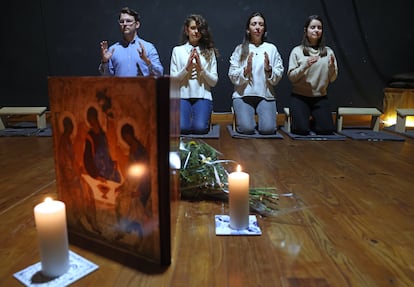
Along these same lines, there are people who think that visualizing wealth can attract wealth, or that letting the positive energy flow can make your tumor shrink. Such an era has been dubbed by author Amanda Montell with a term that also serves as the title of her book: The Age of Magical Overthinking, in which she writes how even as we believe we are living in a hyper-rational, informed and highly sophisticated era, our minds, through a wide array of cognitive biases, think magically in an attempt to find control and logic.
Amid the hustle and bustle of modern life, Montell herself felt a “creeping sense of doom,” the root of which she couldn’t stop Google searching, in vain. It is at this point she started to encounter conspiracy theories, which linked surrounding chaos to a specific cause (an evil elite plot) — as well as disciplines like tarot and astrology, which are gaining prominence on social media and among young generations. And though magical thinking is a natural part of being human, overthinking is “a product of the modern age: this clash between our innate mysticisms, these mental magic tricks that we’ve always played on ourselves to cope, to get through life, these cognitive biases and the excess of information, this information age, when there is this capitalistic pressure to know everything under the sun,” she said in an interview.
The book Conspirituality by Derek Beres, Matthew Remski and Julian Walker delves into the harmful impacts that New Age conspiracy theories, with their massive diffusion on social media, can have on public health. Its exploration starts from a phenomenon widely observed during the coronavirus pandemic: holistic influencers and yoga teachers went from recommending green juice and healthy living to reposting ultra-right hoaxes and memes. “Conspirituality is a powerful and intoxicating socio -religious movement that can ruin families, disrupt public health measures, and encourage civil unrest,” write the authors who themselves come from the world of yoga.
Speak of the Devil
Smell that sulphur? The Devil is back. Use of the Dark Lord to characterize political adversaries is getting increasingly common, so much so that the leader of Spain’s far-right Vox party, Santiago Abascal, has suggested the need to “exorcise” the official presidential residence, La Moncloa. For many U.S. Christians, the Devil is not just a metaphor for evil, but rather an actual being with a tail and horns, according to Javier Cavanilles, author of Satanismo. Historia del culto al mal [Satanism. The history of the cult of evil. Satan is frequently invoked by Trumpism to heighten polarization.
Exorcism is very present in the modern world, according to Grafton Tanner in Purging the Devil: Exorcism and Possession After the Death of God. The book takes a look at the enormous influence of the 1973 film The Exorcist when it comes to the popularization of this kind of anti-demon ritual, and invokes several cases, arguing that demand for exorcisms has actually increased since the mid 18th century.

On a deeper level, the book offers the observation that exorcism has spread to other cultural areas, like the wellness industry, which has come to see therapy as a form of the rite: “removing” trauma, “freeing” emotions, even in the context of treatments for the LGBTQ+ community. It can also be seen in the world of politics, where it is used against groups that resist the power of the state, corporations and the church. Or, as a way of demonizing — literally — youth subcultures. Tanner writes how aforementioned neo-Pentecostal evangelical groups share the belief that dark forces are eroding the moral fabric of the West, and possessing individuals who are not consciously choosing beliefs that challenge the status quo, but rather, are victims of brainwashing.
Sign up for our weekly newsletter to get more English-language news coverage from EL PAÍS USA Edition









































