
‘Nunmania’ is here: Rosalía revives controversial convent craze
The Spanish singer’s approach to religious imagery and her vindication of the convent connects her with other artists, filmmakers and writers who have long paid attention to the world of nuns

Is there a nun craze sweeping the world? The announcement of Rosalía’s new album, titled Lux, seems to be making everything related to nuns trendy, including contemplation, enlightenment, and even the wimple. But this is late 2025, and the singer is neither the first nor the only celebrity to seek answers to the modern world within the walls of the convent.
Rosalía presented her new album in a show of promotional power, overwhelming downtown Madrid and social media. Connecting Callao and Times Square, the Catalan-born singer took to Instagram and TikTok to share her visit to the Spanish capital to unveil the first tracks from an album that nobody has heard yet, although everyone is already talking about it.
Over the past few weeks, she’d been dropping a few hints: first, a mysterious score, then a post on her Instagram account with a rosary around her neck and symphony music playing in the background, and finally, the title, cover art, and track listing.
The new album is called Lux, which means “light” in Latin, and will be released on November 7th. The cover shows Rosalia dressed in white, with a veil covering her head and a dreamy attitude. From her right, a ray of golden light shines down, reminiscent of a classic painting of the Annunciation.
We know her collaborators on the album (from Björk to the Escolanía de Montserrat choir) and have some clues about the content, such as a quote from a Muslim mystic, or the use of words like “mysticism,” “transcendence,” and “a radiant world” in the press materials. Not bad for the woman who sang “te quiero ride/como a mi bike” (“I want to ride you like my bike”) on her previous album.
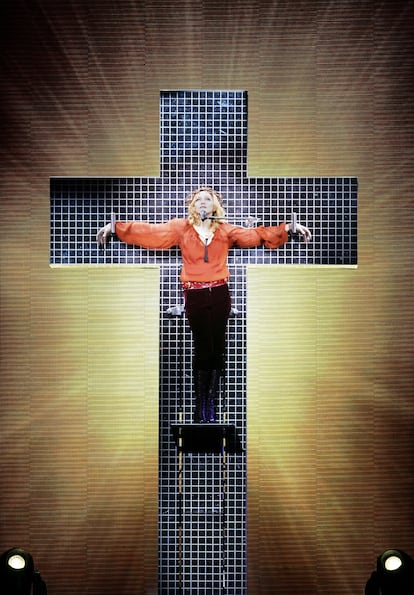
In her short career, Rosalía has demonstrated an extraordinary ability to understand the music industry and anticipate trends. In her handling of fan anticipation and the industry’s promotional wheel, she is reminiscent of Madonna, who, incidentally, came of age musically and produced her first masterpiece when she abandoned “the material world” and embraced spirituality with Like a Prayer. In fact, there are more signs that the nun is making a comeback.
Becoming a nun
The Lux announcement comes the same week as the release of Los domingos (Sundays), the new film by Alauda Ruiz de Azua, which won the Golden Shell at the last San Sebastián Film Festival. Ruiz de Azúa continues her ongoing investigation of the spaces where feminine identities have developed by delving into the one traditionally considered the most limiting: the convent. Los domingos is the story of a teenager who leads a normal life and one day announces to her not particularly Catholic family that she wants to enter a convent.
In an interview in San Sebastián, the director linked her decision to enter the convent to growing older and confronting her family. “I’ve always thought that adolescence is a very delicate time: a need for affection, a need to feel special, that can take you to very exotic or unexpected places, as is the case in the film,” she explained. “Sometimes we adults are very sure of how things work, and suddenly the teenager makes us waver.”
At one point in the film, Ainara, the young protagonist, explains: “I don’t feel bad in the convent. I’m very happy in the convent. That’s why I want to return.” Faced with the turmoil of the contemporary world and the hormonal ups and downs of adolescence, the orderly, simplified, and meaningful convent life becomes a desirable option.
Fascination in film
While in recent years the figure of the nun and the convent had been reduced to the sadistic school teacher or the evil spirit trapped at the crime scene in a horror movie, Instagram has been filled with accounts of young (and not so young) religious women from a wide variety of religious orders who are using social media to vindicate the role of nuns in modern life. Technology has come to the convent to stay.
In cinema, nuns have fascinated audiences for decades. The Bells of St. Mary’s (1945) tells the story of a nun and a priest who team up to save a school for poor children, a story that could only have been told in Hollywood. And they sing, too. It was a huge hit in its time and is one of those films that is shown on TV every Christmas alongside It’s a Wonderful Life!. Coppola demonstrated the impact the movie had in his time in a scene from The Godfather: it’s the film that Michael Corleone and Kay Addams (Al Pacino and Diane Keaton) go to see at the movie theater before finding out about the attempted murder of Don in a newspaper stand. Black Narcissus (1947) is one of the cinematic masterpieces given to us by Michael Powell and Emeric Pressburger and tells the story of the conflicts that sexual desire generates among the nuns of an isolated convent in the Himalayas. The film boasts extraordinary sets and colors, and Deborah Kerr proves she’s one of the finest actresses of her time. And then there’s The Nun’s Story (1959). Who wouldn’t love Audrey Hepburn playing a nun? Her white veil never looked so elegant, as if it had been made by Givenchy. It tells the story of a young Belgian woman from her novitiate to her departure from the convent due to her lack of calling, and including missions in the Congo.
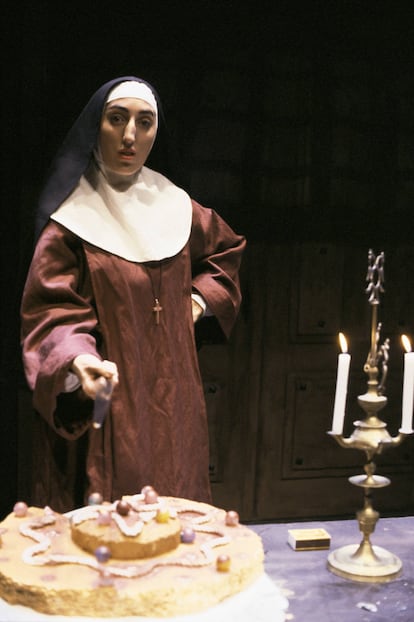
In the 1960s, films about nuns began to rankle the authorities. The French movie The Nun (1966) adapted Denis Diderot’s novel, which had already caused a scandal in Enlightenment France for its exposure of abuses in convent life. Jacques Rivette’s adaptation prompted General Charles de Gaulle to personally censor it, sparking a public confrontation between Jean-Luc Godard (then boyfriend of the protagonist, Anna Karina) and the then minister and intellectual, André Malraux. The Devils (1971), by Ken Russell, recreates the case of the possessed women of Loudon and was one of the most banned films in the history of cinema. With a hallucinatory aesthetic, Vanessa Redgrave plays a deformed nun consumed by desire for Oliver Reed. Not much more needs to be said. The convent scandal subgenre continued with the erotic film classic Behind Convent Walls (1979), by Polish director Walerian Borowczyk. And in 1983 came Dark Habits, perhaps Pedro Almodóvar’s first great film, which traded eroticism for drugs. It tells the story of a junkie bolero singer who takes refuge in a convent after her boyfriend dies from an overdose. The film has it all: lesbian abbesses, nuns with impossible names, eccentric millionaires. Even a tiger. It was a story that could only be told in the Spain just emerging from the Transition and which would these days probably be denounced by the Christian Lawyers association.
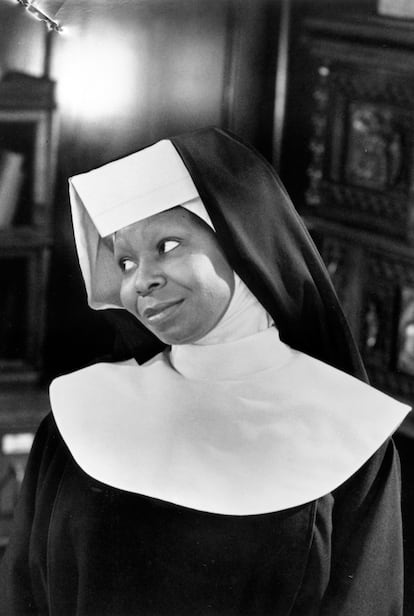
After such scandals, Hollywood came to the rescue to restore virtue to the nuns. Agnes of God (1985) is a 1980s classic that poses dilemmas that aren’t really that interesting but seem that way. Jane Fonda, Meg Tilly, and Anne Bancroft play a psychiatrist, a novice, and a nun, respectively, who must find out who killed a baby found in the convent, who the father is, and how the conception occurred. And Sister Act (1992), the story of a Las Vegas singer who witnesses a murder and must hide from the mob in a convent while awaiting trial, was a hit, attracting a whole new generation of women to the convent and confirming the star status of its protagonist, Whoopi Goldberg.
Perhaps, in an increasingly polarized and noisy world, the time has come to seek answers and peace, as Saint Teresa of Ávila said in The Way of Perfection: “Let us love the virtues and what is good within, and always with study let us be careful to distance ourselves from paying attention to what is external.” For now, Rosalía is doing what she can.
Sign up for our weekly newsletter to get more English-language news coverage from EL PAÍS USA Edition









































