
IACHR opens a crack in Bukele’s jails with a visit to political prisoner Ruth López
The lawyer receives her sister after over 440 days in detention under judicial limbo
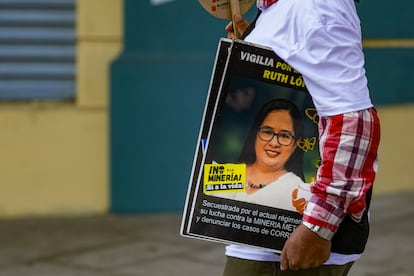
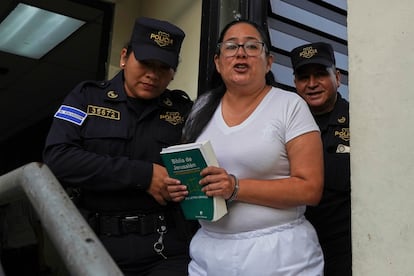
Claudia López, sister of Ruth López — the well-known activist and political prisoner who has been jailed in El Salvador for over 440 days — was able to see her in prison thanks to demands made to the government of Nayib Bukele by the Inter-American Commission on Human Rights (IACHR). “She has lost weight, 10 kilos, and will likely continue losing more,” Claudia López says, recounting the 30-minute visit with her sister. “The food and everything happening around her have affected her. But one of the things that struck me most when I saw her was her mood: she has not lost strength or faith. She remains strong despite everything,” she recounts, 10 days after the meeting.
In a country where prisons are a black hole and where no one knows anything about the nearly 100,000 Salvadorans behind bars, the visit has taken on great significance in El Salvador, a nation mired in a permanent state of emergency by order of Bukele. Ruth López has been in prison since June 18, 2025, when a group of police officers lured her out of her home around midnight, telling her that her vehicle had been involved in a traffic accident. Authorities initially charged her with embezzlement, but later changed the charge to illicit enrichment in a controversial case in which one of Bukele’s longtime political rivals, Norman Quijano, is also being prosecuted.
López, who is also a lawyer, is a prominent activist and human rights defender who in recent years led at least 50 investigations and tabled subsequent complaints before various bodies alleging corruption in Bukele’s government, ranging from irregular purchases to espionage against journalists and human rights defenders.
During the proceedings against her, which have now lasted more than a year, Cristosal, the human rights organization on whose board she serves, has denounced a series of irregularities, such as the use of procedural deadlines from the state of emergency regime (a measure reserved for combating gangs) and her possible temporary enforced disappearance.
In September last year, three months after López’s arrest, the IACHR warned of a possible enforced disappearance after she was kept incommunicado from her lawyers and family, and said her life was at risk because the government could not guarantee the medical care she needed. In December, a local newspaper reported that the activist had been rushed to a hospital for a tumor in her right breast, prompting the family to intensify efforts to see her.
After a year without contact, Claudia López was able to meet her sister on June 30 for approximately 30 minutes. “To enter you have to pass through a very strict screening. You cannot bring anything in, not even a piece of paper or a pen. They give you a very thorough search,” she recounts. “They took me into a kind of office with a room to one side. There were several desks and people coming and going all the time, and the security staff never left us alone. We never had a single second of privacy.”
During the conversation, Claudia says she discussed several topics with Ruth. “First I told her how much support she has out here. She cannot grasp the level of international support she has,” she recalls. “I told her people know she is innocent and she told me that is one of the things she thinks about the most. She said her strength is knowing she did the right thing and that’s why she will never stop fighting.”
Claudia López says her sister told her she is staying strong by leaning on religion. Ruth is Catholic. “She told me that the very next day she began a long fast and that some time ago she had been allowed to attend Mass. She also told me she had requested permission to go again, but they had not allowed it, so they are denying her right to worship as well,” her sister says.
Deaths in custody
Bukele’s prisons are notorious. Although hundreds of YouTubers and international journalists have entered Cecot, his flagship mega-prison, little is known about the other penitentiary centers where tens of thousands of Salvadorans without gang affiliations remain incarcerated. In those other prisons, organizations such as Cristosal have documented systematic torture and others, like Socorro Jurídico Humanitario, have recorded more than 500 deaths from torture or lack of medical care.
Investigative reporting has indicated that there is a system of corruption in which prison authorities charge tens of thousands of dollars to inmates for hospital appointments or family visits. In Ruth’s case, however, contact was granted through IACHR intervention.
“She told me not to worry about her. That she was more concerned about her family. Concerned about her children. She told me: ‘Take care of my children, tell them I love them very much and that I will be with them again,’” Claudia recalls. “Ruth also asked that thanks be given to all the organizations, journalists, and people who have shown solidarity with the case. She asked that people be told what is happening to her. I asked her about the biopsy (which could mean breast cancer), a private matter, and she told me the most important thing is that the truth be known,” López said.
Delicate health
According to Claudia López, the family knew before her arrest that Ruth had several health problems, including a lump in her right breast. “We informed the court of that after her detention,” she says.
In March of this year, Ruth’s family learned that she had been taken back to the hospital and operated on for a 1.5-centimeter nodule. “We did not receive any results from that operation. But in May of this year they performed another biopsy for which we still have no results,” says Claudia, who is also a physician.
Ruth’s case is under full confidentiality, so not even her family can access the medical tests the court has authorized. “That is why we made requests both to the hospital where she was treated and to the prison where she is held, and in both cases they denied us. At the hospital they told us they are not authorized to release the information, that it is the Ministry of Health; and at the prison they told us that only she can request the information precisely because she has not been convicted and retains her rights, but at the same time she cannot go ask for it because she is imprisoned,” she explained.
López’s sister said she is also worried about her relative’s triglyceride levels. “The baseline value is 150 and she has more than 600; that has us very concerned,” she said.
Both Ruth López and her family have demanded a public trial and have declared her arrest a political matter. In El Salvador, Cristosal says there are at least 86 political prisoners being held by Bukele’s government. Meanwhile, the president has ignored criticism and has attacked human rights bodies and journalists who report violations under his administration. Bukele formalized his candidacy on Monday for a third term which, if he wins, would secure him 14 years in power.
Sign up for our weekly newsletter to get more English-language news coverage from EL PAÍS USA Edition









































