
Bukele invokes the Nuremberg trials to justify mass trials against gang leaders accused of 29,000 homicides
Human rights defenders criticize the process, calling it a judicial ‘shortcut’ that seeks convictions instead of establishing individual accountability
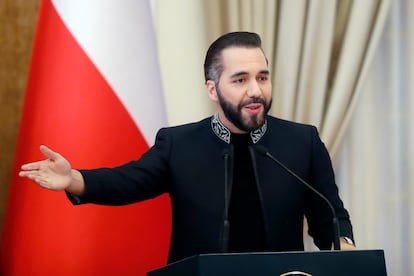
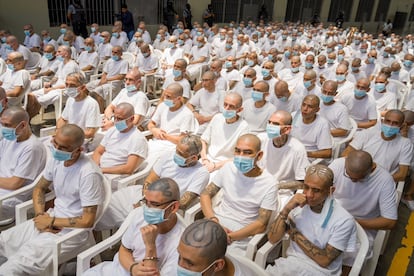
The Salvadoran government has launched a mass trial against 486 alleged gang leaders of the Mara Salvatrucha‑13 (MS-13), including 22 supposed members of the group’s top echelon, known as the Ranfla Nacional, whom authorities accuse of ordering 29,000 homicides committed between 2012 and 2022.
According to the indictment, the gang’s leadership operated from the Zacatecoluca prison in the center of the country, from where they allegedly instructed senior street leaders to “carry out large‑scale killings” — orders that were then passed down to the hitmen tasked with executing them. The proceedings, however, have been criticized by human‑rights advocates, who warn that a trial of this nature does not aim to establish individual responsibility but instead functions as a “shortcut” to convict large numbers of defendants at once. Bukele has described the trial as “historic” and compared it to the Nuremberg trials.
The deputy prosecutor for organized crime, Max Muñoz, said at a press conference that the investigation is based in part on the testimony of 13 witnesses who described details of the so‑called “Open Valves” operation, which allowed homicides to be ordered from inside the prison. “The testimonies are the evidentiary basis that allows us to attribute all the homicides — all the crimes committed by the structure — to the Ranfla,” Muñoz argued.
The proceedings are under strict seal, but EL PAÍS obtained the indictment through a leak. The document identifies, at various points, the leaders who issued orders from Zacatecoluca and, in some cases, the victims, but fails to pinpoint the perpetrators of the crimes. According to authorities, the orders originated in the maximum‑security Zacatecoluca prison — popularly known as Zacatrás — were passed to top leaders on the outside, and then moved down the chain of command until they reached the hitmen.
The government has documented massacres such as the one that occurred between July and September 2017, when, according to authorities, MS-13 ordered the killing of state agents, resulting in the deaths of 16 police officers and six soldiers. In total, the Attorney General’s Office accuses the Ranfla Nacional of murdering more than 80 police officers and soldiers between 2012 and 2022 and more than 800 government employees during the same period.
The investigation indicates that by 2017, there were 12 leaders at large receiving orders from the gang’s leadership in prison. Mara Salvatrucha had divided the country into four operational zones. In the central zone, the person in charge was José Antonio Colocho Martínez, known as “Dasty de Hollywood,” who coordinated an escalation of violence with three defined targets: killing police officers, attacking members of the rival Barrio 18 gang, and eliminating anyone the gang considered an obstacle.
Prosecutors explained on social media that the mass hearing against the gang’s leaders will allow them to resolve, in a single proceeding, 49,000 crimes — including homicides, femicides, extortion, drug trafficking, disappearances, and arms trafficking.
When Bukele took office in 2019, 97% of homicides went unpunished, and only three out of every hundred cases made it to trial. Government critics argue that the mass trials are designed to secure mass convictions as a “shortcut” to ending impunity. “The Salvadoran state has a huge backlog of impunity for crimes committed by the gangs. Mass trials that do not individualize charges or evidence can only serve as a shortcut to create the perception of effective justice,” said Noah Bullock, executive director of Cristosal, a human‑rights NGO targeted by Bukele.
Other organizations warn that, under the state of exception, thousands of people with no gang ties may have been detained. This newspaper revealed that at least 33,000 of those arrested were not identified as gang members before the measure. NGOs caution that mass trials could end up convicting people who committed no crimes alongside those who did.
Prosecutors accuse the 486 defendants of holding leadership positions within the gang, including palabreros (spokespeople), corredores de programa (program managers), and ranfleros (high-ranking officers). These categories correspond, in that order, to the three highest levels of command within the structure. However, among all the defendants, the prosecution focuses primarily on 22 leaders who make up the gang’s core circle of power.
Throughout the indictment, the prosecution names 22 high-ranking members of the gang, including Borromeo Enrique Henríquez Solórzano, alias “Diablito de Hollywood,” the top leader of the organization nationwide. Also named are Saúl Antonio Turcios Ángel, alias “Trece de Teclas,” the second-in-command, and Elmer Canales Rivera, alias “Crook.” The first two were in prison, while the third was released by Bukele’s government after being identified in journalistic investigations as one of the key figures in the gangs’ negotiations with the executive. Canales Rivera was later arrested in Mexico and transferred to the United States, where he had been wanted for extradition since 2020.
The final blow of Operation “Open Valves,” according to the Attorney General’s Office, occurred between March 25 and 27, 2022, when MS-13 ordered the murder of 86 people nationwide. In this instance, however, the investigation does not specify whether the order originated from the prisons that the Bukele administration had claimed to have under control. “It was learned through a report signed by the Attorney General of the Republic that this systematic attack was carried out by the terrorist organization known as Mara Salvatrucha, whose leaders issued directives to their members to commit homicides nationwide, using the term ‘open valves,’ which refers to coordinating with all territorial structures throughout the country to carry out such crimes,” the investigation states.
Bukele has defended the mass trial by calling it “historic” and saying that it is aimed at convicting the gang’s leaders under the principle of “chain of command.” “We didn’t invent that principle. It’s called ‘command responsibility,’ and it was applied in Europe during the Nuremberg Trials,” he wrote on X, comparing the process to the trials of Nazi officials after Germany’s surrender in World War II.
The mass trials in El Salvador are part of a package of constitutional and statutory reforms approved under the state of exception imposed by Bukele, which has toughened the criminal framework, authorized the use of “faceless judges,” and loosened procedural safeguards to facilitate convictions. Under the rules, these proceedings can last two years or more, meaning that people detained since March 2022 could spend six years or longer in prison before being tried.
The government has launched a social‑media campaign around the trial showing hundreds of tattooed men, shackled hand and foot, watching a hearing broadcast by teleconference. Bukele himself acknowledged on X that many of them had already been in prison for years and were already convicted.
Sign up for our weekly newsletter to get more English-language news coverage from EL PAÍS USA Edition









































